


Timely concerns about the future of video, artists’ complicity in the money making system of the ‘establishment,’ and the effect of the camera’s presence on personal encounters, is discussed and debated in this late night video produced by David Cort, Chuck Kennedy, and Skip Blumberg.
Film or Videomaking
The Laughing Alligator, 1979
The personal odyssey recorded in The Laughing Alligator combines methods of anthropological research with diaristic essay, mixing objective and subjective vision. Recorded while Downey and his family were living among the Yanomami people of Venezuela, this compelling series of anecdotes tracks his search for an indegenous cultural identity.
Laurel and Susan, 1973
Laurel Klick and I were members of the feminist art program at CalArts and became close lifelong friends. Laurel is behind the camera as I recount my one-sided flirtation with a guy who worked at CalArts in the equipment “cage” - the cage where I checked out the video Portapak - the Portapak we utilized to record my anecdote. My story about an everyday interaction would become a trademark of my work. “Laurel and Susan” was not edited or presented publicly until 2022.
Libido Lagoon, 2009
This turgid potboiler was made with my class at the San Francisco Art Institute. It steam-rolls a series of overheated episodes to a colorful climax of redemption and moral rectitude. The rest of it wallows in a swamp of spiritual rot and loose codes of clothing and domestic decency.

Lilo & Me, 2003
Which celebrity do you most resemble? For artist Kip Fulbeck, this question starts a rollicking ride that is part autobiography, part family portrait, part pop-culture survey, and all Disney* all the time. Watch as Fulbeck documents his uncanny resemblance to Pochahontas, Mulan, Aladdin, and other "ethnically ambiguous" animated characters. Both hilarious and touching, this educating video examines the muting of race in mainstream media and its effects on multiracial Americans. *Disney is a registered trademark of Disney Enterprises, Inc.
Liquid Image, 2017
September 24th, 2016, North Avenue Beach, Chicago. It was a sunny day. According to the weather report, the temperature was 75°F, with the barometer reading of 30 inches height and the wind speed of 13 miles per hour. The time was 2:27 pm, I was standing by the Michigan Lake. In my hand there was a waterproof camera that weighs 2.6 ounces. I pressed the record button on the camera and threw it into the lake. The camera sank into the lake immediately and embarked on a mysterious journey. During the journey, it was elevated, pressed, panned, rotated, and spun by the water.
a little girl dreams of a new pluralism meanwhile the old war continues V.1 2009, 67:00
Sharon Lockhart is a photographer and filmmaker. Her photographic and filmic works interrogate the inversion of the static image as cinematic and the manipulation of the moving image into a static/stop-motion frame. Her work also contemplates how we perceive our own real-time realities.

Looking for Letine, 2024
Unable to locate the grave of Letine—leader of a 19th century acrobatic cycling troupe (and buried locally)—I went home and wondered.
And then I made this film.
Equal parts experimental animation, stylised domestic drama, and autobiography accompanied by reflections on mortality, filmmaking, and magic. Plus more.
— Paul Tarragó
Lossless #2, 2008
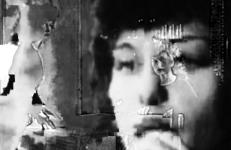
Lossless #2 is a mesmerizing assemblage of compressed digital images of Maya Deren and Alexander Hammid’s 1943 masterpiece Meshes of the Afternoon. Baron and Goodwin play heavily with Teiji Ito’s 1959 soundtrack, making the film’s lyrical ambience feel more astonishing than ever before. --Neil Karassik
Lossless #2, 2008
Lossless #2 is a mesmerizing assemblage of compressed digital images of Maya Deren and Alexander Hammid’s 1943 masterpiece Meshes of the Afternoon. Baron and Goodwin play heavily with Teiji Ito’s 1959 soundtrack, making the film’s lyrical ambience feel more astonishing than ever before. --Neil Karassik
Lossless #3, 2008
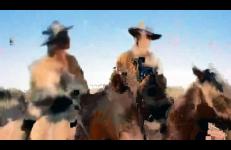
Removing keyframes from a digital version of John Ford's The Searchers, Baron and Goodwin attack the film's temporal structuring to render a kinetic “painted desert” of the West. The dust kicked up by the movement in the film is pure pixel, unanchored from the photographic realism that used to constrain it.
Lossless #3, 2008
Removing keyframes from a digital version of John Ford's The Searchers, Baron and Goodwin attack the film's temporal structuring to render a kinetic “painted desert” of the West. The dust kicked up by the movement in the film is pure pixel, unanchored from the photographic realism that used to constrain it.
Lossless #4, 2008
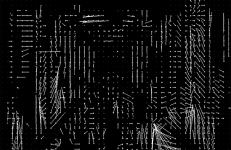
Derived from Ernie Gehr's Serene Velocity, Lossless #4 is the result of a digital file's debugging routine that reveals vectors describing apparent movement in the frame. Having removed the picture, thereby isolating these vectors, the formal qualities of Gehr's film are detectable. The hypnotic effects of the shifts in the lens’s focal length in the original are now substituted with a purely graphical representation, creating a perverse replacement of the optical effect of the original.
Lossless #4, 2008
Derived from Ernie Gehr's Serene Velocity, Lossless #4 is the result of a digital file's debugging routine that reveals vectors describing apparent movement in the frame. Having removed the picture, thereby isolating these vectors, the formal qualities of Gehr's film are detectable. The hypnotic effects of the shifts in the lens’s focal length in the original are now substituted with a purely graphical representation, creating a perverse replacement of the optical effect of the original.
Lossless #5, 2008
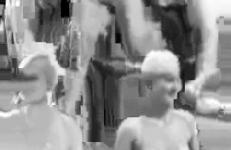
In Lossless #5, a water-ballet crafted by the famed Busby Berkley is compressed into an organic mitosis, within which we detect the spirit of a "buggy" Brakhage ghosting about the integrated circuit.
Lossless #5, 2008
In Lossless #5, a water-ballet crafted by the famed Busby Berkley is compressed into an organic mitosis, within which we detect the spirit of a "buggy" Brakhage ghosting about the integrated circuit.
Luminous Image, 1984
The Luminous Image was an international exhibition of video installations held in the fall of 1984 at the Stedelijk Museum in Amsterdam.
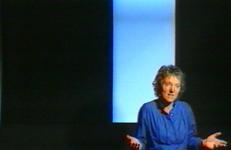
Jodie Mack: An Interview, 2013
In this 2013 interview, experimental animator and School of the Art Institute of Chicago alumna Jodie Mack discusses the developments that have taken her from an interest in musical theater and playwriting to organizing microcinemas and DIY filmmaking.
Mack describes her interest in early cinema history and the relationship between its technologies and spectacle, particularly the manner in which video production incorporates planned obsolescence. Referring to the “scavenger nature” of her work, Mack discusses her interest in waste and her desire to use reclaimed materials in her work. Using fabric and paper to create shifting fields of color, Mack references corroded and glitched digital media in her work. Her use of quotidian materials reflects upon the role of abstract animation in everyday life, and serves to draw audience awareness to the spectacle of televisual technology.
– Kyle Riley
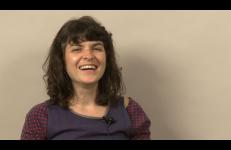
Includes feats with cards and ropes, legerdemain, sleights of camera, a perky river, and rare insights into the activities of a local magician-ventriloquist from the 1930s. A companion piece to Magic Explained (which probably means this is part two of a trilogy), and similarly lively.
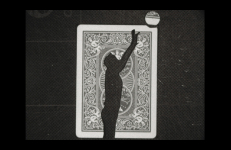
Mayday Realtime, 1971
Shot over one day, this program records the events and protests in Washington DC on May Day, 1971. This was the day when one of the most disruptive actions of the Vietnam War era occurred in Washington, DC, when thousands of anti-war activists tried to shut down the Federal government in protest at the War.
A feel for the mood in the city is gained during the first half of the video with shots of the city from a moving car in traffic. Protestors, city residents, and police are captured on tape, along with exciting and moving shots of the day's actions and arrests.
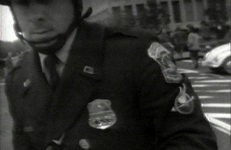
Mayday Realtime, 1971
Shot over one day, this program records the events and protests in Washington DC on May Day, 1971. This was the day when one of the most disruptive actions of the Vietnam War era occurred in Washington, DC, when thousands of anti-war activists tried to shut down the Federal government in protest at the War.
A feel for the mood in the city is gained during the first half of the video with shots of the city from a moving car in traffic. Protestors, city residents, and police are captured on tape, along with exciting and moving shots of the day's actions and arrests.
Me - You, 1972
Freed overlays the signal from two cameras pointed toward one another. Each camera is panned around to reveal a domestic environment. In a monosyllabic call and response Freed, along with her fellow operator, describe the content of the frame as the cameras move. During the piece, Freed and her collaborator present a contemplative series of observations into what is clearly an ongoing experiment. In discussion, Freed notes that the two cameras are not alike and create different imagery - they joke about both being transfixed to the monitor and suggest the cameras see more than they do.
Me's and Youse, 1971
A wonderful and humorous example of early image processing, Parry Teasdale and Carol Vontobel perform to camera as their faces are morphed together, forming an image of one person.
Money, 1970
Taped on Prince Street in Soho, New York City, Skip Blumberg creates a one-word performance. Shouting the word "money" over and over, he attracts the attention of New York's finest. The video crew attempt to explain to the policemen that there is no public disorder as the streets were empty when they began to tape.
The video is an unwitting early example of the reaction of the state to the use of video cameras on the streets.