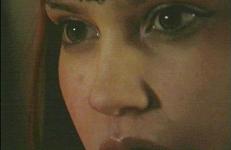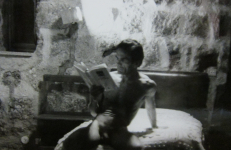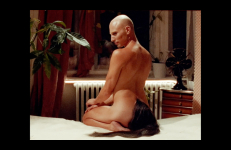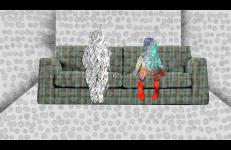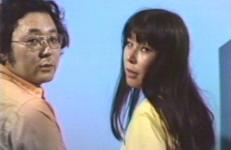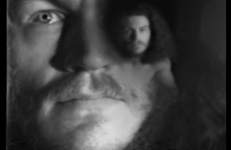



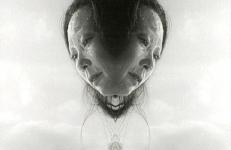
By subjecting fragments from the Akira Kurosawa’s film Rashomon to a mirror effect, Provost creates a hallucinatory scene of a woman’s reverse chrysalis into an imploding butterfly. This physical audiovisual experience produces skewed reflections upon Love, its lyrical monstrosities, and a wounded act of disappearance.
Film or Videomaking
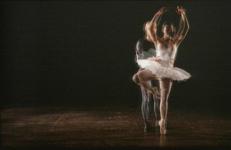
The orchestra begins and a male and female dancer move from opposite sides of the stage. The dancers embrace and begin the White Swan pas de deux from the ballet Swan Lake. However this is not the ballet as it is normally performed. The choreography has been re-staged so that in every single frame the two original dancers have been replaced by the bodies of four new dancers. The movement remains continuous, the characteristics of the dancers’ movements and gestures the same, but in each frame a different person occupies the dancers’ body spaces.
Known as one of Italy's most important filmmakers, Pier Paolo Pasolini was first and foremost one of its poets. Combining staged and archival material, this elegiac essay considers Pasolini's brutal murder alongside the texts he published or left unfinished during the last year of his life.
A foley artist creates sounds for a film featuring a dressage horse and dissolves into their own imitation. As the character in the film, played by the gender fluid performer Simon(e) Jaikiriuma Paetau seems to transform into a gender-defying centaur, the film reflects on the boundaries between the human and the animal as well as on fictional gender roles and their transcendence. Shot on 16mm film, Passage alludes to Eadweard Muybridge’s pre-cinematic experiments with horses.
Written, Directed, Produced & Edited: Ann Oren
Paternal Rites is a first-person essay film that examines the secret underbelly of a contemporary Jewish American family as they grapple with the aftereffects of physical and sexual abuse on their present-day lives. It is also a groundbreaking film about the nature of trauma and memory itself: the ways in which trauma encrypts in uncanny ways; the function of speech and narrative in the process of decryption; and the role of film and filmmaking in the practice of healing.
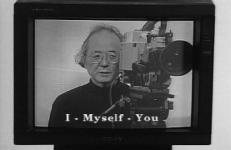
This compilation is produced with "myself" as the sole object, as well as the material of the performance (except two videos with Akiko iimura). The videos are not just documents of the performances, but works of video-art made specifically for utilizing the video system, including the camera and monitor, as part of the performances. The collection also questions the identity of oneself in video, having tense relationships between words and images, and asks who is "I" and what "I" means.
DVD includes:
Self Identity, 1972, 1:00 excerpted
The first twelve minutes features Phil keying his own image over his left eye (right on the screen), where he smokes and performs various facial gestures. The audio begins with background static noise, but part way through, it changes to a puzzling sound effect that he explains later.
Media artist Cyrille Phipps has been involved with numerous alternative media and lesbian activist projects, including Dyke TV and the Gay and Lesbian Emergency Media Campaign. Her video projects include Respect Is Due (1991), Black Women, Sexual Politics and the Revolution (with Not Channel Zero, 1992), Our House: Gays and Lesbians in the Hood (with Not Channel Zero, 1992), Sacred Lives, Civil Truths (with Catherine Saalfield, 1993), Dreaming Ourselves...
The crowded streets of New York City turn into fictive, cinematographic scenery. Provost is playing with our collective memory, its cinematic codes and narrative languages - questioning the boundaries between a staged, suggested reality and authentic fiction. Although filmed with a hidden camera, Plot Point presents a highly dramatic construction with overly sophisticated images and a subtle but tangible urge in the soundtrack.
Tom Poole is an organizer of many things. Counting arts administrator, media facilitator, and activist among the many titles he has held over the years, Poole currently brings all these capacities to bear as the executive director of the Pittsburgh Community Television (PCTV) station. In his contribution to the On Art and Artists series, Poole discusses his early foray into media activism as a member of the video art collective Black Planet Productions.
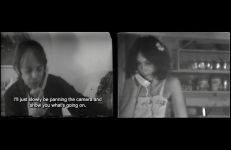
This eight-minute video is part experimental video art, part sketch comedy routine, and part informational lesson on the advantages and disadvantages of owning Sony's latest video technology. In it, David and Carol participate in a brilliantly theatrical, seemingly improvisational conversation, in which each one adopts the specific identity and perspective associated with a particular video technology: David plays the part of the Sony Camera AVC 3400, while Carol takes on the personality of the Sony Portapak AV3400.
Phil Morton starts the conversation by discussing an engineering project at the University of Wisconsin which was developing an early video communication system over satellite. Phil predicts the use of live-transmission of audiovisual elements for jamming purposes; his visionary thought resembles Marshall McLuhan’s prediction about the internet and social media. With the availability of a home terminal that transmits signals in real-time, the “system becomes a radical educational learning experience.”
A flowing river, an injured arm, a dance floor, and a woman washing clothes in the bay—what carries the dust is the wind.
Screenplay | Chi Jang Yin and Elizabeth Feiertag
Produced, director, edited, video effects, main cast | CHI JANG YIN
Cinematographer | Ross Heran
Sound editor and mixer | Lou Mallozzi
Primate Cinema: Apes as Family is a drama made expressly for chimpanzees – and the chimps' reaction to its screening at the Edinburgh Zoo. Chimpanzees watch television as a form of enrichment in captivity. But no filmmaker had made a film for a specifically ape audience.
This tape, shot in April 1971, documents the making of a WNET/13 TV show about video collectives and how they use the new video technology.
I’ve always enjoyed making trailers, figuring them as a celebratory time of play after the main work has been done; they function as both announcement and invitation, and - most likely - will be viewed by way more folk than will see the finished piece.
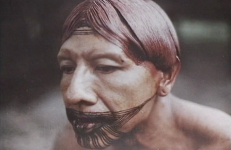
A daily chronicle of the Ashaninka community during the rainy season, recorded on video during a workshop in a village on the Amônia River in the state of Acre. The involvement of the filmmakers with the Ashaninka community makes the film go beyond a mere description of activities, reflecting the rhythm of the village and the humor of its inhabitants.
Direction and photography by Valdete, Isaac, and Tsirotsi Ashaninka, Llullu Manchineri, Maru Kaxinawá, Nelson Kulina, Fernando Katuquina, and André Kanamari; edited by Mari Corrêa.
In Ashaninka with English subtitles.
Red Chewing Gum is a video letter that tells a story of separation between two men, set within the context of the changing Hamra, a formerly booming commercial center. The video looks at image making in relationship to consumption and the possession of desired subjects. It examines issues of desire and power, and the attempt to capture fleeting time.
Red Green Blue Gone with the Wind is a phosphorescent deconstruction of David O. Selznick's Technicolor classic Gone with the Wind (1939). Through the structural devices of condensation, the frame-by-frame separation of the red, green, and blue Tehnicolor layers, and the de-interlacing of the video field, LeVeque presents a destabilized illumination of the relentless romantic nostalgia for the antebellum past.
This title is also available on Reconstruction Trilogy: Les LeVeque.
A portrait of the artist as a not-so-young man. The filmmaker attempts to enter the digital age by making a new video version of one of his old films.
"The award of the Short Film Festival goes to a video in which the reflection of artistic work becomes a form itself. John Smith manages to give us a self-ironic humorous experiment about art and time."
—Prize of the International Short Film Festival, Oberhausen 2000
This title is also available on John Smith: Program 2.
Return of the Black Tower was conceived as a 'response' film to John Smith's 1987 classic short experimental film, The Black Tower.
"Barmy, baffling and weirdly funny,... an elliptical, satirical examination of contemporary belief, as much as it is about the problem of art as an incommensurate, incommunicable experience."
— JJ Charlesworth, Time Out London
A Return to The Return to Reason is a tribute to Man Ray's 1923 film Le Retour à La Raison (A Return to Reason), the first film to use his 'Rayograph' technique in which Man Ray exposed found objects onto film negative.
Martha Rosler (b.1943) received her BA from Brooklyn College in 1965 and her MFA from the University of California, San Diego in 1974. Rosler has produced seminal works in the fields of photography, performance, video, installation, criticism, and theory. Committed to an art that engages a public beyond the confines of the art world, Rosler investigates how socioeconomic realities and political ideologies dominate everyday life. Rosler's work has entered the canon of contemporary art through a process of steady, stealthy infiltration. Lacking commercial gallery representation until 1993, her endeavors as a prolific essayist, lecturer, and political agitator enabled her agenda to trickle down through critical channels.
Dan Sandin designed the Image Processor that, partly because of his decision to give away the building plans, has effected an energetic and aesthetic investigation of the technological structures of electronic media. He sees the Image Processor as both an event and an environment for artists to explore and experience. During the interview, Sandin spontaneously synthesizes his own image.
Interview by John Manning. Shot by Christine DeLignieres.
A historical interview originally recorded in 1980.
Parry Teasdale, David Cort and Chuck Kennedy visit The Kitchen in New York looking for Shirley Clarke, and bump into Steina and Woody Vasulka who are overseeing a show in progress. A few doors down they find Shirley in her studio, dressed in white and full of energy.