


In 2002, my troupe, La Pocha Nostra and I were invited to conduct a workshop at Columbia College in Chicago with 15 students and faculty from different departments. At the end of the two-week workshop, we created a large-scale performance-installation with the participants. Canadian video artist Liz Singer was invited to shoot the entire process, from the early workshop exercises, meant to connect students with their bodies and build a sense of community, up to opening night... In this documentary we reveal the working methods and radical pedagogy of La Pocha Nostra.
Documentary
Buffalo Death Mask, 2013
A conversation with Canadian artist Stephen Andrews returns us to a pre-cocktail moment, when being HIV+ afforded us the consolation of certainty.
Burrow-Cams, 2012
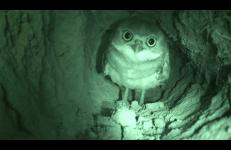
Burrow-Cams features footage from cameras that have been placed inside underground animal habitats (dens, burrows, etc.). Animals showcased include: burrowing owl, black-footed ferret, porcupine, badger, prairie vole, swift fox, deer mouse, and black tailed prairie dog.
Note: This title is intended by the artist to be viewed in High Definition. While DVD format is available to enable accessibility, VDB recommends presentation on Blu-ray or HD digital file.
Bury Me Not, 2016
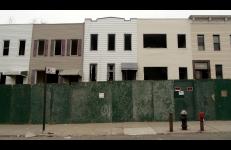
"This film is closely related to my last feature-length project, Counting. I take the temperature of a neighborhood. In this case, the place is my New York. I think about street life and its threatened demise – a death ushered in as Big Money relentlessly re-makes cities in ever more categorical ways. I think with the camera, on the move, in fragments.
China Town, 2009
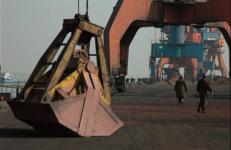
China Town traces copper mining and production from an open pit mine in Nevada to a smelter in China, where the semi-processed ore is sent to be smelted and refined. Considering what it actually means to "be wired" and in turn, to be connected, in today's global economic system, the video follows the detailed production process that transforms raw ore into copper wire--in this case, the literal digging of a hole to China--and the generation of waste and of power that grows in both countries as byproduct.
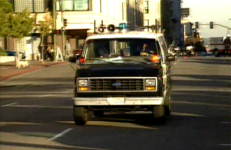
From the performance by the same name, by Suzanne Lacy, Julio Morales and Unique Holland, with Kim Batiste, Raul Cabra, Patrick Toebe, David Goldberg, and Anne Maria Hardeman, Oakland, 1998-2000.
In this 2001 interview, filmmaker Jem Cohen discusses the origins of his film philosophy, and the circuitous route he has taken in his pursuit of an anti-narrative film practice outside the mainstream. Cohen sheds light on the many influences that have impacted his sentiments towards conventional film, and his desire to eschew both classical avant-garde and theatrical filmmaking in favor of a model rooted in the tradition of the 1940s New York School of street photography. Cohen also locates his aesthetic as being impacted by the 1970s hardcore and DIY scenes he was exposed to as a youth in Washington, DC.
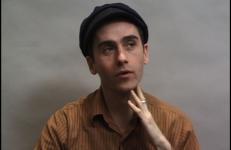
In this 2006 interview, filmmaker Jem Cohen discusses his early interest in art, his family’s welcome antipathy towards commercialization, and his unconventional, anti-mainstream film practice. In particular, Cohen discusses his film This is a History of New York, and how this piece exemplifies his interest in the “territory of sensation” rather than simple visual descriptiveness. Cohen concludes by discussing the role of archiving in his practice, and how compulsive documentation of the quotidian and unexceptional can result in the empowerment of the everyday.
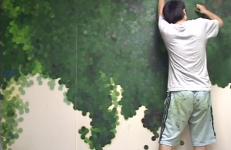
Color on Colors, 2005
Satoshi Uchiumi, Japanese abstract painter, believes that the beauty of painting lies within paint itself. He has pursued beauty by painting thousands of colored dots. He has also become known for his ability to highlight the relationship between the artwork, the exhibition space, and the viewer.
come lontano is a perverse historical romance in which two lives are exposed, inter-mixed, doused with sentiment, and — hopefully — redeemed. The work revolves around a central ‘couple’ — Pier Paolo Pasolini and Maria Callas. There is a third main character, an ambiguous villain made of steel, glass and rubber. Each member of our central couple has her/his own external distractions which impinge — to varying degrees — on their brief, ecstatic encounter. This encounter was in fact a cinematic collaboration; it’s product the film Medea (1969).
Set in Medellín, Colombia, Como crece la sombra cuando el sol declina (Like Shadows Growing as the Sun Goes Down) features tireless car traffic, jugglers at intersections, and employees on breaks, focusing on precise movements marking the repetitive flow of time.
Company Line, 2009
Company Line is a film about one of the first predominately Black neighborhoods in Mansfield, Ohio. The title, Company Line, refers to the name historically used by residents to describe their neighborhood, located on the north side of town close to the old steel mill. The Company Line began during the post–war migration of Blacks from the south to the north in the late 1940’s. The neighborhood was purchased in the early 1970s and its residents were scattered throughout Mansfield.
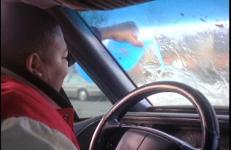
From 1970 to 1972, Arthur Ginsberg and Video Free America recorded the private life of a not-so-average American couple-Carel Row and Ferd Eggan. She is a porn actress and filmmaker; he is a bisexual junkie. The video verite camera captures the desires and frustrations of their evolving relationship and their responses to the ongoing videotaping exercise. The tape, a study in "the effect of living too close to an electronic medium," reveals attitudes and discussions that also render it a fascinating social document of the west coast counterculture.
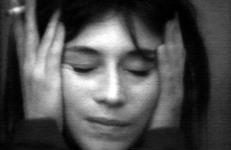
Cooperation of Parts, 1987
The fragment contains within it an implied reference to something that was once whole. It suggests damage and violence, time and distance. These qualities I found were integral to my own constitution, and it was with the making of Cooperation Of Parts that this became clear.
“Misfortune makes and breaks you.” I have the misfortune of a history of disruptions, and the fortune of having that history to work with.
This video takes its departure from the BBC's coverage of the killing of three IRA volunteers by British Security Forces in Strabane, a small town on the border between Northern Ireland and the Irish Republic. Interrogating television discourse, the video examines what is referred to as the British “shoot to kill” policy of planned assassination in the North.
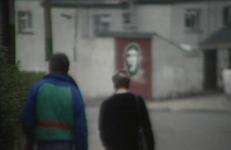
This video takes its departure from the BBC's coverage of the killing of three IRA volunteers by British Security Forces in Strabane, a small town on the border between Northern Ireland and the Irish Republic. Interrogating television discourse, the video examines what is referred to as the British “shoot to kill” policy of planned assassination in the North.
A portrait of Luce Vigo, film critic, educator, and the daughter of pivotal French filmmaker Jean Vigo. Commissioned by the Spanish documentary festival, Punto de Vista, the film incorporates Luce's memories of her extraordinary life, reflections on her father, and images of Northern Spain.
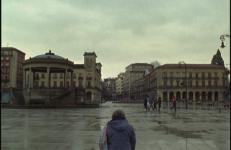
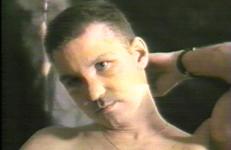
Danny, 1987
This video is a moving personal documentary about Danny, a friend of Kybartas who died of an AIDS-related illness in 1986. This powerful work explores the reason for Danny’s return home and his attempts to reconcile his relationship with his family members who had difficulty facing his homosexuality and his imminent death. Retracing Danny’s memory of his once-high lifestyle in the clubs and gyms of Miami, Danny avoids sentimentalizing its subject as it juxtaposes images, text, and voice-over to build a sense of the psychological struggle brought on by Danny’s impending, premature death.
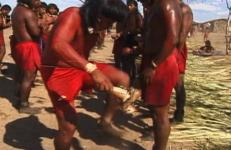
After the screening of his film Wai'á rini, the power of dream in other Xavante villages, the people of Aldeia Nova from the São Marcos reservation asked Divino to make a film on the same ritual, the Wai'á ceremony. In this ceremony the young men are initiated into the spiritual world to develop their curative power. This is a new experience for Divino, as he has to shoot in a different village, but also find a way to try new tricks and to develop his editing skills.
Various languages.
Direction and photography: Divino Tserewahú
This piece investigates the possibilities and limits of writing a history of the Lebanese civil wars (1975-1991). The videos offer accounts of the fantastic situations that beset a number of individuals, though they do not document what happened. Rather, they explore what can be imagined, what can be said, what can be taken for granted, what can appear as rational, sayable, and thinkable about the wars.
As a "Post-Mexican” performance artist operating out of the US for over 20 years, one of my conceptual obsessions has been to constantly reposition myself within the hegemonic maps. Whether this map is the Americas, the larger cartography of art, or my personal biography, one of my jobs has been to move around, cross dangerous borders, disappear and reappear somewhere else, and in the process create "imaginary cartographies” capable of containing the complexities of my multiple and ever-changing identities, voices, communities and performative bodies.
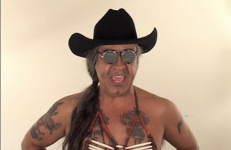
As a "Post-Mexican” performance artist operating out of the US for over 20 years, one of my conceptual obsessions has been to constantly reposition myself within the hegemonic maps. Whether this map is the Americas, the larger cartography of art, or my personal biography, one of my jobs has been to move around, cross dangerous borders, disappear and reappear somewhere else, and in the process create "imaginary cartographies” capable of containing the complexities of my multiple and ever-changing identities, voices, communities and performative bodies.
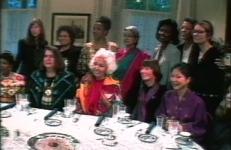
Dinner at Jane's, 2000
Executive produced by Sara Diamond at the Banff Art Centre, co-produced by Michelle Baughn and Suzanne Lacy, directed by Tom Weinberg and Dick Carter, and edited by Holen Kahn.
Dislocation Blues, 2017
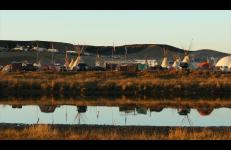
An incomplete and imperfect portrait of reflections from Standing Rock. Cleo Keahna recounts his experiences entering, being at, and leaving the camp and the difficulties and the reluctance in looking back with a clear and critical eye. Terry Running Wild describes what his camp is like, and what he hopes it will become.
Displaced Person, 1981
This film uses the ‘old fashioned’ conventions of documentary film practice to stand history on its head. There is a narration taken from a radio lecture by Claude Lévi-Strauss entitled, “The Meeting of Myth and Science,” images from the Deutsche Wochenshau of June 25, 1940 that recorded Hitler’s dawn visit to Paris, images from American newsreels, a movement from one of Beethoven’s Rasumovsky Quartets. The film could only succeed, in my mind, if the imprint of prior usage of all elements was clear.