


Ever listen to Loveline? Well, here's an episode with a 24-year-old Korean American guy who's never been kissed. They're offering free concert tickets to any girl who'll come in and take a chance. The girls get their tickets, and "David" gets to pick one of them for his first smack. Trouble is... no volunteers. Combining personal dating stories and the hypnotic imagery of multi-colored koi, Sweet Or Spicy? explores Hapa and Asian American male sexuality in popular culture.
Humor
Sybil, 1970
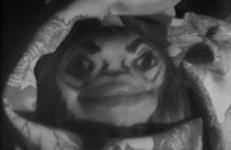
Nancy Cain interviews an upside down chin face about Women's Liberation, asking "Where do you stand on the subject?" The chin face professes to be happy with her lot, and says she enjoys living alone with her cat.
This video was shot in the Prince Street, New York loft/studio used by the Videofreex.
The Target Shoots First, 1999
“Christopher Wilcha’s fascinating feature-length video reminds us how seldom we’re allowed to see certain businesses operating from the inside. Wilcha, a 22-year-old college graduate and alternative-rock enthusiast, was hired by the Columbia Record and Tape Club—apparently as a fluke—to help launch a whole new niche-marketing division, which brought him face-to-face with the contradictory meanings of the term ‘alternative’ once it’s been embraced by the mass market.
Televised Texts, 1990
Holzer adopts the form and language of commercial messages to disrupt communication, presenting kamikaze texts that are designed to stimulate thought, with humor, and inspire a critical attitude in an often passive audience. As in all of Holzer’s work, these television spots present deceptively simple sequences of text that mix provocative social commentary with resonant poetic reflection.
(tell me why): The Epistemology of Disco is an often humorous, at times sarcastic and poignant look at the role that disco music has played in the formation of gay male identity.
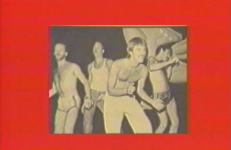
Most of TVTV’s work takes place in the city, at the center of some pop culture event. “The Good Times Are Killing Me” takes place in the country – Southwest Louisiana, around the towns of Mamou and Eunice, the heart of Cajun country. This is an indigenous culture of food, music, language, and bawdy French-language jokes – something you don’t see much anymore in America. The event is rural Mardi Gras, where beer-drinking, boudin-eating men and boys on horseback capture and behead chickens for a big gumbo and town dance.
The Sausage, 2015
Based on a Swedish folk tale, The Sausage tells the humorous story of two sisters, three wishes, and a calamitous obsession with a sausage. The Sausage is the first completed episode of Fairy Fantastic!, a fairy and folk tale series presenting gender fluid adaptations of classic tales.
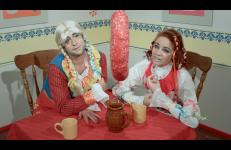
The Sausage, 2015
Based on a Swedish folk tale, The Sausage tells the humorous story of two sisters, three wishes, and a calamitous obsession with a sausage. The Sausage is the first completed episode of Fairy Fantastic!, a fairy and folk tale series presenting gender fluid adaptations of classic tales.
The disparate chronicles of a high school wrestling team, a flooded town of aliens, and the love affair between two young men. Performers responded to individual drawings and prompts to collectively generate improvisational dialog during the Pilot Conference: Experimental Media for Feminist Trespass, in Chicago, 2004.
With Becca Taylor
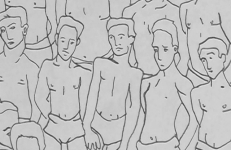
There There Square, 2002
The desire to own and name land and the pleasures of seeing from a distance color this personal survey of the history of mapmaking in the New World. There There Square takes a close look at the gestures of travelers, mapmakers, and saboteurs that determine how we read - and live within - the lines that define the United States.
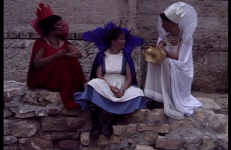
Half-breed Alice attempts to become queen and struggles with the Red Queen and the White Queen's disapproval of her racial transgressions. A funny and quirky take on race, starring Cosmosquaw as the Red Queen, Shawna Dempsey as the White Queen, and TJ Cuthand as Alice.
Throwing Stones, 2004
As the camera looks out through a barred window and the clock strikes four in a Swiss city, the death of Yasser Arafat provides the starting point for a journey back in time.
Throwing Stones is the third episode in the Hotel Diaries series, a collection of video recordings made in the world’s hotel rooms, which relate personal experiences and reflections to contemporary conflicts in the Middle East.

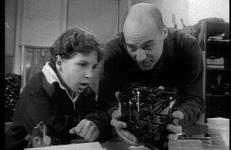
Modeled after NBC’s long-running science program Watch Mr. Wizard, this tape features Torreano as Mr. Wizard instructing a skeptical boy on how to build a diamond out of pieces of wood. The boy remains unimpressed until Torreano uses a “video paintbox” to create flashy special effects. Painter John Torreano’s use of galaxy clusters as a reference for his fake jewel studded canvases and diamond-shaped sculptures suggested the nostalgic format of this video profile by MICA-TV.
Trick or Treat Pony, 2002
A rockin’ talkin’ pony and its human companion examine the evolution of Halloween games, from the ancient rite of bobbing for apples to the contemporary spectacle of American football. Confronting liminality on 3rd down and long, the pony BRINGS IT TO THE HOUSE.
This title is also available on Ben Coonley: Trick Pony Trilogy.

Turistas, 2002
Turistas deals with the letdown of a world that is pre-mediated and post-digested—a video travelling guide that updates the 19th century artist's Grand Tour and downgrades it to 21st century not-so-Grand status.
—Maria-Christina Villasenor, Associate Curator of Film and Media Arts, Guggenheim Museum
The Tutor, 2007
Joe Gibbons plays Dr. Joe Baldwin, the self-styled child education expert. He prepares Zoe, from birth, for acceptance into a coveted “gifted-only” kindergarten program. He brings to each lesson an assortment of modified educational books, games and toys. These sessions, along with monologues analyzing her development, are recorded in hopes of proving that “genii [his term] are not born, but made.” What becomes evident is one man’s misguided quest to manipulate pitted against one child’s exuberant resistance to being controlled.
Director’s statement:
Bill Murray and Christopher Guest lead a behind-the-scenes tour of the 1976 showdown between the Dallas Cowboys and the Pittsburgh Steelers. This irreverent view of football and America's number one sports event examines the "Woodstock of corporate America" from the viewpoint of the players, the wives, the fans and the media. The big business of sports, the high stakes, the pressures, the cost in health and happiness are all covered in this kaleidoscopic view of another American ritual.

Unruly Fan/Unruly Star, 1996
TV's invasion of viewers' domiciles gets turned upside down in the video as a fan's (Millner) domestic life is superimposed onto the set of Roseanne, driving home unexpected reverberations as the nuclear family teeters on the edge of dysfunction. A schmooze-fest between Millner and Roseanne ends by detonating the UNcommon desire that both fan and star articulate, to GO TOO FAR. Note: This tape is a director’s cut of the version originally telecast as part of the PBS mini-series, Signal to Noise, about the videomaker’s obsession with Roseanne.
A love letter to the Internet from a feral cat in Brooklyn.
Anonymously published to the web in 2006, Valentine for Perfect Strangers was an early example of an art video that "went viral," amassing over a half-million views and landing on the front page of YouTube.
Vicki in 3:30, 1990
Using the fictional character of “Vicki” as a foil, this confessional boy story confronts sexual politics head on.
“(Fulbeck’s) narrative runs around like a chicken with its head cut off, deconstructing everything in its path — dating, gender roles, stereotypes, and the whole notion of sexual conquest. We end up wondering who the ‘winner’ really is” — Keith Fung, Momentum
This title is only available on Kip Fulbeck Selected Videos: Volume Two.
Walt Disney's re-imagineering of Martin Scorsese's classic film Taxi Driver follows Mickey Mouse-obsessed Travis Bickle as he looks for love in a rapidly transforming New York City. A 'fair use' parody by Bryan Boyce.
"A brilliant video essay."
-- Roger Ebert
The Waste Land, 1999
A personal interpretation of the poetry and letters of T.S. Eliot that explores the ambiguities of language and space in a scenario built around an anagram. "A brilliant, absurd staging of Eliot’s The Waste Land in the local pub by the master of irony himself, John Smith. Smith’s use of the subjective camera tradition of independent film takes the viewer on a shaky journey from bar to bog and back again."
—UK/Canadian Video Exchange (touring program, 2000)

“A spoof on current art attitudes [that] stretches the definition of what can be considered art. Because the late 1960s and early 1970s were periods of innovation, using the human body as art, making process equivalent to product... [etc.], Baldessari questions that very sense of originality and exploration by taking it to its (rather mundane) limits. By taping a stick at one end, then picking it up at the other, he is both questioning and spoofing what constitutes art.” —Marcia Tucker, “John Baldessari: Pursuing the Unpredictable,” John Baldessari (New York: New Museum, 1981)
The Weak Bullet, 1983
A bullet fired by two children travels on and randomly, intervening in a series of scenes in Oursler’s quirky, dismal puppet land. The bullet kills a suicidal man, re-aligns an antenna, strikes a prize stud bull, and ultimately impregnates a woman by passing through her neighbor’s left testicle, then lodging in her ovary. In this metaphor for the spread of violence in society, the bullet represents destructive forces of accidental death and the sexual forces that create new life.
It was 1990 and, although the iron curtain was falling, Soviet official control was still iron-fisted. Camcorder reporter Skip Blumberg went along with a group of art aficionados on a tour of the Moscow studios of the unofficial artists, an underground community of talented, courageous and often wacky conceptual artists. His report reveals an insider’s view of the art world and, at the same time, is a video about making a video.