


George Barber doffs his cap to the 20th anniversary of Scratch Video with What’s That Sound?, a mesmerizing montage of questions, answers, and the cries and screams of people caught in a disaster movie. The work uses as its starting point, the film Airport '77 where, improbably, a jumbo jet sinks to the bottom of the sea. What follows is a clever amalgamation of absurd linguistics, cries and shouts, highlighting the artist’s permanent fascination with speech, and human reaction to out-of-the-ordinary situations.
Humor

This video was originally part of an installation at the Whitney Museum of American Art, part of which included the video collaboration Channels of Desire. Recreating coin-operated porno booths, Channels aired one photo image on seven TVs, interrupted only by the viewer inserting a coin and choosing a segment. The concept behind it was the construction of desire in categorical ways, the form of the piece speaking to sexual desire as something that is constantly evading the viewer. The images presented women’s experiences with interracial, lesbian, and heterosexual encounters.
Repurposing an ancient confessional video diary made about 40 years ago, this 11-minute narrative creates a poignant and humorous conversation where both ‘selves’ question, enlighten, and warn one another about things in life that really matter.
Note: This title is intended by the artist to be viewed in High Definition. While DVD format is available to enable accessibility, VDB recommends presentation on Blu-ray or HD digital file.

In this wistful tape, Segalove looks at how her childhood vision of the future holds up (or doesn't) in adulthood. Commissioned by the Los Angeles County Museum of Art.

Where is God? The Dive, 1974
Using the first color video camera, the artist questions where the devil might be hiding, and then takes a nighttime swim.
Whiskey Dick, 2002
Between basement and stoop, PBRs and politics, two bros discuss rock music history, protest, incarcerated relatives, fine cheese, the book plot of Bridge to Terabithia, and lesbian girlfriends.

“[Segalove] pursues her self-analysis via the popular culture and TV addiction of her youth: seeing JFK shot on TV, falling in love with the TV repairman, being glued to the tube while suffering from the requisite bout of mononucleosis, and associating the memory of watching her parents kiss with the soundtrack of Dragnet.” —Marita Sturken, “Revising Romance: New Feminist Video,” Art Journal 45 (Fall 1985)
The World of Photography, 1986
A day in the life of a professional photographer (Wegman) and his eager student (Smith), this tape offers a humorous, at times surreal, how-to instructional course in photography. Filled with practical advice, the tape sardonically centers itself more on the need to cultivate an effective artistic persona than actually taking any photographs. Wegman asks: "Before you carve out your own niche, it’s important to ask yourself one tough question: do you have the aptitude?"
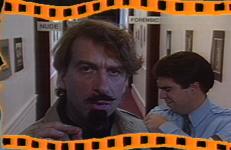
The World of Photography, 1986
A day in the life of a professional photographer (Wegman) and his eager student (Smith), this tape offers a humorous, at times surreal, how-to instructional course in photography. Filled with practical advice, the tape sardonically centers itself more on the need to cultivate an effective artistic persona than actually taking any photographs. Wegman asks: "Before you carve out your own niche, it’s important to ask yourself one tough question: do you have the aptitude?"
Is everything larger in Texas? Everyone knows that Texans like to show off "big-ly" and they like to perpetuate the myth in a big way, too. The World's Largest features larger-than-life-size monuments built primarily in small Texas towns, the monuments in commemoration of a local resource.

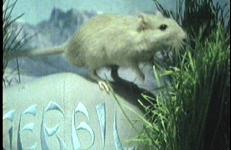
wüstenspringmaus, 2002
"The gerbil has long been associated with New World capitalism because of its incessant energy. The Golden Age of Hollywood takes on the history and evolution of this delightful household pet."
— International Film Festival Rotterdam (2003)
— "Jim Finn's Wüstenspringmaus, a well-sprung, rear-screened account of a gerbil's life in the '70s."
— Guy Maddin, Film Comment, January (2004)
This title is also available on Jim Finn Videoworks: Volume 1.