


In New Report, Wynne Greenwood and K8 Hardy are reporters at WKRH - the feminist news station that is "pregnant with information." As Henry Irigaray (Hardy) and Henry Stein-Acker-Hill (Greenwood), these two lesbian feminist artists stage reports on and with their friends, their social herstories, their nerves, and their bodies. It is urgently broadcast live to the newsroom and out to their studio audience.
Humor
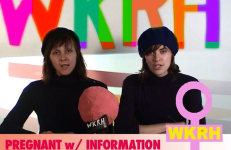
The second installment of the collaborative project New Report, an ongoing series of performances and videos, Artist Unknown features K8 Hardy (founder of the queer feminist art collective LTTR) and Wynne Greenwood (of Tracy and the Plastics) playing Henry Irigaray and Henry Stein-Acker-Hill, and anchor and roving correspondent for WKRH, a feminist TV news station whose tagline is "pregnant with information." Based on documentation of a live, digital communication in real time between Greenwood at Foxy Production Gallery and Hardy on the street in New York.
The second installment of the collaborative project New Report, an ongoing series of performances and videos, Artist Unknown features K8 Hardy (founder of the queer feminist art collective LTTR) and Wynne Greenwood (of Tracy and the Plastics) playing Henry Irigaray and Henry Stein-Acker-Hill, and anchor and roving correspondent for WKRH, a feminist TV news station whose tagline is "pregnant with information." Based on documentation of a live, digital communication in real time between Greenwood at Foxy Production Gallery and Hardy on the street in New York.
Niebla, 2021
This episode includes: two more adverts, considerations of the future, a multiple projection spectacular in miniature, a riverine jaunt, much fog, and an ending x 2.
This is the fourth and final episode in The Variations cycle.
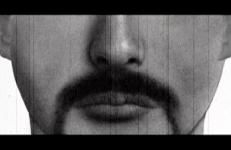
Now Let Us Praise American Leftists is an experimental video animation that seeks to eulogize and ridicule the American leftist movement of the past century. Foregrounding the exclusionary nature of American leftist politics, and its persistent refusal to allow more diversity in terms of race, ethnicity, and sexual orientation to enter into the larger political daialogue, the video presents representations of American leftists as they are: men with mustaches.
Now That I've Lost My Buffalo, I Don't Know Who to Grind is a short animation conceived through the collaboration of three visual artists — Diane Christiansen, Jessie Mott, and Alejandra Trigoso — that stages a volatile theater of bodies in flux. Within a shifting frame, cut-out fragments of animals and humans slip in and out of view, forming and unforming as creatures that vomit, expel, and rearrange their own parts. The work resists stable form, instead embracing mutation, rupture, and play as its guiding principles.
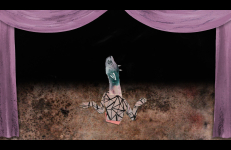
Now That I've Lost My Buffalo, I Don't Know Who to Grind is a short animation conceived through the collaboration of three visual artists — Diane Christiansen, Jessie Mott, and Alejandra Trigoso — that stages a volatile theater of bodies in flux. Within a shifting frame, cut-out fragments of animals and humans slip in and out of view, forming and unforming as creatures that vomit, expel, and rearrange their own parts. The work resists stable form, instead embracing mutation, rupture, and play as its guiding principles.
Now That I've Lost My Buffalo, I Don't Know Who to Grind is a short animation conceived through the collaboration of three visual artists — Diane Christiansen, Jessie Mott, and Alejandra Trigoso — that stages a volatile theater of bodies in flux. Within a shifting frame, cut-out fragments of animals and humans slip in and out of view, forming and unforming as creatures that vomit, expel, and rearrange their own parts. The work resists stable form, instead embracing mutation, rupture, and play as its guiding principles.
Om, 1986
A film about haircuts, clothes, and image/sound relationships.
"This four-minute film explores our response to stereotypes—aural, visual and ideological. Smith signals these stereotypes to the viewer through a chiefly associational system, which deftly manipulates the path of our expectations. The structure is stunningly simple and deceptively subtle. We are taken on a journey from one concrete stereotype to its diametric opposite, as images transform and juxtapose to, ultimately, invert our interpretation of what we see and hear."
—Gary Davis

On Our Own, 1990
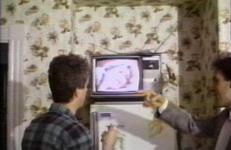
As recent state cut-backs force many mental patients out into the real world, Tony Oursler and Joe Gibbons team up to address psychiatric deinstitutionalization from a comic angle. After years of being cared for, Tony, Joe and their dog Woody leave the cuckoo’s nest and reluctantly face the prospect of finding jobs and cooking their own meals. Their darkly comic adventures include a comatose Tony tuning in to daytime TV, and Joe fantasizing about death while strolling in the park.
On Our Own, 1990
As recent state cut-backs force many mental patients out into the real world, Tony Oursler and Joe Gibbons team up to address psychiatric deinstitutionalization from a comic angle. After years of being cared for, Tony, Joe and their dog Woody leave the cuckoo’s nest and reluctantly face the prospect of finding jobs and cooking their own meals. Their darkly comic adventures include a comatose Tony tuning in to daytime TV, and Joe fantasizing about death while strolling in the park.
One Mile per Minute, 2002
Take a joyride through comfortable suburbia—a landscape molded by seductive television and corporate America (and keep in mind: disaster is another logo for your consumption...). This is the age of the "culture jammed" consumer preened with Friends hair, Survivor courage, and CNN awareness. A generation emptying their wallets for the most important corporate product of all: lifestyle. The psychological road trip across a slightly battered America travels at One Mile per Minute.
One Trick Pony, 2002
Introduces the audience to the rockin' talkin' pony, who provides musical accompaniment for a series of Texas country-dance lessons.
This title is also available on Ben Coonley: Trick Pony Trilogy.
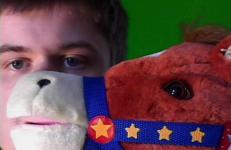
OPERATION INVERT, 2003
Are gender outlaws considered the new biological terrorists seeking weapons of mass bodily destruction? OPERATION INVERT compares the different regulations mediating botox-related plastic surgery and gender reassignment "sex change." Historical medical assessments of the invert (homosexual and transsexual) "condition" reveal seemingly outdated absurdities about outsider deviance. Nonetheless, current institutional loopholes governing gender re-assignment surgery suggest a fresh resurgence of loony pathology and diagnosis.
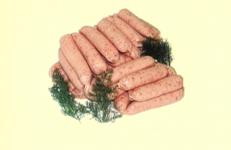
Oral Fixations, 2005
Oral Fixations is a single channel video installation that evolves over a seven hour time period. The project is a darkly humorous look at a habit of endless consumption and the resulting accumulation of waste. A narrative gradually emerges from the on-screen action that depicts a large mouthed character who dances while flossing its one protruding tooth. A conveyor belt regularly delivers factory-farm fresh hams that the character delights in taking one large bite from and then tossing aside.
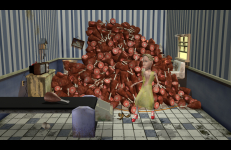
The Orrery, 2021
The expansive cycles of time vs. the ever smaller circles of life under lockdown. Includes: a journey to the river, some rat facts, more adverts, anagrams, and a noticeable build up of ideas.
Third video in The Variations cycle.
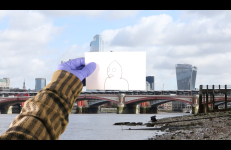
A high and low fidelity record of obsessions past and present. A hooded man named Cobra Commander (drawn naked) and a boy with black glasses. A fanged woman named Shadow-La and a girl in a rose colored wig. Belinda (Heaven on Earth), Madonna (Live to Tell), and headphones (worn naked). An airport terminal. Home. The Montgomery Ward catalog circa 1980. That orange bedspread, that red flowered couch.
The Badger Series has issues and attempts, each episode, to resolve them. Recasting a glove puppet show through his own present day sensibilities, Paul assumes the role of kindly uncle mentor to a household of capersome woodland creatures. Mortality, self-sacrfice, depression, altered states of consciousness and transgressive art practices are all explored as part of their everyday lives together.
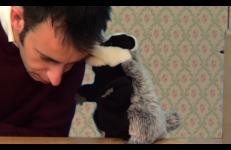
The Badger Series has issues and attempts, each episode, to resolve them. Recasting a glove puppet show through his own present day sensibilities, Paul assumes the role of kindly uncle mentor to a household of capersome woodland creatures. Mortality, self-sacrifice, depression, altered states of consciousness and transgressive art practices are all explored as part of their everyday lives together.
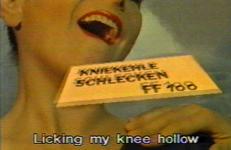
A Perfect Pair, 1987
A Perfect Pair posits the idea that individual consumers are walking billboards for the products they use; product slogans and brand names peeking out from every crevice and cranny of the actors’ bodies. Export demonstrates how the body of the consumer, especially that of the female consumer, is co-opted by commercialism. In tongue-in-cheek fashion, A Perfect Pair celebrates the modern-day co-mingling of fetish objects, as a body builder seduces a prostitute at a bar saying, “Your eyes are the most beautiful blue ad-space. Your cheek could promote a Mercedes.
Pixelhead, 1998
A stark and simple drama of man versus TV. "Pixelhead is an exploration of my love-hate relationship with the television medium in the form of an exaggerated, tragi-comic, semi-autobiography." —Bryan Boyce
Plastic Rap with Frieda, 1983
In this early Tom Rubnitz, Barbara Lipp and Tom Koken collaboration, "Frieda" performs her rap song with a bevy of dolls as back-up singers and dancers. Features rock-bottom production values and song lyrics by Barbara Lipp and Tom Koken.
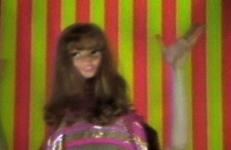
Plastic Rap with Frieda, 1983
In this early Tom Rubnitz, Barbara Lipp and Tom Koken collaboration, "Frieda" performs her rap song with a bevy of dolls as back-up singers and dancers. Features rock-bottom production values and song lyrics by Barbara Lipp and Tom Koken.
Plastic Rap with Frieda, 1983
In this early Tom Rubnitz, Barbara Lipp and Tom Koken collaboration, "Frieda" performs her rap song with a bevy of dolls as back-up singers and dancers. Features rock-bottom production values and song lyrics by Barbara Lipp and Tom Koken.
Pool Boy, 1997
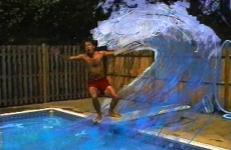
This real-time video-meets-digital-animation trilogy of shorts features the highly excited and mildly delusional Joe Gibbons, whose springboard becomes a surfboard as he fantasizes about his days as a lifeguard in 1963, when the young Brian Wilson would sit and jot down the songs he would sing while saving lives.