



Dramatically Repeating Lawrence of Arabia is a re-edit of David Lean’s 217-minute orientalist “classic” Lawrence of Arabia into a 15-minute hallucination of repeating masculinized poses, costumes and dramatic gestures. An algorithmic structure condenses and frame-by-frame remixes the original film into a cycling of divergence, convergence and momentary mirrorings.
Film or Videomaking
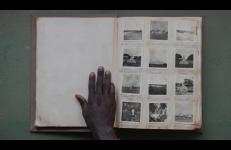
The Embassy, 2011
The Embassy deals with the codes of representation used by the former Portuguese colonial power over the West African country Guinea-Bissau, and with modes of memory production. It shows a photo album depicting the perspective of the Portuguese colonist, who photographed with documentary diligence landscapes, people, architecture and monuments in Guinea-Bissau in the 1940s and 1950s.
Empire of Evil, 2011
This high octane drama that I made with my students at the San Francisco Art Institute chronicles the moral decline of it's heroine, as the love of a man she obsesses over drives her over something else: a cliff into hell. It's a free fall all the way to the bottom destination, and there's a heck of a lot of nice looking, young people along for the ride.
Videofreex members Davidson Gigliotti, Bart Friedman, Skip Blumberg and Nancy Cain travel to Syracuse, New York to attend an exhibition and two-day conference featuring video art at the Everson Museum of Art held from April 4-7, 1974. More than simply recording this event known formally as “Video and the Museum,” the tape poignantly highlights the ways in which the Freex—by wielding a video camera—simultaneously become art world archivists, video collaborators, and on-the-ground reporters of culture and art in the 1970s.
Excess, 2009
A rumination via handwritten index cards and an assortment of images recalling histories and ambitions of varied film productions.
Fascination, 2006
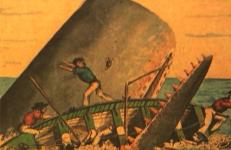
" order to take the next step (not forward or backwards, but only: to go on) it is often necessary (for me) to lean on a picture made by someone else; sometimes a word will do, a gesture, the look on a stranger's face. Colin Campbell made the next step possible for me, so I took up a video camera (his pictures were my company, and my camera accompanied his pictures). Between his images of the past and mine, Colin Campbell emerged as a Cold Warrior, as an artist who would fight the Cold War with stereo.

Fashion Vixen, 2002
This sprawling drama about a group of country folk sucked into the fashion world of magazine layouts and romantic intrigue features a cast of glamorously garbed gals and good-natured bumpkins. Produced in collaboration with his students at the San Francisco Art Institute, the picture delivers high-octane antics fueled by the $800 budget and creative desperation typically inherent in these types of endeavors. The cast is large and labors valiantly with the high speed shooting schedule and color saturated subplots.
Film Folk, 2004
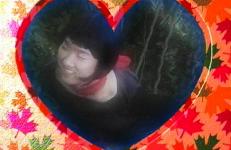
A young moviemaker discusses the horror film he hopes to open commercially. In the process he opens his lavish apartment to the hungry eyes and tummy of he who rots in the sidelights. During this discourse we feast on the vitality of youth as it restores life to the walking and digesting dead who bring maturity to both sacred and profane altars. Also along for the ride is a redheaded fleshpot in need of sudsy holy water for a good gargle.
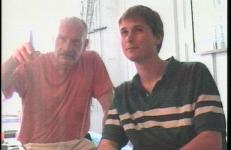
In 1973, Dan Sandin designed and built a comprehensive video instrument for artists, the Image Processor (IP), a modular, patch programmable, analog computer optimized for the manipulation of gray level information of multiple video inputs. Sandin decided that the best distribution strategy for his instrument "was to give away the plans for the IP and encourage artists to build their own copies.
Forbidden to Wander, 2004
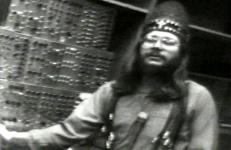
Forbidden to Wander chronicles the experiences of a 25-year-old Arab American woman traveling on her own in the occupied territories of the West Bank and Gaza Strip during the summer of 2002. The film is a reflection on the complexity of Palestinian existence and the torturously disturbing “ordinariness” of living under constant curfew. The film’s title reflects this, as the Arabic words used to describe the imposed curfew “mane’ tajawwul” literally translate as “forbidden to wander”.

Fountain, 2005
Cutting to the core of cinematic realism, Fountain presents the plot-less character of human encounters. In a string of moments with the people who have presented themselves to Cumming’s camera for over twenty years, Fountain allows the accidental and the absurd to dominate our impressions. Storytelling is evacuated in the process.
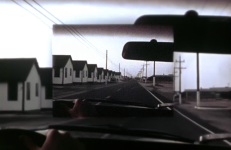
Frame, 1977
Provincetown, Cape Cod.
A reconstructed 'landscape' inspired by a drive down 6A. The norm when driving of watching the landscape approaching and receding, and the side-show of dioramas.
–– Ken Kobland
This work was restored in 2022.
In the 1960s and '70s, Hollis Frampton (1936-1984) emerged as one of the most important experimental filmmakers, creating structuralist works such as Zorns Lemma (1970), Poetic Justice (1972), and Nostalgia (1973).
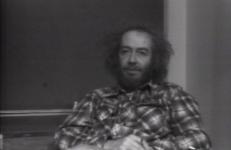
Freex German TV, 1971
German filmmaker Valeska and her crew—soundwoman Constanza and cameraman Albert—arrive at Maple Tree Farm during the Thanksgiving holiday of 1971 to film a piece for German TV on the Videofreex. In this video, the Videofreex turn the tables so to speak, making the Germans’ filming process—and the artificiality of the filmmaker’s prefabricated shots—their subject.
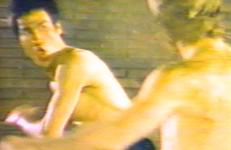
Game of Death, 1991
Using footage from the legendary Bruce Lee’s last, unfinished, film, Fulbeck turns the subtitled martial arts movie on itself—levelling criticism and commentary with the genre's own tools, and examining the various representative functions of the late actor.
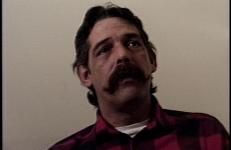
In this 2002 interview, filmmaker Joe Gibbons (b.1953) discusses his early work and the path that led him to an interest in both narrative and experimental film. Gibbons recalls how exposure to P. Adams Sitney’s Visionary Film: The American Avant-Garde while at Antioch College would compel him to begin making his own structural films. Describing his appreciation for the directness and immediacy of experimental filmmaking, Gibbons discusses a subject’s relationship with the camera as one characterized by intense intimacy.
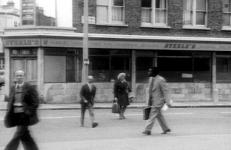
The Girl Chewing Gum, 1976
“In The Girl Chewing Gum a commanding voiceover appears to direct the action in a busy London street. As the instructions become more absurd and fantasized, we realize that the supposed director (not the shot) is fictional; he only describes—not prescribes—the events that take place before him. Smith embraced the ‘spectre of narrative’ (suppressed by structural film) to play word against picture and chance against order.
The GODmother, 2003
This crime drama made with my students at the San Francisco Art Institute is a mixed bag of colorful misadventures featuring a wayward member of the clergy and a corrupting, femme fatale with bangs. The couple open a casino of ill repute with money acquired during their murderous rampage upon the population of a small community of churchgoers. The action is fast and cheap because of the $400 budget, and the cast attractive because youth itself is always beautiful.
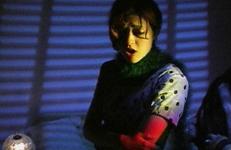
Great Man and Cinema, 2009
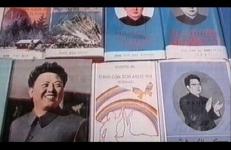
Kim Jong Il, the Stalinist David O. Selznick, runs the state film studio as a way of promoting his own and his father's cult of personality. The film's title, Great Man and Cinema, comes from a propaganda booklet filled with stories of how the Dear Leader has written, edited, produced and given acting advice in films for the last 40 years. This film succinctly synthesizes the Dear Leader's directing philosophy with his feelings toward the imperialist beast at his heels.
Film festivals are in progress as this video takes the viewer from the autumn rich colors of a Washington State movie event to the Virginia countryside of flaming, October foliage. In between bouts of waterlogged imagery we hear the peeps and exhortations of those in front of and behind the screens that plaster this geography with tribal dreams. Water sloshes and spurts freely in the chilly air, unfrozen by stage fright, while wineglasses clink to the coming winter. Featuring festival goers Nicholas Cage and Guillermo Gomez-Pena.

Hacked Circuit, 2014
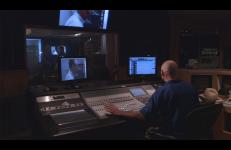
A single-shot, choreographed portrait of the Foley* process, revealing multiple layers of fabrication and imposition. The circular camera path moves inside and back out of a Foley stage in Burbank, California. While portraying sound artists at work, typically invisible support mechanisms of filmmaking are exposed, as are, by extension and quotation, governmental violations of individual privacy.
Doug Hall: An Interview, 2005
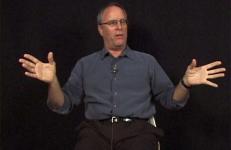
This extensive interview with California artist Doug Hall (b. 1944) provides unique insight into the culture and politics of experimental artistic production during the 1970s. Discussing the founding of the performance group TR Uthco, Hall offers context for his contribution to the field of video art, and shares stories of his collaborations with Ant Farm, Videofreex, and others. Ranging from his early years as an art student, to his romance with artist Diane Andrews Hall, to reflections on technology in art, this interview importantly extends the discourse surrounding topics of archive, performativity, and autobiography—subjects that have come to define the contours of video art today.
Harriet, 1973
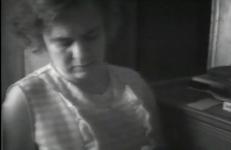
This tape, Harriet, created by Videofreex member Nancy Cain, unfolds much like a short play or literary character study. With very little directed dialogue, we gain intimate entry into a day in the life of Harriet—a long-time resident of Lanesville and mother of five—over the course of one day. No stranger to the Videofreex, Harriet was a frequent guest on the collective’s television production of Lanesville Television, as both an on-screen visitor and routine hotline caller.
Indians In Brazil is an educational series for Brazilian public schools that invites students to experience cultural diversity. Four teenagers are invited to discover a new world and participate in Indian daily life in two different communities. They show their emotions, curiosity and fears, and are surprised by their new friends.
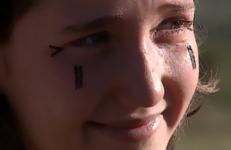
Indians In Brazil is an educational series for Brazilian public schools that invites students to experience cultural diversity. Four teenagers are invited to discover a new world and participate in Indian daily life in two different communities. They show their emotions, curiosity and fears, and are surprised by their new friends.