



Matt Wolf returns to Joe Brainard's iconic poem I Remember (1970) in this videowork. His archival montage combines audio recordings of Brainard reading from the poem, as well as an interview with his lifelong friend and collaborator, the poet Ron Padgett. The result is an inventive biography of Joe Brainard, and an elliptical dialog about friendship, nostalgia, and the strange wonders of memory.
Poetry
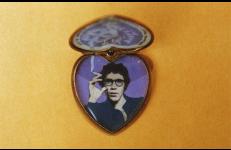
An elegy to Diane Burns on the shapes of mortality and being, and the forms the transcendent spirit takes while descending upon landscapes of life and death. A place for new mythologies to syncopate with deterritorialized movement and song, reifying old routes of reincarnation. Where resignation gives hope for another opportunity, another form, for a return to the vicissitudes of the living and all their refractions.
“I’m from Oklahoma I ain’t got no one to call my own.
If you will be my honey, I will be your sugar pie way hi ya
way ya hi ya way ya hi yo.”
In The Jungle, 2017
In The Jungle playfully and sorrowfully tells the tale of an unreliable narrator in a self-imposed exile. Given a grant to study the equivalent of animal cries and whines in jungle flora our heroine has lived for 1,612 days deep in an unnamed jungle. This jungle serves as an extended metaphor for excessive and continual growth and death and fear and sustenance; a metaphorical space of chaos in which the scientist finds solace and which stands in contrast to the human jungle of 'civilization'.
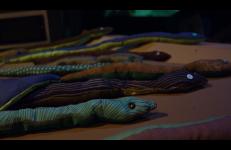
Joe, 2018
A portrait of New York author Joe Westmoreland. Joe is reading from his short story Sweet Baby Joe. This video was shot in 2014 in Joe's Chelsea loft, and the reading was recorded in 2016.
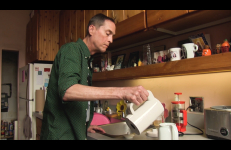
Just Hold Still, 1989
In his New York City landscape, Cohen finds inspiration in disturbance. Looking to life for rhythm and to architecture for state of mind, he locates simple mysteries. Just Hold Still is comprised of an interconnected series of short works and collaborations that explore the gray area between documentary, narrative, and experimental genres.
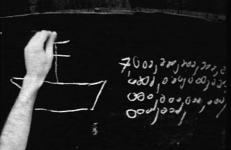
Kevin & Cedar, 2002
I arranged a visit to poet/novelist Kevin Killian’s South of Market apartment in San Francisco to shoot a portrait of him, and when I arrived he had a guest, poet Cedar Sigo. They had corresponded earlier, but were meeting for the first time, and Cedar agreed to participate in our video shoot. This is perhaps the least planned, most verité and documentary of the videos about writers so far. Our immediate plan was for Kevin to read one of Cedar’s poems and for Cedar to read one by Kevin.
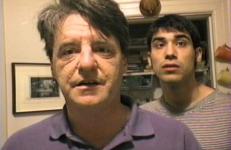
The Lamps, 2015
The Baroness Elsa von Freytag-Loringhoven né Plotz, was an unsung member of the Dada Movement. A poet, artist, runaway, and all around public provocateur; she actively did not fit into her historical moment, and like most misfits, suffered for it. As with many women artists throughout history, her cultural legacy has been obscured and in some instances appropriated into the oeuvres of better known male peers.
Leslie, 1998
In the early 1990s, I went to a reading by Leslie Scalapino at Intersection for the Arts in San Francisco. I could not understand the writing, which can seem difficult and unwieldy to a reader unaccustomed to language poetry, and understood less the more I tried. After a certain point in the reading I stopped trying to figure it out and I let the words seep in. My reward was an effortless understanding of how her poetry works.
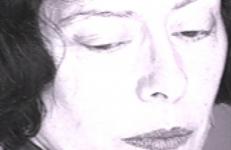
Lessons: XXXI-LX, 2016
Sections 31-60 of an incomplete extended poem describing the artist's connection to the radical black tradition. The completed poem will be formed of 180 sections.
"Lessons are all about constraints; they are thirty seconds, must feature a black figure, and I have rules about where to make cuts, how to edit sound, etc."
— Martine Syms in conversation with Aram Moshayedi, Mousse Magazine
Lore, 2019
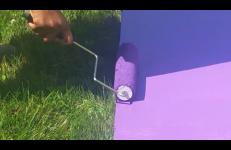
Images of friends and landscapes are cut, fragmented, and reassembled on an overhead projector as hands guide their shape and construction in this film stemming from Hollis Frampton’s Nostalgia. The voice tells a story about a not too distant past, a not too distant ruin, with traces of nostalgia articulated in terms of lore; knowledge and memory passed down and shared not from wistful loss, but as a pastiche of rumination, reproduction, and creation.
Lost Book Found, 1996
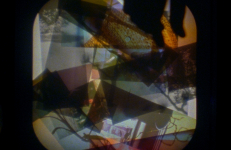
The result of over five years of Super-8 and 16mm filming on New York City streets, Lost Book Found melds documentary and narrative into a complex meditation on city life. The piece revolves around a mysterious notebook filled with obsessive listings of places, objects, and incidents. These listings serve as the key to a hidden city: a city of unconsidered geographies and layered artifacts—the relics of low-level capitalism and the debris of countless forgotten narratives. The project stems from the filmmaker's first job in New York—working as a pushcart vendor on Canal Street.
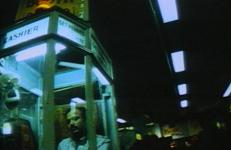
In this interview, American writer, artist, performer Eileen Myles (b.1949) discusses the various philosophies that motivate her work, including the language of film, embodied performance, and the alienation evoked by bodily vulgarity. Myles links her wide range of artistic and literary practice with notions of abstraction, improvisation, and the mythology of gender, which she explores in relation to her own identity as a working, middle-class lesbian woman. She reflects on the significance of geographical locations, both New York City and San Diego, on her art, and shares how her past struggles with addiction have shaped her life and practice.
Nine Gates, 2016
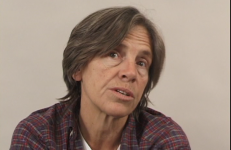
Wojtasik's Nine Gates explores the possibility of transcendence through sexual passion: averting the gaze from the objectification of the other, the female body or the obscure enemy, to the vast and microscopic details of the body unknown to the viewer, becoming a meditation on love beyond definition.
Nomads, 1993
“I fear nomads. I am afraid of them and afraid for them too.”
—Jane Bowles, “Camp Cataract” in My Sister’s Hand in Mine (New York: Ecco Press, 1978)
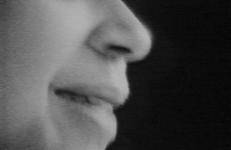
One Vast Focus, 2011
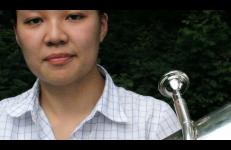
In this diptych, Yi-Ching Chen plays the lowest possible sound on her tuba and Magenheimer's own electronically synthesized voice sings a letter that Ada Byron, the world's first computer programmer, wrote to her mother. In the letter she describes what it felt like to discover the extraordinary power of her own vast intellect.
Text excerpted from a letter Ada Byron wrote to her mother.
Palace of Pope, 2018
Palace of Pope is an experimental video composed of found photographs, original text and sound art. A three-act piece, the video moves from poetic rumination both visually and sonically to a brief dialectic narrative to a long list of names and portraits as the sound breaks down and moves towards music.
Points On A Space Age, 2007
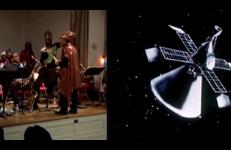
“A documentary about the Arkestra, but it's one whose presentation reflects the multilevel approach Sun Ra had to music and life in general. Jump cuts and split screens dot the visual stream with home movie footage from the Arkestra in Egypt during the 1970s to the Arkestra of today led by Marshall Allen. Director Ephraim Asili wisely divides the 40 minutes into distinct chapters, illustrating each with band interviews, live footage, visuals of planets and NASA launches, and his voice quoting writings from Ra.
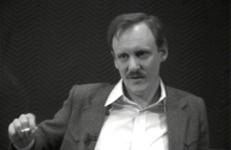
Peter Schjeldahl (b.1942) began writing his “poetical criticism” for Tom Hess at ArtNews in the mid 1960s. He has since written for both popular and specialized publications including The New York Times, Art in America, and The Village Voice, among others. In this interview from 1982, Schjeldahl discusses the critic’s relationship to the artist, the audience, artwork, and the professional community of art critics. He also reads some of his own poetry.Currently, Schjeldahl writes for The New Yorker and various art journals.
The Sea is History, 2016
The Sea is History, made in the Dominican Republic and Haiti, is a free adaptation of the poem by Derek Walcott.
Shadow and Substance, 1997
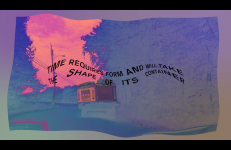
In Shadow and Substance, cloth as a motif and a total eclipse of the sun are metaphors used to suggest the intersection of the spiritual and physical worlds and the moods, emotions, and colorations that these intersections can evoke. Shot on location in India, Nepal, and Houston, Shadow and Substance is an interpretation of Eastern and Western aesthetic traditions and an exploration of the resonances between music, poetry, and image.
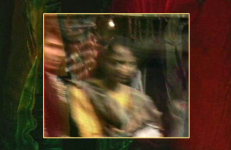
Shayne's Rectangle, 2011
In Shayne's Rectangle, Dani Leventhal's moving and mysterious prayer for healing, a horse farm and a casual poolside dissection are the nodes between which a series of patiently taken sharp turns maneuver through moods both intimate and detached. The camera pursues, observes, offers, reflects, and is reflected. Things clear and things indistinct interact rhythmically, resonantly, producing a volatile and haunting visual prosody.
— Jeremy Hoevenaar
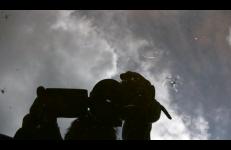
Sombra a Sombra, 1988
An example of what Reeves terms “video poetics,” layered images of a deserted village in the Spanish countryside play counterpoint to poetry by Cesar Vallejo and Pablo Neruda. Using slick production techniques, Reeves marks the passing of time and human presence with a video transparency effect. What we see is a ghost of what was. Reeves’s precise editing makes for an extraordinarily fluid tape, as images seem to fly through the landscape, through past, present and future.
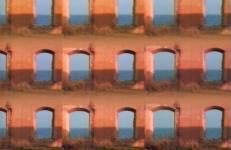
Son of Border Crisis, 1990
In these seven short video performances directed by Isaac Artenstein, Gómez-Peña confronts Mexican-American culture clashes, stereotypes, and the Fourth World (immigrants). Speaking through a bullhorn or on the airwaves of mock-station Radio Latino FM, he broadcasts a message that will not be silenced.
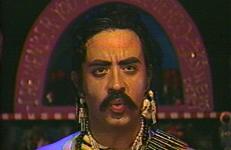
Son of Border Crisis, 1990
In these seven short video performances directed by Isaac Artenstein, Gómez-Peña confronts Mexican-American culture clashes, stereotypes, and the Fourth World (immigrants). Speaking through a bullhorn or on the airwaves of mock-station Radio Latino FM, he broadcasts a message that will not be silenced.