



Men asleep, a dream, play, a song; angel and snow, wings and flowers, money and trees; fast then slow, piano decays, laughter.
Men asleep, a dream, play, a song; angel and snow, wings and flowers, money and trees; fast then slow, piano decays, laughter.
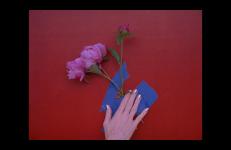
3 Peonies is a brief, poetic 16mm film of a simple sculptural action. What becomes apparent is the humor possible in material interactions and the tender and sometimes melodramatic symbolism of cut flowers. The reverence for beauty ends up pointing towards the abstract expressionism and color field painting of high modernism that, in many cases, eschewed the banality of such ‘natural’ beauty.
The dog in dreamland? Or at least one of us is…
–– Ken Kobland
Vito Acconci (b. 1940) is known as a conceptual designer, installation and performance artist. In the 1960s he embraced performance in order to "define my body in space, find a ground for myself, an alternate ground from the page ground I had as a poet." Acconci’s early performances, including Claim (1971) and Seedbed (1972), were extremely controversial, transgressing assumed boundaries between public and private space and between audience and performer.
Largely focused on the critical use of language both archaic and contemporary, poet Caroline Bergvall’s work asks questions about cultural identity and feminism and explores challenging or unknown historical and political events. She works across multiple media practices including audio texts, plurilingual poetry, installation and Performance Writing.
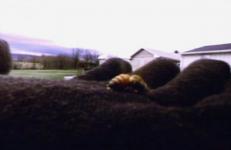
Blind Huber is a film interpretation of a poem by the American writer Nick Flynn loosely based on the life of Francois Huber, the blind 18th Century beekeeper, who sat before a series of hives for fifty years unlocking an unknown world.
Written by Nick Flynn. Cinematographer: Alex Stockwell.
This title is only available on Broad Daylight and Other Times: Selected Works of Kevin Jerome Everson.
This video is staged as a reading of the great Soviet poet Vladimir Mayakovsky's famous poem A Cloud in Trousers, written 1914-15. It was an attempt to go beyond the autobiographical mode of Fast Trip, Long Drop by appropriating the allegorical potential of another artist's work. Mayakovsky's poem is lyrical and didactic, romantic and materialist.
A poetic meditation on distance, Come Closer is a short and peripatetic film, casting an affective web between the locations of Lisbon, San Francisco and Brazil. Focusing on Brazilian-Algerian filmmaker Karim Aïnouz, musician Derrick Green –– the filmmaker’s brother and lead singer of Brazilian band Sepultura –– and her own work produced in Lisbon since 1992, Come Closer can be thought as a meditation on friendship and saudade.
In this interview American filmmaker, poet, and lyricist, Cecelia Condit gives shape to the contours of her work process. The artist describes the influence of her relationship with her mother, her long-term investment in the macabre, and her ongoing desire to confront death through art. While covering a broad range of topics, Condit’s discussion of her work and interests returns to several defining themes: aging, grotesqueness, and the notion of movement, both in terms of her own past as a dancer and the notion of the body in decay. With a particular emphasis on the production and context of her videos, Annie Lloyd (2008), and All About a Girl (2004), this interview offers insight into the artist’s fascination with aging, sweetness, and storytelling, while also articulating her joyful sense of discovery within the art-making process. No longer working with scripts, Condit presents herself in the interview as a scavenger–much like the crows she incorporates into her work–assembling videos which straddle the line between strange and silly. – Faye Gleisser
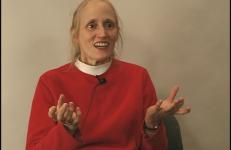
As a "Post-Mexican” performance artist operating out of the US for over 20 years, one of my conceptual obsessions has been to constantly reposition myself within the hegemonic maps. Whether this map is the Americas, the larger cartography of art, or my personal biography, one of my jobs has been to move around, cross dangerous borders, disappear and reappear somewhere else, and in the process create "imaginary cartographies” capable of containing the complexities of my multiple and ever-changing identities, voices, communities and performative bodies.

As a "Post-Mexican” performance artist operating out of the US for over 20 years, one of my conceptual obsessions has been to constantly reposition myself within the hegemonic maps. Whether this map is the Americas, the larger cartography of art, or my personal biography, one of my jobs has been to move around, cross dangerous borders, disappear and reappear somewhere else, and in the process create "imaginary cartographies” capable of containing the complexities of my multiple and ever-changing identities, voices, communities and performative bodies.
A lonely girl is approached by a shy boy on a moonlight balcony. Their longing is hampered by the mysteries of love. The Divers is a neo-romantic audiovisual painting. It is a poem that combines the quest of the artist for the mysterious elements that create pathos in sound and image, as much as it is a melodramatic experience reaching for the viewer's subconscious cinematic and emotional memory.
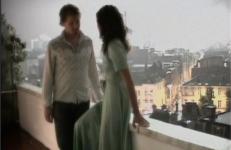
Four dummies, two cats, and a portal to bliss inside their attempts at symmetry. A hairball, and a mess of twigs, whose love has died and who are sad.
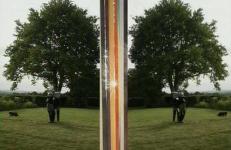
In Dry Blood (Sagre Seca), various historical moments of political activism in Mexico are superimposed and corroded on the emulsion of expired film. Footage from the International Women's Day in 2017 is coupled with the recording of a powerful speech about the gruesome aftermath of the 2006 civil unrest in San Salvador Atenco.
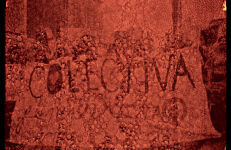
Earthglow is a poem written for the character generator and switcher that conveys a writer's internal dialogue through both subtle and dramatic color changes and through movement, size, and placement of words. The ambient soundtrack evokes the confluence of past and present perceptions.
This video is an unabashed fan letter to poet Eileen Myles. As in Laurie, my desire was to romanticize the poet, but not through her writing so much as through her reputation as the natural born child of the New York School and the Beats. I shot the movie as I imagined Robert Frank and Alfred Leslie shooting Pull My Daisy, a film that left an impression on me chiefly of the struggle between form and formlessness, plan and improvisation, sketch and story.
At the computer, I cut video threads of wind storms and quaking trees. I create a companion piece for Florence called Etty using the words of a young woman from completely different circumstances who transcends fear and resists terror in the midst of extreme circumstances. Etty Hillesum was a 29 year old Dutch writer we know only from her diaries first published in the early 1980s.
Every Wandering Cloud is the first installment in a series of experimental videos inspired by the writings of Oscar Wilde. Interweaving text from Wilde's "The Ballad of Reading Gaol" with hand-drawn animation derived from Eadweard Muybridge's Human and Animal Location, Every Wandering Cloud is a meditation on themes of freedom and imprisonment. The video juxtaposes an eclectic array of archival and contemporary imagery, including documentary footage and original Super-8 and digital video.
I sit at my computer cutting up real time footage of waterfalls, snow storms, boiling water. I combine these to make threads of moving images. I look and listen to the result in front of me and I think of people whose actions transcend fear—not in a momentary instinctual way—but over a sustained period of time. The name Florence Nightingale comes to mind, a woman whose name has become a cliche but of whom I know so little. I order books of her writings from Amazon and select phrases spread over hundreds of pages to make a soliloquy or poem. We collaborate.
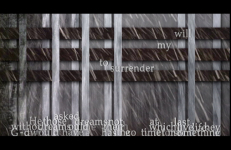
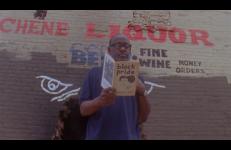
Fluid Frontiers is the fifth and final film in the series entitled The Diaspora Suite, exploring Asili’s personal relationship to the African Diaspora. Shot along the Detroit River, Fluid Frontiers explores the relationship between concepts of resistance and liberation, exemplified by the Underground Railroad, Broadside Press, and artworks of local Detroit Artists.
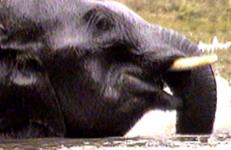
A song of mourning, praise, and compassion for the sentient creatures with whom we share this planet. Focusing on the myth, history, and natural life of the elephant, the video explores the gulf we have created between ourselves and animals. Powered by the poetry of Lorca, Kipling, and Reeves, this impassioned lament for subjugated and slaughtered elephants earns its polemical stance—a broader relation to inhumanity—by force of its compelling subject matter.
Allen Ginsberg (1926-1997) was a leading American poet who gained notoriety in the 1950s and ’60s through his association with the Beat Generation and the San Francisco Renaissance. One of the most controversial poets of his time, his book Howl and Other Poems faced an obscenity trial in 1957 and became one of the most widely read poems of the 20th Century. In the '60s and '70s, Ginsberg studied under gurus and Zen masters.
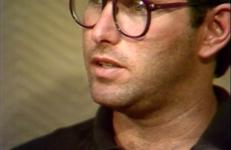
Gray Hairs is a visual and aural poem to Man Ray, featuring close-up shots of the dog’s body and a soundtrack of panting, sniffing and licking.
Nurit Sharett visited the city of Hebron over the course of a year, teaching video art to a group of young Palestinian women. Over time the artist established firm relationships with three of her students and their families. The video documents everyday life in that microcosm, dissimilar to any other city.
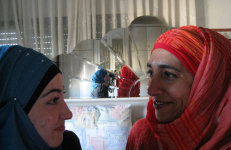
The video hovers tentatively between therapy, documentary, poetics and mystic traipsery and ends, like all good things, in surrender to song. There is a challenge presented (the challenge to engage earnestly with the piece as it requests) to fall into the breathing and pacing presented, and the challenge to view the video as a discrete piece of art at the same time. The piece relies heavily on the text, the disembodied Virgil through which the words become musical, instructive and (due to the absence of image) visual.