


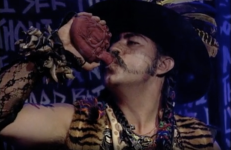
A documentation of a performance/installation. Guillermo Gómez-Peña and Roberto Sifuentes created a fictional religion based on inter-cultural confessions. Exhibiting themselves in Plexiglas boxes as "end-of-the-century saints", the two performers hear the confessions of audience members willing to reveal their intercultural fears and desires to the saints.
Performance
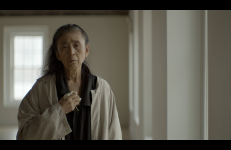
Thank You Sam, 2020
Commissioned by Lower Manhattan Cultural Council (LMCC) for the occasion of Eiko receiving the Sam Miller Performing Arts Award. Premiered at LMCC’s A Toast to Downtown on December 9, 2020. Shot at LMCC’s Arts Center at Governors Island.
Performer Eiko Otake.
Director/Editor Liz Sargent.
DP Minos Papas.
Production by Cyprian Films, New York.
The Cave, 1993
In the Bible, Abraham buys a cave from Ephron the Hittite as a burial place for his wife Sarah. The Cave of the Patriarchs, as it has come to be known, became the final resting place not only for Sarah, but for Abraham and their descendants as well. In Jewish mystical sources the cave is also a passageway back to the Garden of Eden. It is said that Adam and Eve are also buried there.
The Cave, 1993
In the Bible, Abraham buys a cave from Ephron the Hittite as a burial place for his wife Sarah. The Cave of the Patriarchs, as it has come to be known, became the final resting place not only for Sarah, but for Abraham and their descendants as well. In Jewish mystical sources the cave is also a passageway back to the Garden of Eden. It is said that Adam and Eve are also buried there.
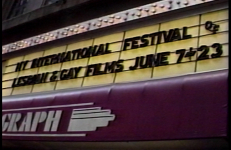
The New Festival, 1991
In this video, Brenda and Glennda attend the opening day of The New Festival (now known as NewFest), a queer film festival in New York City. They interview attendees and filmmakers at the festival to discuss the importance of queer film. Videographer Hans Christian Dany pans back and forth between Brenda and Glennda's interviews and onlookers of the festival, some of whom seem intrigued by the crowd gathering outside the theater, and some who seem offended by the openly queer festival goers.
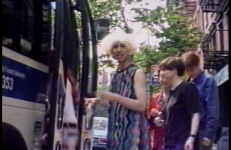
In this episode of The Glennda and Brenda Show, Glennda and Brenda take over a public bus to protest discrimination and violence against queer people who are "out and outrageous". They pick up many other out and proud friends to stage this queer sit-in.
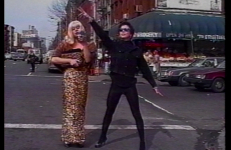
The Post Queer Tour, 1993
Interspersed with clips of Judy Garland films and televised concerts, Glennda Orgasm and Judy LaBruce (Bruce LaBruce's Garland inspired drag persona) travel to the West Village to "discover their gay roots". They discuss the current state of queer culture with people attending gay bars and patroning queer businesses, with a cameo from Sadie Benning. They discuss the idea of the post-queer movement, and give guests a "post-queer quiz".
An episode of Glennda and Friends, hosted by Glennda Orgasm and Judy LaBruce.
The Suicide, 1996
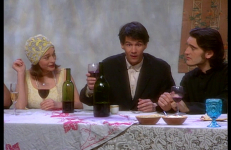
The tension arising between the demands of AIDS activism and Bordowitz's increasing desire to explore aspects of his own life outside the framework of AIDS resulted in the appropriation of a work from the Soviet avant-garde: Nikolai Erdman's play The Suicide. The protagonist, Semyon, as he tries to unyoke himself from the enforced optimism of a bureaucratic order that prohibits any discussion of disappointment and despair following the revolution.
Featuring Lothaire Bluteau as Semyon.
The World is Mine, 2017
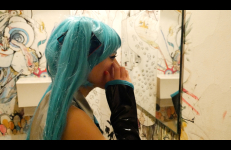
Hatsune Miku is a co-creation platform, personified by a cute and oddly seductive animated character. Fans bring her to life by creating content that she “delivers”. Her entire persona: lyrics, music and animation – is fan created, and that's her charm. Cosplaying Hatsune Miku, Ann Oren goes to Tokyo for a performative journey among these fans and explores the Miku phenomenon as an expression of collective fantasy. The habits of Miku's fans is a familiar exaggeration of our social media habits, that flood us with crowd creativity.
Theme Song, 1973
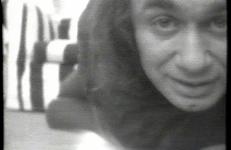
In a vile and ingenious way, Acconci pleads with the camera/spectator to join with him, to come to him, promising to be honest and begging, "I need it, you need it, c'mon... look how easy it is." Acconci addresses the viewer as a sexual partner, acting as if no distance existed between them. The monitor becomes an agent of intimate address, presenting a disingenuous intimacy that is one-sided and pure fantasy, much like the popular love songs in the background with which Acconci croons, "I'll be your baby, I'll be your baby tonight, yeah, yeah."
Thirst, 1985
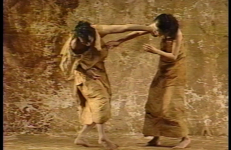
Their first longer piece entirely in silence. The backdrop and floor were painted with a burned flour paste which crumbled down as they moved. In bright light, Eiko & Koma became thirstier as the four sections progressed, seeking both water and intimacy in an extreme setting.
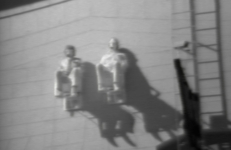
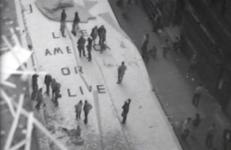
April 26, 1976. San Francisco. Doug Hall and Jody Procter of T.R. Uthco, a San Francisco art/performance group, sat 60 feet above the pavement in chairs bolted to the masonry wall outside the east windows of the third floor of La Mamelle Gallery on 12th Street. They sat from 9:00 in the morning until 3:00 in the afternoon, and during this time They talked continuously. The two performers were clearly visible to spectators on the street below. The sounds of their amplified voices and video images from two nearby cameras were fed into the gallery space.
April 26, 1976. San Francisco. Doug Hall and Jody Procter of T.R. Uthco, a San Francisco art/performance group, sat 60 feet above the pavement in chairs bolted to the masonry wall outside the east windows of the third floor of La Mamelle Gallery on 12th Street. They sat from 9:00 in the morning until 3:00 in the afternoon, and during this time They talked continuously. The two performers were clearly visible to spectators on the street below. The sounds of their amplified voices and video images from two nearby cameras were fed into the gallery space.
This is the Truth, 1982
“Similar in structure to The Speech, this tape suggests the gesture and language of the television proselytizer as opposed to the politician.”
— Doug Hall
“This Is The Truth is a recitation of the rules and social codes that makes evident the results of strategic posturing and facial expression on television. Through emblems and selected phrases, Hall dissects those components that produce the image of authority.”
— Bob Riley, The CAT Fund Presents: Doug Hall (Boston: Institute of Contemporary Art, 1986-87)
Threads of Belonging, 2003
Threads of Belonging depicts the daily life of Layton House, a fictional therapeutic community, where doctors live with their schizophrenic patients. The characters and events of Layton House were drawn from writings of the anti-psychiatry movement, whose most famous proponent was R.D. Laing. In this film we see experimental therapies, power struggles, and the individual arcs of mental illness converge, as a community struggles to understand itself and determine its destiny.

Three Grizzlies, 1974
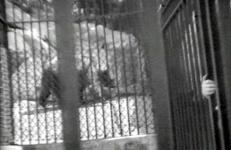
Forti uses the camera as a research tool to record the movements of three grizzly bears pacing anxiously behind the bars of their cage in the Brooklyn Zoo. The collected visual information becomes part of the basis for Forti's movements in Solo No. 1.
Three Tales, 2002
Three Tales was commissioned in the late 1990s by different international music festivals to reflect on 20th century life as the new century approached. It recalls three well known events from the early, middle, and late 20th century—Hindenburg, Bikini, Dolly. Each of these events reflects on the growth and implications of technology during the 20th century from early air transport to the current ethical debate on the future of our species.
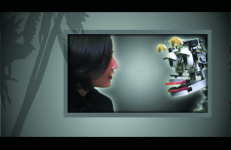
Three Tales, 2002
Three Tales was commissioned in the late 1990s by different international music festivals to reflect on 20th century life as the new century approached. It recalls three well known events from the early, middle, and late 20th century—Hindenburg, Bikini, Dolly. Each of these events reflects on the growth and implications of technology during the 20th century from early air transport to the current ethical debate on the future of our species.
through the glass, 1973
Performers throw themselves into an underground passageway. They exit through the mirror, a symmetrical mirror world which exists because of the placement and angle of the mirror as an upside-down place.
Performers: Ellen Krueger and Monica Wilson
Throwing Stones, 2004
As the camera looks out through a barred window and the clock strikes four in a Swiss city, the death of Yasser Arafat provides the starting point for a journey back in time.
Throwing Stones is the third episode in the Hotel Diaries series, a collection of video recordings made in the world’s hotel rooms, which relate personal experiences and reflections to contemporary conflicts in the Middle East.
Thumb War, 2004
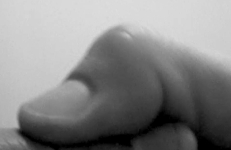
A dance, performed by A.K. Burns and Lanka Tattersall
This title is also available on A.K. Burns: Early Videoworks
Danny Tisdale is a performance artist from New York City. His performances challenge prevailing ideas of race, assimilation, appropriation and success by offering passers-by the chance to racially change their appearance as a means to achieve greater financial success. The mimicry of museological practices of cataloguing and preservation, display and presentation provides one of a range of rhetorical frameworks upon which Danny Tisdale hangs his practice of social critique.

The Videofreex document a street intervention by Turkish artist Tosun Bayrak (b.1926). The performance was to become a notorious example of the element of "shock" in contemporary art. Within the work:
Tosun's Dinner and Wake, 1971
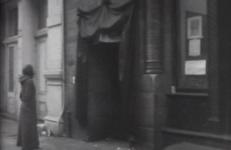
In this tape the Videofreex document an impromptu experimental art gathering in 1971, hosted by New York artist, Tosun Bayrak. Before entering the gathering, the Freex record their encounters with a police officer, passersby, and a member of Vegetarians for Ecological Action (an animals’ rights activist group) protesting the misuse of animals in performance art.
Touch Parade (crush), 2011
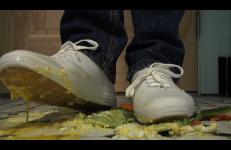
The first video of the installation Touch Parade, which as a whole explores “plastic love” or fetish culture and the assimilation of marginalized sexuality on the internet. In questioning what is an explicit and/or illicit image, fetishes found on YouTube that consist of banal gestures, are re-performed. Unlike other pornographic content, these videos evade censoring because they are not culturally recognized as representations of sexuality.