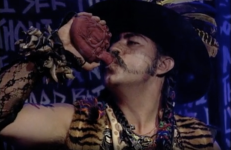



This collection of five shorts includes "These Are The Rules", a frightening incantation of "dos and don'ts" delivered by a red-faced fascist figure played by Hall. Each unique video "song" conveys and elicits a psychological space that is at times beautiful, and often disturbing. This tape also includes: "Fear of Falling", "Sounds of Glass", "Through the Room", and "Leaning Forward Carefully". "
Performance
Sounding Board, 1970
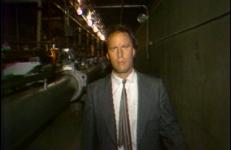
Acconci literally feels the music in this tape as he lays down on speakers playing jazz. The sound pulses through his body while a collaborator massages his nude back in time with the music, occasionally striking Acconci like a rhythm instrument.
This title was in the original Castelli-Sonnabend video art collection.
Sounds in the Distance, 1984
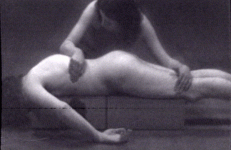
Sounds in the Distance is a video adaptation of David Wojnarowicz's 1982 book Sounds in the Distance: Thirty-five Monologues from the Road.
Cast in order of appearance: Allen Frame, Tara Kelly, Nan Goldin, Kirsten Bates, Elisabeth Walker, Bill Rice, Brian Burchill, Suzanne Fletcher, Frank Franca.
Directed by Kirsten Bates and Allen Frame, Produced by Peggy Bates
Soup in Cup, 1972
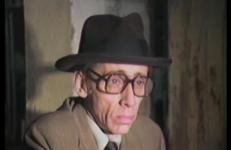
A Japanese Kabuki-influenced performance piece, shot in the woods in Winter. A masked woman emerges from a snowy forest and approaches a stone dwelling, where another woman is waiting. The pair enact a tea ceremony in silence.
In the next scene the tea tray appears in the road, and then disappears after a car passes. Image processing magic.
Please note, production year is approximate.
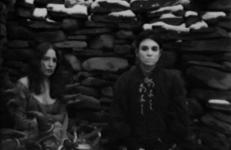
“We lose good artists to the past all the time because their work was ephemeral, or difficult, or fashion wasn’t on their side. The performance artist Stuart Sherman, who died of AIDS in 2001, was a candidate for disappearance on all three counts.”
— New York Times, 2009
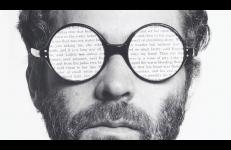
Sphinxes Without Secrets, 1990
Sphinxes Without Secrets is an energetic and transgressive acount of outstanding female performance artists, and an invaluable document of feminist avant-garde work of the 70s and 80s. No Mona Lisa smiles here, as performance artists spill their guts about what outrages and delights them. Performers, curators, and critics unravel the mysteries of a new art form and ponder the world women confront today. Since its inception, performance art has provided a forum for artists who create work that challenges the dominant aesthetic and cultural status quo.
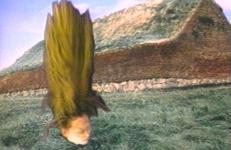
Spirit, 2007
Patti Smith asked if I would do a short film to accompany the release of her version of Nirvana's Smells Like Teen Spirit. As neither of us are fans of the music video format or industry, we approached the project as a short film, with no lip sync, that would simply try to get at the heart of her version of the song. I shot in Super 8 film and pulled a few things from my archive. The film is a domestic portrait of Patti and her son, Jackson. William Blake was invited in the form of a plaster cast of his death mask.
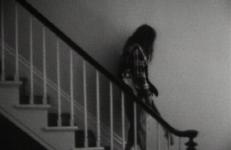
Spit Sandwich, 1970
Spit Sandwich is a compilation of 19 comical and entertaining works from the master of deadpan. Experiments with the video signal combine with visual jokes and one-liners to hilarious effect. Includes: II got . .Spit Sandwich is a compilation of 19 comical and entertaining works from the master of deadpan. Experiments with the video signal combine with visual jokes and one-liners to hilarious effect. Includes: II got . .

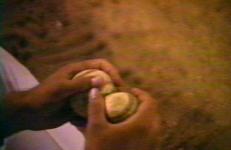
Thinking of herself as a spy assigned by the female sex, Green reinterprets baseball’s symbolism—its womblike landscape, its cycles and rituals—and constructs an iconography that pays homage to the female. In one magnificent montage, numerous phallic symbols pass by as Green sees the real purpose of the game: baseball is the only sport about returning home—and where is home...? In a mother’s belly. With humor and irony, Green creates a tape that is both a personal revelation and a heretical portrait.
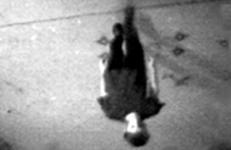
Stamping in the Studio, 1968
From an inverted position, high above the floor, the camera records Nauman’s trek back and forth and across the studio; his stamping creates a generative rhythm reminiscent of native drum beats or primitive dance rituals. However, Nauman is not participating in a social rite or communal ritual—he is completely individualized. Isolated in his studio, his actions have no apparent reason or cause beyond his aesthetic practice.
This title was in the original Castelli-Sonnabend video art collection.
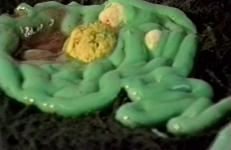
Swamp Swamp, 1999
Swamp Swamp and Wurmburth are each comprised of a series of tightly cropped shots of small, hand-made table-top sculptures or "sets". Paint and many other materials that behave like paint (i.e. lotion, shampoo, foodstuffs) are blown through these environments with plastic tubing and forced air. Each edited collection of shots makes an endless cycle of primal sludge and rupturing goo.
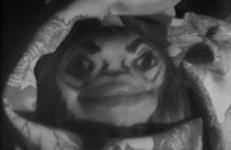
Sybil, 1970
Nancy Cain interviews an upside down chin face about Women's Liberation, asking "Where do you stand on the subject?" The chin face professes to be happy with her lot, and says she enjoys living alone with her cat.
This video was shot in the Prince Street, New York loft/studio used by the Videofreex.
Symmetry, 2016
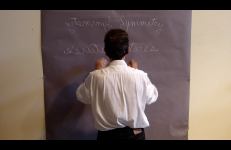
As the artist writes on a paper pinned to the wall in chalk, the left hand writes a mirror image of the right hand. The text reads "Symmetry is nature's way of seeing itself. P Kos 2004-2016"
Sympathetic Vibrations, 1986
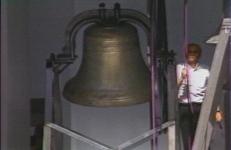
Twelve church bells are rung daily for 30 days in a sculptural setting at the Capp Street Project in San Francisco. Ringers progress from practice sessions on beer bottles to a full-scale ring.
This piece was shot using a combination of 3/4" U-matic video plus Hi8 video.
This title is also available on Sympathetic Vibrations: The Videoworks of Paul Kos.
Take Off, 1974
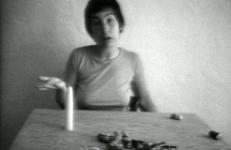
"I made Take Off in my studio apartment on Myra Avenue during my second year living in Los Angeles. As a member of the Feminist Studio Workshop, I was writing an essay at the time comparing male artists’ representations of their sexuality with female artists’. Vito Acconci was my model for a male perspective. I had been captivated by his videotapes; particularly Undertone, where he was supposed to be masturbating while seated at a table. The videotape was my ultimate response and commentary on Acconci as well as an expression of my own sexuality."
— Susan Mogul
In Takeover of the Empire State Building, Brenda and Glennda visit the top of the Empire State Building as it is lit up in lavender for Gay Pride. They interview both tourists visiting the building, and activists who have come to see the lights. Ultimately, they question whether this gesture is adequate, or if there is still a way to go until equality is achieved.
Talent Show, 1996
Talent Show satirizes music videos, while exploring sexual development in the age of the spectacle. The images in Talent Show are from the same found footage as Performance. The young boys lip-synch to a bubble gum rock song as they attempt to publicly assert their new-found sexual power. This display is disrupted both by the realistic "lyrics" in the soundtrack, and the comically over-enthusiastic thrusting of young boys' bodies as they flail about on stage.
Target, 1999
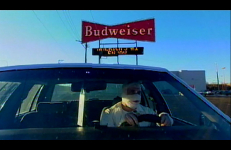
Why is this injured man driving around and around a shopping center parking lot? Just what is his Target? An atmospheric mystery tale that hints at a sad story.
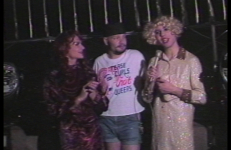
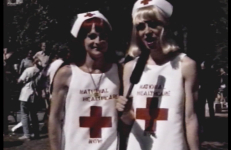
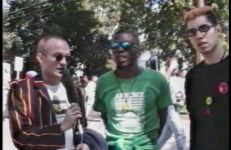
This two-part episode features Glenn Belverio and Duncan Elliott participating in an ACT UP demonstration at President George Bush’s summer house in Kennebunkport, Maine, interviewing activists and documenting this historic event. In addition to this, Brenda Sexual and Glennda Orgasm attend Wigstock, an annual outdoor drag festival in Manhattan's East Village. At the festival, they rally for National Healthcare and discuss other issues such as violence against LGBTQ+ people.
This two-part episode features Glenn Belverio and Duncan Elliott participating in an ACT UP demonstration at President George Bush’s summer house in Kennebunkport, Maine, interviewing activists and documenting this historic event. In addition to this, Brenda Sexual and Glennda Orgasm attend Wigstock, an annual outdoor drag festival in Manhattan's East Village. At the festival, they rally for National Healthcare and discuss other issues such as violence against LGBTQ+ people.
Tarlabaşı, 2014
Tarlabaşı integrates performances of everyday movements and gestures as a direct response to the devastation caused by the centralized state sponsored urban renewal project in downtown Istanbul.
Dancer: Idil Kemer
Music: Cenk Ergün
Production: Yunus Demir
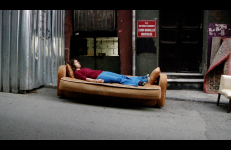
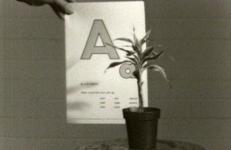
“[A] rather perverse exercise in futility,” this tape documents Baldessari’s response to Joseph Beuys’s influential performance, How to Explain Pictures to a Dead Hare. Baldessari’s approach here is characteristically subtle and ironic, involving ordinary objects and a seemingly banal task. The philosophical underpinnings of Baldessari’s exercise are structuralist theories about the opaque and artificial nature of language as a system of signs.
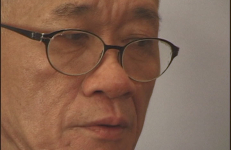
At the age of twenty-four, Taiwanese artist Tehching Hsieh (b.1950), moved to New York, where he has created and documented time-specific, conceptual art performances since the 1970s. In this interview, Hsieh discusses his formative years and philosophical moorings. This dialogue includes description of the artist’s early period of painting, his military service in Taiwan, and the cultural atmosphere of a country then undergoing massive political change. Much of the discussion focuses specifically on Hsieh’s understanding of the relationship of art and life, his investment in “free thinking,” and the politics of documentation. For Hsieh, the ability to think freely is art’s bottom line—he believes the essence of his work lies in human communication. To this end, Hsieh insists that his work, though incredibly personal, is not autobiographical, but philosophical.
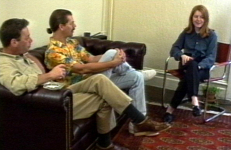
The Telling, 1998
The Telling (1994-98) shows Anne McGuire telling two acquaintances a secret from her past using a three-camera set-up in the Desi Arnez style. The commodification of intimacy is not the strangest thing about this work. The fractured editing, silences, and lapses in continuity suggest vast narratives far more evocative than anything revealed on screen. McGuire uses television vernacular ambiguously to provoke discomfort, two things that television strives to avoid at all costs.
Temple of Confessions, 1996
A documentation of a performance/installation. Guillermo Gómez-Peña and Roberto Sifuentes created a fictional religion based on inter-cultural confessions. Exhibiting themselves in Plexiglas boxes as "end-of-the-century saints", the two performers hear the confessions of audience members willing to reveal their intercultural fears and desires to the saints.