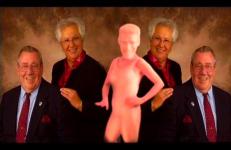



Taking its title from the sea nymphs in Homer’s Odyssey—the treacherous spirits whose sweet voices lured sailors to their death upon the rocks—Sirens presents four hallucinatory scenes, visual puns authored by a mischievous agent. Mocking laughter that shatters the illusion and causes viewers to doubt the assumptions implicit in their viewing disrupts stills of what seem to be unpopulated landscapes.
Mental Landscape
So To Speak, 2000
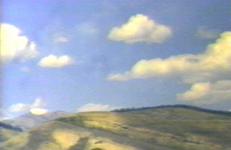
Employing the 'case studies' of Helen Keller, Genie the 'wild child' and Angel at My Table author Janet Frame, Goss's extraordinary video contemplates the struggle to be heard, to break free from the prison of the incommunicable self. '[A] tour of the house and grounds of language,' constructed with beguiling visual spaces and surfaces, startling edits, and insinuatingly layered sound design. —New York Video Festival (2000)
Sol Negro, 2016
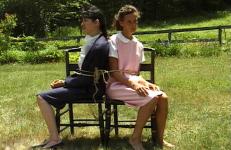
"The title (Black Sun) is as evocative of solar eclipse as it is of the 'dark spleen' which doctors, all through Antiquity, used to attribute to melancholic and suicidal drives, especially as they affected artists. Here such drives end up striking the existence of Antonia, an opera singer whose dark beauty brings light to the film. Through discreet and elliptical staging, Laura Huertas Millán presents Antonia’s multi-faceted character.
Solitary Acts #6, 2015
Wittnerchrome, Exacto Knife, 1.5mm Letter Punches, Hammer, Leather Puncher
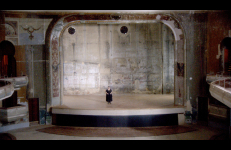
This is a feminist critique of the Oedipal complex. The filmmaker recounts an abortion she had in 2009. The aborted child survives and becomes her lover. Her subject is filmed in a private act, complicating what could be an act of the solitary.
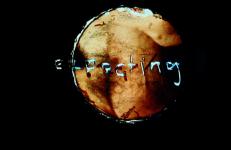
Some Chance Operations, 1999
Shot in Naples, Vienna, and New York, Some Chance Operations explores the notion of an archival form, in this instance film, as an unstable memory receptacle that can vanish. History and how it is made is meditated upon as one of many chance operations. The filmmaker Elvira Notari, who had a film production company in Naples from 1906 to 1930, plays a significant role as an impetus for Some Chance Operations. Despite the fact that she was a prolific filmmaker, producing over sixty feature films, only three remain intact.
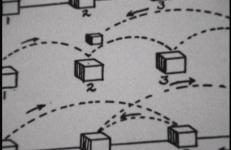
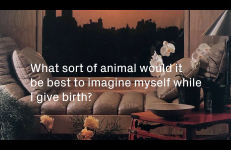
Prompted by Apple’s Siri to ask questions, Magenheimer takes the AI invitation seriously and invents a long list of queries. We see them appear one by one over scanned images from Architectural Digest magazine’s idealized interiors of 1981, the year Magenheimer was born and the year Ronald Reagan became president.
Someone Behind the Door, 2005
A world with no escape... from the surveying cameras, an eye, a presence, always there to control our minds and movements. Looking even for the most secure little movements of life.
This title is also available on Half-Lies: The Videoworks of Ximena Cuevas.
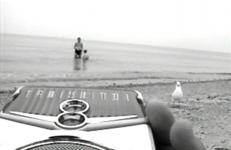
Son of Oil, 1982
Calling for oil like the Tin Man in The Wizard of Oz, Son Of Oil is a tale of the well-greased machine of the mind breaking down. Nuts fall off; thoughts turn bad; things don't work. Balancing panic and hopelessness, Oursler argues with phantom voices that taunt the hero with the consequences of his action and inaction. On this starkly social stage, Oursler confronts an individual's sense of responsibility in a society filled with violence, industrial decay, and alienation.
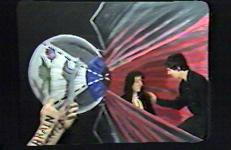
Space Ghost, 2007
Space Ghost compares the experiences of astronauts and prisoners, using popular depictions of space travel to illustrate the physical and existential aspects of incarceration: sensory deprivation, the perception of time as chaotic and indistinguishable, the displacement of losing face-to-face contact, and the sense of existing in a different but parallel universe with family and loved ones.
Physical comparisons such as the close living quarters, the intensity of the immediate environment, and sensory deprivation, soon give way to psychological ones: the isolation, the changing sense of time, and the experience of earth as distant, inaccessible, and desirable. The analogy extends to media representations that hold astronauts and prisoners in an inverse relationship: the super citizen vs. the super-predator. Astronauts, ceaselessly publicized, are frozen in time and memory whereas prisoners, anonymous and ignored, age without being remembered.
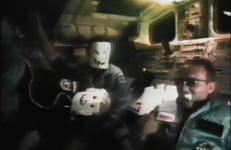
The close collaboration between internationally celebrated artist-filmmakers Ben Rivers (Two Years at Sea) and Ben Russell (Let Each One Go Where He May) has yielded an intriguing ethno-trance aesthetic that finds its stunning summa in their much anticipated co-directed feature A Spell to Ward Off the Darkness. An immersive, at times mesmerizing experience, Spell follows a nameless protagonist — played with Bressonian restraint by musician Robert A.A.
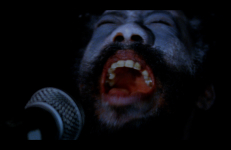
The close collaboration between internationally celebrated artist-filmmakers Ben Rivers (Two Years at Sea) and Ben Russell (Let Each One Go Where He May) has yielded an intriguing ethno-trance aesthetic that finds its stunning summa in their much anticipated co-directed feature A Spell to Ward Off the Darkness. An immersive, at times mesmerizing experience, Spell follows a nameless protagonist — played with Bressonian restraint by musician Robert A.A.
Stanley, 1995
The tale of a fanatical tool collector who recreates the world according to a logic dictated by his cross-wrench. An examination of the abstract technology of sanity, Stanley inverts the documentary portrait—incorporating interviews, found footage, weapons catalogs, and alligator wrestling. An exploration of masculinity and instrumental power as wielded both in the tool shop and in the corridors of the Pentagon, Stanley underscores the larger significance of daily gesture in the production of meaning.
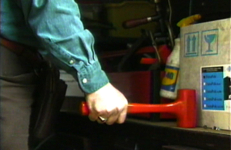
Staying Alive, 2001
Blind man: “It is bad to be alone.”
The Creature: “Alone, bad.”
—The Bride of Frankenstein
It can be so bad to be alone that even an artificial heat is better than none.
This title is also available on Ximena Cuevas: El Mundo del Silencio (The Silent World) and Half-Lies: The Videoworks of Ximena Cuevas.
Steve Hates Fish, 2015
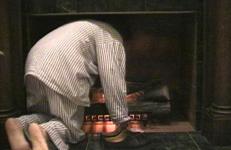
Filmed directly from the screen of a smartphone using a language translator app that has been told to translate from French into English, Steve Hates Fish interprets the signage and architecture in a busy London shopping street. In an environment overloaded with information, the signs run riot as the confused and restless software does its best to fulfill its task.
suicide, 2003
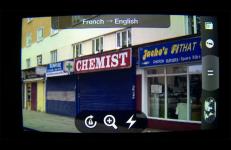
suicide is 70 packed minutes of a fictional filmmaker's crazed ruminations on travel, family history, death and sex as she traverses a world of malls, airports and train stations, chronicling her fiercely hopeful search for a reason to continue living.

super-max, 2003
I drove around the U.S. filming these super maximum-security prison buildings the spring and summer after the World Trade Center bombing. I knew that counties within various states had been frantically outbidding each other to get these high-tech gulags to replace the farming and manufacturing jobs that have been lost over the last 25 years. The timing seemed right to remind everyone what we have been doing with our public funding and to draw parallels with the neo-liberal economic policies espoused with variations by the Reagan, Clinton and both Bush administrations.
Suspension, 2007
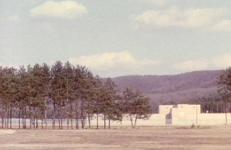
Letting go of realist constraints, and going back to the mirror-images of some of Provost’s famous previous works, we are diving into a cosmic ocean of ever metamorphosing baroque circumvolutions in which our minds try to capture reassuring forms before letting the ghostly demons blur our vision.
Swallow, 1995
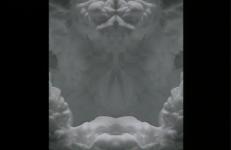
Based on accounts of girlhood anorexia, Swallow unravels the masked and shifting symptoms that define clinical depression. With a densely layered soundtrack, humorous and painful scenes of potential psychological breakdown reveal a critical loss of meaning, and the failure to diagnose mental illness. Weaving narrative, documentary, and experimental strategies, Swallow intimately traces the awkward steps from unacknowledged depression to self-recognition.
That Which Is Possible, 2015
That Which Is Possible is a portrait of a community of painters, sculptors, musicians and writers making work at the Living Museum, an art-space on the grounds of a large state-run psychiatric facility in Queens, New York. Shot over the course of two years and structured across the arc of a day, the film observes with an intimate lens and unspools like a musical, both bracing and tender. That Which Is Possible explores the liberatory and reparative functions that creative action has for a group of artists drawn together by shared struggle.
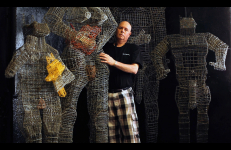
This Day (al yaoum), 2003
Shot in Lebanon, Syria and Jordan, this essay uses transportation, video, and photography to examine images circulating in a historically charged, and presently war-torn and divided, Middle East. From images of camels in the desert to images of the Arab-Israeli conflict, the video looks at states of mind in relation to actual geographies. The video pays tribute to an unformatted and open-ended documentary approach, and examines modes of access to information such as travel, television and the Internet, while carefully displaying the resulting iconography.
This is a Sign, 2025
This is a Sign (by Bob Snyder and Sara Livingston) is a contemporary daydream, with the kinds of conceptual twists and turns that daydreams often have. Natural forces in motion, a slow dance with robotic arms, a historical procession of masks, a feeling of unchecked growth, all punctuated with clouds. As with all Illustrated Music productions, "the music is the story".
Threads of Belonging, 2003
Threads of Belonging depicts the daily life of Layton House, a fictional therapeutic community, where doctors live with their schizophrenic patients. The characters and events of Layton House were drawn from writings of the anti-psychiatry movement, whose most famous proponent was R.D. Laing. In this film we see experimental therapies, power struggles, and the individual arcs of mental illness converge, as a community struggles to understand itself and determine its destiny.
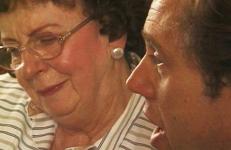
The Tower, 2001
Back in the days of hippy bliss, Ulrike and her husband used to believe that the world would be revolutionized by their activities, consisting mainly of smoking pot and having sex. Thanks to a large family fortune, none of them has ever had to work for a living. But the ‘three generation millions’ – one generation makes it, the second maintains it and the third generation blows it – are slowly disappearing. So now the burden of maintaining the tower falls on the children, of whom Sirius (the Latin form of Osiris) actually seems to enjoy making money.
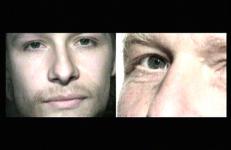
Track One, 2011
The time is now! The present can be replaced in real time. Not quite yet by the future, but very easily by the past? eteam's video Track One is a replay of such time disjuncture. As they keep following the memory of a yellow cab that keeps driving through the now deserted streets of Taipei, their pastime augments itself with a mesmerizing sense of reality.
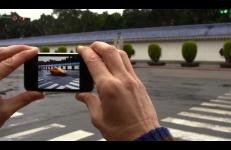
I'm here to bring you the Truth and the Pleasure
Here to show you the meaningful form
It's going to feel like a new kind of leisure
It's going to smell like a freshly mown lawn
I'm installing a personal toolkit for thinking
Especially customized only for you
You enable it just by the action of blinking
From now on your thoughts will be focused and true