


Mental Landscape

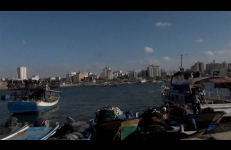
Home Movies Gaza introduces us to the Gaza Strip as a mircrocosm for the failure of civilization. In an attempt to describe the everyday of a place that struggles for the most basic of human rights, this video claims a perspective from within the domestic spaces of a territory that is complicated, derelict, and altogether impossible to separate from its political identity.

"... Basma Alsharif’s Home Movies Gaza, a film that captures the impossibly politicized domestic sphere of the Gaza Strip, under the constant hum and buzz of overhead drones."
horizon, 2014

A poem or brief poetic collage of 16mm home movie footage from Egypt in the 1950s along with elements of Capra's Lost Horizon soundtrack interwoven with recordings of a small and frustrated boy. 

The original footage was given to me by my mother, who worked some 30 years as a maid for the millionaire couple who shot this while on an around-the-world honeymoon trip. The woman’s voice pondering utopia, peace and joy; the small boy frustrated by the tonal and linguistic romanticism of this expression. 

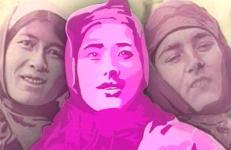
Adapted from psychologist A.R. Luria’s research in the Islamic outskirts of the Soviet Union in the 1930s, How to Fix the World brings to life Luria's conversations with Central Asian farmers learning how to read and write under the unfamiliar principles of Socialism.

Colorful digital animations based on Max Penson's photographs of collective farmers play against a backdrop of landscape images shot in Uzbekistan in 2004.

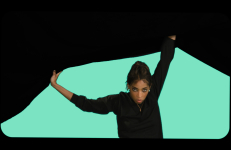
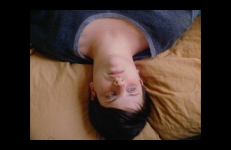
In i am wise enough to die things go (2023), Syms explores the idea of psychosis through an unnamed protagonist reciting a monologue. Responding to the work of iconic animator Chuck Jones, Syms transfers the form and narrative structure of an animated short into live-action. Working with the inherent challenges and restrictions brought about by this sort of translation, she delves into both the breaking up of images and the breakdown of the psyche.

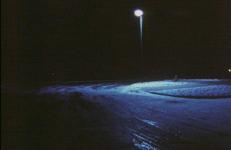
An uncompromising look at the ways privacy, safety, convenience and surveillance determine our environment. Shot entirely at night, the film confronts the hermetic nature of white-collar communities, dissecting the fear behind contemporary suburban design. An isolation-based fear (protect us from people not like us). A fear of irregularity (eat at McDonalds, you know what to expect). A fear of thought (turn on the television). A fear of self (don’t stop moving).

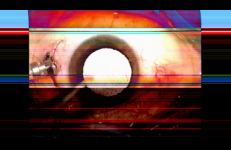
Insomnia, 2020

This is the state of mind in the post-Covid quarantine. This is the state of the body into the pandemic vortex. This is our post-Covid eyes. Part of the Hauntology and Post-Covid series.

A deceased hoarder, reconstituted through technology, recounts a difficult childhood as inhabitants of a virtual world struggle to reconcile materialistic tendencies. A scientist leads an effort to understand the passage of time, but the data is unreliable. The question remains, what happens to our things after we are gone?

It Hurts, 2006

The repeatedly distorted, primate behaviour of an (ani)female carrying her baby, reflecting the pain and suffering provoked by the mother/child relationship.

What I am//What you are//salt and sweat on my tongue.

A quarantined love letter of domestic imagination. A year of rain and other fluids. Contentment is a difficult emotion. 26 Main St. Bucksport, ME

A familiar landscape comprised of big box stores and parking lots proves a rich site for longing, intimacy, and radical change. Celebrities are observed in this environment and are reduced to ordinary beings in the process. An enigmatic protagonist reveals little moments of subjectivity that escape into the piece like a contaminant, rupturing the view and evidencing the paradox of connection and belonging within systems that simultaneously contain us and comprise us.

There were three brides, and they all married at different times to different people in different places. They came from similar backgrounds and lived in the same general area, but circumstances had led them down parallel - never to cross - paths. One night, however, they all shared the same dreams…

The personal odyssey recorded in The Laughing Alligator combines methods of anthropological research with diaristic essay, mixing objective and subjective vision. Recorded while Downey and his family were living among the Yanomami people of Venezuela, this compelling series of anecdotes tracks his search for an indegenous cultural identity.

Life Without Dreams is set in the outer space of consciousness, where the surfaces of far out planetary bodies form the terrain for an exploration of 24/7 capitalism, insomnia, and the disappearance of darkness.

In the film Mad Ladders, the prophetic ramblings of an unseen narrator recount fantastical dreams of the coming Rapture, as crystalline imagery of rolling clouds gives way to heavily-processed video of moving stage sets from The American Music Awards telecasts of the 1980s and early 1990s. Blooming and pulsing in and out of geometric abstraction, this swirling storm of rising curtains, spinning set pieces, and unveiled pop idols forms an occult spectacle, driven by its impassioned narrator and an 8-bit leitmotif.

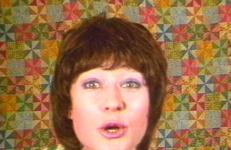
Combining Rubnitz’s skillful manipulation of the familiar “look” of TV shows with an extraordinary range of characters, performer Ann Magnuson convincingly impersonates the array of female types seen on TV in a typical broadcast day. From glitzy to drab, from friendly housewife to desperate evangelist, Magnuson is a one-woman universe appearing on every channel, the star of every program—giving her all as the chameleon woman who is always on display.

Combining Rubnitz’s skillful manipulation of the familiar “look” of TV shows with an extraordinary range of characters, performer Ann Magnuson convincingly impersonates the array of female types seen on TV in a typical broadcast day. From glitzy to drab, from friendly housewife to desperate evangelist, Magnuson is a one-woman universe appearing on every channel, the star of every program—giving her all as the chameleon woman who is always on display.

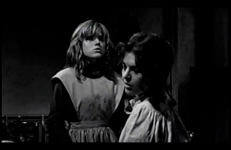
Anne Bancroft and Patty Duke proceed to beat each other while text from psychiatrists and ex-patients discuss the violence in some forms of psychiatric care. Four actions repeat as the struggle for autonomy rages.

Sara Magenheimer earned her MFA at Bard in 2013 and has since shown her work internationally in Canada, Iceland, the Czech Republic, and Denmark. Her cross-disciplinary practice plays with the juxtaposition between the form and content of language, exposing the absurdity of expected meanings.

The Making and Unmaking of the Earth turns to geology as both a metaphor for and a psychic container of women's emotional states and embodied experiences of physical pain. Combining archival footage of earth processes with interviews describing mysterious physical experiences and emotional attachments, this film explores how everything we bury deep inside eventually speaks through the geology of the body.

Mama, 2005

"Mama mama mama...," a woman calls out again and again, over and over. Is it her child that she mimics, or is she calling for her own mother? A desperate video performance in the first person.

A distinguished looking man (performance artist Richard Layzell) is apparently trapped in an ever changing void of colour, locked in a power play with a perversely operated camera. A mute, caged, charismatic TV presenter he is by turns charming, menacing, educational, confused. At times he appears to have great powers. A voiceover tells us extraordinary things — how this man is special — the first man to 'have a baby'. Hallucinogenic flash-frames punctuate the colour field to give us a view of his world's disturbing and alien futuristic logic.

Kipnis describes this tape as "an appropriation of the aesthetics of both late capitalism and early Soviet cinema—MTV meets Eisenstein—reconstructing Karl Marx for the video age.” She presents a postmodern lecture delivered by a chorus of drag queens on the unexpected corelations between Marx’s theories and the carbuncles that plagued the body of the rotund thinker for over thirty years. Marx’s erupting, diseased body is juxtaposed with the “body politic", and posited as a symbol of contemporary society proceeding the failed revolutions of the late 1960s.

“Hopinka’s video Mnemonics of Shape and Reason (2021) traverses the memory of a place and space visited by the artist. Employing an original syntax of storytelling, the artist interweaves scattered and reassembled landscapes with layers of captured audio, poetic text, and music. A rhythmic account of the spiritual implications of colonial plunder, Hopinka’s fluid reflections transmute ideas of spiritual malleability tied to land, sky, sea, myth, place, and personhood.”

Commissioned by ICA Miami.

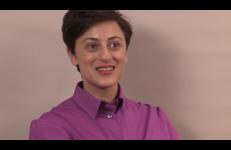
Theo Cuthand and his mother Ruth Cuthand have a candid conversation about Theo's last hospitalization for Bipolar Disorder in 2007. While Theo only knew his manic episode from the inside, Ruth had to deal with caregiving decisions and trying to find help. While they reminisce they also have to reckon with the feelings of animosity that arose between them during these events.

Co-directed with Ruth Cuthand. 

An Ocean Between Us expresses the desire for a relationship that is made up of transitions, successive time shifts, and coordinated changes without an essential unity. This project tells a story about a couple that roam inside a boat moored in a slip along the dock by the port of Lisbon, waiting for the ‘last call’ to departure to Luanda. In the video the audio track is composed of the sounds of boat engines and waves from the ocean that brought this couple together, and now take them apart. They walk close to each other, but are spiritually far apart.