


Mental Landscape

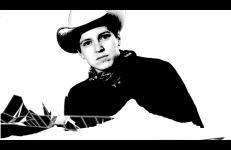
Torn over the pressure to perform for his audience, Acconci fantasizes about "a dancing bear" who takes his place, performing in the spotlight, doing what others want, "what I always had to do."  The viewer is placed in the position of an authority or analyst, above Acconci’s head, listening to his hallucination.  This fantasy becomes increasingly erotic as Acconci unburdens himself psychologically and reveals his contradictory need to control and to be controlled.

This title was in the original Castelli-Sonnabend video art collection.
"Conspiracy Of Lies speaks of the alienation of minorities, of consumer culture, urban isolation and the fine balance between mental order and chaos. The video begins with a voice (my own) recounting the story of the discovery of a series of diary entries and lists written by an anonymous author. When I found the texts, I assumed the author to be a white, gay man, like myself. Through the use of twelve narrators of different race, gender, religion, and sexual orientation, I attempted to destabilize my own subjectivity and challenge my pre-existing assumptions regarding difference.

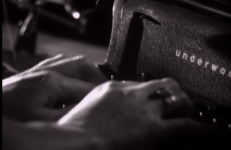
The police phoned. They left a message on the machine. They said he was dead. The video unwinds through stories of sex for rent, unclaimed bodies, cigarette burns, and other monuments of life’s long run from wall to wall. Cut the Parrot is three grotesque comedies in one: the stories of Gerry, Susan, and Albert. Songs of hope and heartbreak spill from the mouths of the performers. The order of impersonation rules.

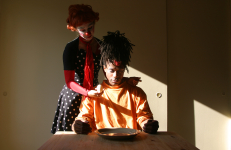
Riffing on relations between grief, love, bodies, and embodiment, this short film features two former professional Ringling Bros. and Barnum & Bailey Circus clowns. A Dark Love Story for Clowns weaves together a loosely adapted William Faulkner story with a spiritual ritualistic practice in order to explore the performativity around ethics of care and love.

This piece investigates the possibilities and limits of writing a history of the Lebanese civil wars (1975-1991). The videos offer accounts of the fantastic situations that beset a number of individuals, though they do not document what happened. Rather, they explore what can be imagined, what can be said, what can be taken for granted, what can appear as rational, sayable, and thinkable about the wars.

Deadline, 1981

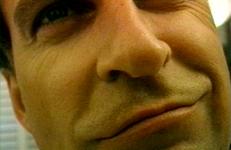
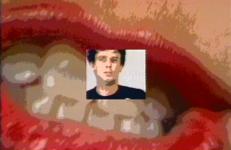
An insert square of a man running is superimposed over a magnified mouth that speaks to him — first in nurturing encouragement, then with a no-win Mommie Dearest kind of criticism. Originally presented as an installation on six monitors, Deadline focuses on “the stress man feels in the urban environment,” using a range of digital video effects to stretch, compress, flip and fracture the image.

DED, 2021

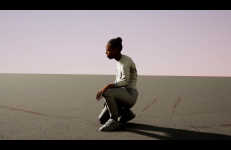
An avatar, created through a 3D scan of Syms, navigates a plain and vast virtual landscape, the perspective sometimes floating above, sometimes alongside, as she progresses through a perpetual cycle of death and resurrection. Her avatar's journey seems to reflect the spectacularly confusing or nonsensical experience of inhabiting a body during a time of violence and illness that has unceasingly threatened notions of stability and consequentiality, forcing ever-evolving tactics of survival.

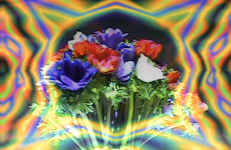
This film is a recording of a live signal analog video/audio synthesizer performance with a voiced narration made in collaboration with an AI program. A speculative machine guided psychedelic broadcast of an astral floral projection. A fictional telepathic transmission that saturates the boundaries of perception with interlacing signals of interconnected consciousness.

— Les LeVeque


A hypnosis-inducing pan-geographic shuttle built on brainwave-generating binaural beats, Deep Sleep takes us on a journey through the sound waves of Gaza to travel between different sights of modern ruin. Restricted from travel to Palestine, I learned auto-hypnosis for the purpose of bi-locating. What results is a journey, recorded on Super 8mm film, to the ruins of ancient civilizations embedded in modern civilization in ruins, to a site ruined beyond evidence of civilization.

Dreamtime, 1988

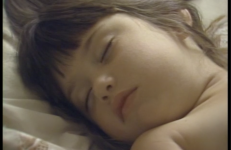
While asleep and dreaming, older children and adults alike tend to perceive dream events as external reality, but very young children do not understand "asleep" and "conscious" to be different domains. Perhaps they are not. Dreamtime is, quite literally, dream inspired video. A sleeping five-year- old girl (Alaine Ball) recounts dreams recorded over a three-month period in a voice-over sound track. She experiences what is referred to as a "lucid" dream, which is characterized by the dreamer knowing that he or she is dreaming

An epistolary, musical reimagining of Wuthering Heights by Branwell Brontë — the tubercular, alcoholic and opium-addicted brother of Emily Brontë. When Branwell — the ne’er-do-well, tubercular brother of the Brontë sisters — discovered that Emily was writing her first novel, he offered to be her editor. Once he realized that he was the model for the alcoholic Hindley Earnshaw character, he reimagined the story as a musical memoir of his own life with Hindley as the hero.

In an empty room, a slideshow projection of abandoned places plays alongside the narrative of two girls who find themselves on the shores of a pre-apocalyptic paradise. Told through subtitle text that weaves fact and fiction together, the story of a massacre unfolds. When the image and text malfunctions and the story is no longer comprehensible, the video wanders away from the room of the slideshow, allowing us to see what is happening elsewhere.

Excess, 2009

A rumination via handwritten index cards and an assortment of images recalling histories and ambitions of varied film productions.

The Fool, 2021

The Fool melds varied footage while a narrator describes a brief encounter with a former love interest. A performance of a gymnastics routine merges with iconic Baroque paintings; club scenes mix with a day at the beach. Taking the viewer on a hazy, dream-like journey, the images at times seem to illustrate the story being recounted but elsewhere fail the narrator entirely: in one surreal moment, a large fig tree rolls across a hallway on a skateboard.

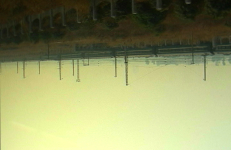
What happens when memory collapses into an unknown landscape? Upside-down train tracks merge and blur the distinction between reality and imagination.

Future From Inside is the last in the trilogy begun in 2016, by Dani and Sheilah ReStack (also including Strangely Ordinary this Devotion and Come Coyote.) The work traces the ReStack collaboration, as it manifests in life and in work.

Future From Inside is the last in the trilogy begun in 2016, by Dani and Sheilah ReStack (also including Strangely Ordinary this Devotion and Come Coyote.) The work traces the ReStack collaboration, as it manifests in life and in work.

"i am very grateful that my 鬼鎮 (Ghosttown) series has shown internationally over the last couple years and is recognized by viewers, reviewers, critics, and curators as doing decolonizing work as a feminist project that queers and glitches the Western genre. 鬼鎮 (Ghosttown) questions the quintessentially American Western in the forms of experimental films and games that are made from glitches and noise, pushing boundaries of legibility and tipping over threshold states of stability.

This fictional memoir gives voice to the woman who haunted Andre Breton's 1927 Surrealist novel Nadja. Speaking from the sanitarium as World War II approaches, she recounts their nine-day love affair in the streets of Paris. Nadja is imaged following the game of exquisite corpse, with staged and framed gestures, excerpts from Surrealist films and archival newsreels as well as fragments from the walks of the filmmaker as flaneur.

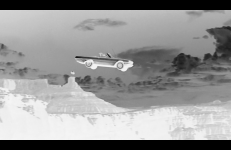
Goodbye Thelma synthesizes footage from the 1991 film Thelma & Louise with footage of the author’s own making to create a mysterious, and at times disturbing, exploration of traveling alone. In contrast to the dramatic events of Thelma & Louise, this story is one of suspended fear, which inverts stunning vistas into unsettling and uncertain landscapes.

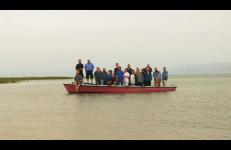
A collection of unidentified individuals is stuck together on a boat. Are they going home? Where is their home and why are they so silent? This short work takes a look at a displaced and uprooted community.

Shot in Portland International Airport. Animation by Jalal Jemison.

"In Haysha Royko, three people sit nonchalantly in airport chairs, while their different-colored auras, or something much like auras, shape shift, overlap, and compete."

— Emily Hall, The Stranger, July 17th, 2003 

Healing, 2012

The video hovers tentatively between therapy, documentary, poetics and mystic traipsery and ends, like all good things, in surrender to song. There is a challenge presented (the challenge to engage earnestly with the piece as it requests) to fall into the breathing and pacing presented, and the challenge to view the video as a discrete piece of art at the same time. The piece relies heavily on the text, the disembodied Virgil through which the words become musical, instructive and (due to the absence of image) visual.

"By way of lush formal and associative shifts, Hearts Are Trump Again evokes the ever-present tension between seemingly polarized states of experience. Desire and repulsion; freedom and constraint; pain and pleasure all find articulation in images of ferocious dogs and mock conversations about childbearing. Tonally complex and viscerally rich, Hearts Are Trump Again is a lyrical exploration of emotional weather."

— Brett Price