


In the spring of 1988, video-maker/activist Gregg Bordowitz tested HIV-antibody positive. He then quit drinking and taking drugs and came out to his parents as a gay man. This imaginative autobiographical documentary began as an inquiry into these events and the cultural climate surrounding them. While writing the film, a close friend was diagnosed with breast cancer and his grandparents were killed in a car accident. The cumulative impact of these events challenged his sense of identity, the way he understood his own diagnosis, and the relationships between Illness and history.
LGBTQ

Fever Freaks, 2017
A detective is hired to find the original copy of a lost ancient book. The book recounts the tale of a plague. A form of radiation, unknown at the present time, activates a virus. The virus affects the sexual and fear centers in the brain and nervous system; fear is converted into sexual frenzies which are reconverted back into fear, the feedback leading in many cases to a fatal conclusion.
Fighting Chance, 1991
Fighting Chance is a continuation of Richard Fung’s previous documentary Orientations, which told of the personal challenges and struggles of Asian-Canadian gays and lesbians to express their sexual identities. When Fung produced Orientations in 1984, AIDS had not yet fully manifested itself (particularly among Asians), but by 1991, as we see in Fighting Chance, the epidemic has become threateningly widespread. Individuals and couples candidly discuss the various hurdles and challenges that AIDS has presented.
finally destroy us, 1991
“But these meetings, these partings, finally destroy us.”
—Virginia Woolf, The Waves (New York: Harcourt, 1978)
Fingers and Kisses, 1995
Cheang has taken her camera to the streets for a candid glimpse of lesbian public sexuality. If Asian women and lesbians share a certain amount of invisibility in the culture, Fingers and Kisses offers not only a bold representation of both, but a challenge to the question “What do lesbians do?” Tokyo’s own out-and-loud music by Chu punctuates the narrative as what begins in the streets continues under the sheets.
Script and performance by Izumo Marou and Claire Maree.
With Superdyke Inc. Japan.
Music by Chu.

First Night Out, 2022
Frances, a young Gay Indian (2 Spirit), played by Lacey Hill, is struggling with the aftermath of a gay basing. Through her friendship with her ex Jean, she gathers the strength to go out in public again. This video is a salute to the 70s and to Gay Indian movements which became 2Spirit/Indigiqueer communities.
Song performed by Lacy Hill.
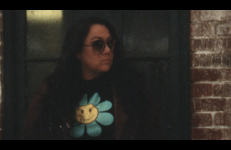
Flat is Beautiful, 1998
Flat is Beautiful is an experimental live-action cartoon using masks, animation, subtitles, drawings, and dramatic scenes to investigate the psychic life of an androgynous eleven-year-old girl. Growing up in a working class neighborhood with her single mother and gay roommate, Taylor confronts the loneliness of living between masculine and feminine in a culture obsessed with defining gender difference. Shifting between black and white film and grainy pixelvision video, Flat is Beautiful explores the internal and external worlds of sad people.
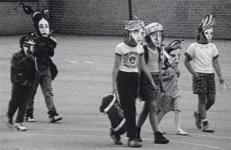
Freebird, 1993
Silver directs and performs all the roles in this raucous and hilarious music video rendition of Lynyrd Skynyrd’s "Freebird", the infamous Southern rock anthem for an entire generation of 1970s male youth. In this spoof of straight mass culture, Silver flips ironically between roles; from a lesbian proudly proclaiming her sexuality at the Academy Awards, to an in-concert Coors-drinking Ronnie Van Zant, and, finally, to a black-lace lesbian lounge swinger celebrating the wild, colorful world of “out” visibility.

Frida & Anita, 2012
Shot in the style of a silent film from the 1920s, Frida & Anita is a political fantasy, intersecting the lives of two queer radicals — Frida Kahlo and Anita Berber — who happen to meet one fateful Berlin night in 1924 at the infamous La Garcon Cabaret.

Frieda! (The Movie), 1980
This first "Frieda" collaboration between performance artists Barbara Lipp and Tom Koden and video artist Tom Rubnitz chronicles Frieda's rise from assembly-line worker in a box factory to singing superstar. Featuring rock-bottom production values and a sound track which includes the Brady Bunch kids' tune "Gonna Find a Rainbow".

Frieda! (The Movie), 1980
This first "Frieda" collaboration between performance artists Barbara Lipp and Tom Koden and video artist Tom Rubnitz chronicles Frieda's rise from assembly-line worker in a box factory to singing superstar. Featuring rock-bottom production values and a sound track which includes the Brady Bunch kids' tune "Gonna Find a Rainbow".
Frieda! (The Movie), 1980
This first "Frieda" collaboration between performance artists Barbara Lipp and Tom Koden and video artist Tom Rubnitz chronicles Frieda's rise from assembly-line worker in a box factory to singing superstar. Featuring rock-bottom production values and a sound track which includes the Brady Bunch kids' tune "Gonna Find a Rainbow".
From Fagtasia to Frisco, 1992
In From Fagtasia to Frisco, Brenda and Glennda report from Fagtasia, an event honoring the Summer Solstice in New York organized by the Radical Faeries. Through interviews with Faeries and footage of their walk across the Brooklyn Bridge, the group proposes to reclaim the city as a safe space for queer people, and discuss reorienting queer consciousness toward spirituality.
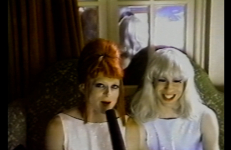
From The Files of the Pyramid Cocktail Lounge is a series of video clips taken at the Pyramid Club, a seminal location for the East Village drag scene in the midst of the club's most influential years. While rummaging through a file cabinet full of event fliers from the Pyramid Club, an office worker in drag guides the viewer through video documentation of past performances at the club.

Future From Inside, 2021
Future From Inside is the last in the trilogy begun in 2016, by Dani and Sheilah ReStack (also including Strangely Ordinary this Devotion and Come Coyote.) The work traces the ReStack collaboration, as it manifests in life and in work.
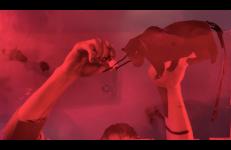
Future From Inside, 2021
Future From Inside is the last in the trilogy begun in 2016, by Dani and Sheilah ReStack (also including Strangely Ordinary this Devotion and Come Coyote.) The work traces the ReStack collaboration, as it manifests in life and in work.
Gay Men's Book Club, 2025
Seven homosexuals, ages ranging 28-85, and strangers to one another, convene in a Los Angeles bookstore. The following unscripted conversation is facilitated by the filmmaker in collaboration with community organizer, founding member of the Radical Faeries, and Jungian psychologist, Dr. Don Kilhefner, and explores community, organizing, identity and intersectionality. Gay Men's Book Club is an intergenerational portrait of a community and the social dynamics found within informal learning environments.
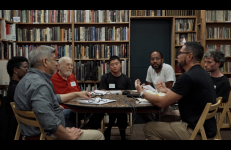
Gay Tape: Butch and Femme is Cecilia Dougherty's first video work. She was immersed in two things at the time: making artwork, and being a part of the Oakland, California lesbian bar scene. The tape is the child of those two activities. Dougherty asked her friends, Ann and Joanne, and her girlfriend at the time, Rosa, to speak on camera about dating and the emergence of butch-femme relationships, which alluded to not so much a regression to old-time lesbian subculture, as to a quotation of those times, and an appreciation of that kind of lesbian eroticism.
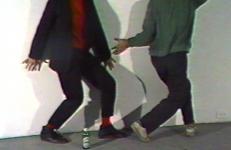
This two-part video Gender Cruise on the Circle Line involves Brenda and Glennda leading a group of drag queens, drag kings, and other gender nonconforming people on a three-hour ride on the Circle Line boat around Manhattan.

The two-part video Gender Cruise on the Circle Line involves Brenda and Glennda leading a group of drag queens, drag kings, and other gender nonconforming people on a three-hour ride on the Circle Line boat around Manhattan.
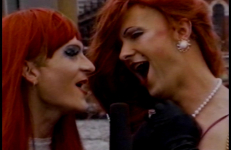
German Song, 1995
Shot in black and white Super 8, this lyrical short follows a wandering, disengaged youth through grey afternoons. German Song features the hard-edged music of Come, an alternative band from Boston.

Girl Power, 1992
Set to music by Bikini Kill (an all-girl band from Washington), Sadie Benning's Girl Power is a raucous vision of what it means to be a radical girl in the 1990s. Benning relates her personal rebellion against school, family, and female stereotypes as a story of personal freedom, telling how she used to model like Matt Dillon and skip school to have adventures alone. Informed by the underground “riot grrrl” movement, this tape transforms the image politics of female youth, rejecting traditional passivity and polite compliance in favor of radical independence and a self-determined sexual identity.
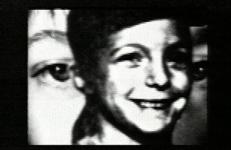
The Girls at the Dock, 1993
In The Girls at the Dock, Teramana features performers at The Dock, a popular LGBTQ+ bar and nightclub in Cincinnati, Ohio. Teramana engages in backstage banter with the performers before a Tuesday night show, especially with Sirrocco, who was a friend and neighbor of Teramana's, and whom Teramana interviewed for an earlier video piece (Sirrocco). The Dock closed in 2018.
"I never knew Tuesday night could be so much fun... but it sure didn't do much for Wednesday." –Diane Teramana
In Glennda and Bruce Do Times Square, Glennda is taken on a night tour of Times Square by author Bruce Benderson. They observe the dynamic between forms of culture that would typically be identified as “underclass” in “suburbanite” culture within the economic and spatial landscape of New York City. Glennda and Bruce visit the apartment of performer Consuela Cosmetic, who was prolific within New York’s ball scene. She maps out the ways in which she believes gender can be expressed, and discusses the implications of ‘passing’.
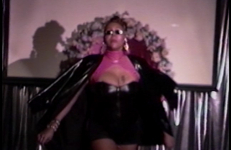
In this video, Glennda Orgasm and social critic Camille Paglia walk the streets of downtown Manhattan and discuss the status of mainstream feminism in the early 1990s. They visit the Stonewall Inn, Washington Square Park, and a gay bookstore, and confront a group of anti-pornography protesters.
An episode of Glennda and Friends, hosted by Glennda Orgasm and Camille Paglia. Featuring The Centaurians, Brian Roach, and Rennard Snowden.