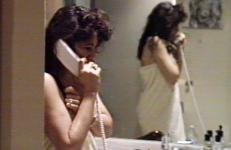



Filmed in Susan Mogul’s Los Angeles multi-ethnic working class neighborhood, Highland Park, Everyday Echo Street: A Summer Diary, is an insider’s view of how home and neighborhood are constructed in everyday relations. Composed of conversational and anecdotal portraits of neighbors and merchants, Susan ruminates about the past and the present, as she looks out her apartment window. Struggling to arrive at a new definition of “home,” she ponders loss, middle age, and living alone.
Autobiography
Excess, 2009
A rumination via handwritten index cards and an assortment of images recalling histories and ambitions of varied film productions.
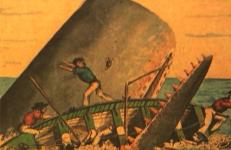
Feathers: An Introduction is a self-portrait centered on the story of Latham's grandmother’s comforter which, old and worn, scatters feathers everywhere. Displaying an arresting stage presence, Latham addresses the viewer as a potential friend or lover, speaking in a soft-spoken near-whisper, and gingerly touching and kissing the camera lens and monitor. Then, almost mocking the video’s intimacy, Latham gives us close-ups of herself chewing a sandwich and shaving her armpits, heightening the sense that she has been playing cat and mouse with the viewer all along.
A music-filled tour of Christmas good cheer overtakes this gastronomically oriented excursion through the winter season of discontent and yuletime yearnings craving ignition.
Film Folk, 2004
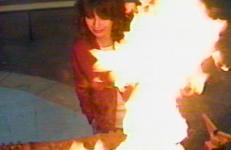
A young moviemaker discusses the horror film he hopes to open commercially. In the process he opens his lavish apartment to the hungry eyes and tummy of he who rots in the sidelights. During this discourse we feast on the vitality of youth as it restores life to the walking and digesting dead who bring maturity to both sacred and profane altars. Also along for the ride is a redheaded fleshpot in need of sudsy holy water for a good gargle.
Five True Stories, 1980
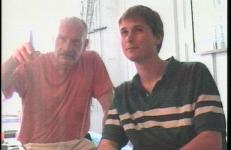
Segalove relates a tale from her childhood of a man's exposure with text (“the painter wagged it at me right here”), while an arrow blinks over a shot of the house where she grew up. Segalove narrates: “I looked down and expected to see a can of green paint. I saw a pink penis instead, peeking out of the fly of his pants... I wondered how it had got so pink; had he painted it too?” This and four other memorable stories are humorously presented in a series of video one-liners.
Forbidden to Wander, 2004
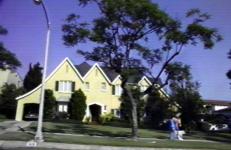
Forbidden to Wander chronicles the experiences of a 25-year-old Arab American woman traveling on her own in the occupied territories of the West Bank and Gaza Strip during the summer of 2002. The film is a reflection on the complexity of Palestinian existence and the torturously disturbing “ordinariness” of living under constant curfew. The film’s title reflects this, as the Arabic words used to describe the imposed curfew “mane’ tajawwul” literally translate as “forbidden to wander”.
Greetings from Boulder, 1986
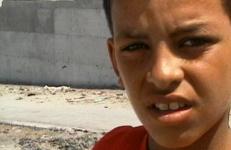
One of the earlier video diaries where George vacations in Colorado, reflects on scenery and animal life and visits people. "
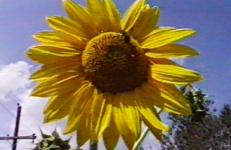
Habit, 2001
Habit is an autobiographical documentary that follows the current history of the AIDS epidemic along dual trajectories: the efforts of South Africa’s leading AIDS activist group, the Treatment Action Campaign, struggling to gain access to AIDS drugs and the daily routine of the videomaker, a veteran AIDS activist in the U.S. who has been living with AIDS for more than ten years.
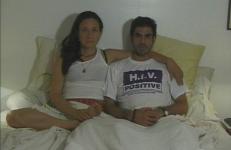
Doug Hall: An Interview, 2005
This extensive interview with California artist Doug Hall (b. 1944) provides unique insight into the culture and politics of experimental artistic production during the 1970s. Discussing the founding of the performance group TR Uthco, Hall offers context for his contribution to the field of video art, and shares stories of his collaborations with Ant Farm, Videofreex, and others. Ranging from his early years as an art student, to his romance with artist Diane Andrews Hall, to reflections on technology in art, this interview importantly extends the discourse surrounding topics of archive, performativity, and autobiography—subjects that have come to define the contours of video art today.
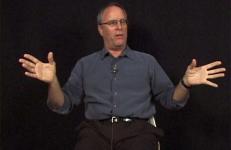
Home Movies Gaza, 2013
Home Movies Gaza introduces us to the Gaza Strip as a mircrocosm for the failure of civilization. In an attempt to describe the everyday of a place that struggles for the most basic of human rights, this video claims a perspective from within the domestic spaces of a territory that is complicated, derelict, and altogether impossible to separate from its political identity.
"... Basma Alsharif’s Home Movies Gaza, a film that captures the impossibly politicized domestic sphere of the Gaza Strip, under the constant hum and buzz of overhead drones."
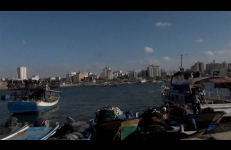
Home Safe Home, 1997
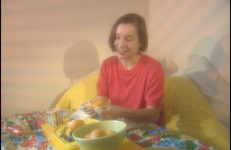
Ensconced in my urban Los Angeles bed, I recount growing up "safe" on suburban Long Island. A cameraman from KCET filmed and lit the piece. This is the only film I ever made that was not filmed by a colleague, friend, or myself. As a result, it has a very different visual sensibility than the rest of my work. Commissioned by and co-produced with KCET, a Los Angeles PBS station, for their daily magazine program Life and Times. Also presented In New York City at The Jewish Museum in the exhibition, Moving Portraits 2000.
Freed experiments with kaleidoscopic imagery while capturing images of children and herself around the home. Utilizing an infinity mirror, she creates numerous reflections of arms, legs, faces as well as other body parts and points the camera through a translucent surface to further this reflective aesthetic. Amongst intimate self portraits, Freed occasionally turns control of the camera over to the children which results in playful switching between video signals and switching lights on and off erratically.
I Remember Beverly Hills, 1980
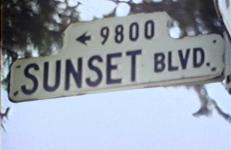
Segalove comes out as the child of a movie star haven where messy lawns are reported to the police and designer labels are removed from hand-me-downs for the maids. She reveals some of the dirt among the manicured yards, including a local custom of girls jumping from a terraced lawn at Beverly Hills High to induce miscarriages, and her friend Yasmin Hayworth’s wish that Rita was a “natural mother.”
I Stare at You and Dream, 1997
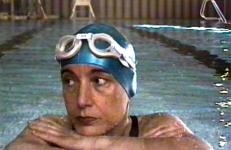
I Stare at You and Dream is a slice of life melodrama that journeys to the core of interrelationships. This film juxtaposes and links the lives of four people: the filmmaker, Susan Mogul; her friend, Rosie Sanchez; Rosie’s teenage daughter, Alejandra (Alex) Sanchez; and Ray Aguilar; Susan’s-on-and-off boyfriend. Tender and unflinching, each character gradually reveals their desires, wounds, and romantic entanglements in the context of their everyday lives.
I've Been Afraid, 2020
I've Been Afraid is a musical encyclopedia about how women get abused, and why it is they stay. It uses emojis that are as ubiquitous as abuse is in our culture.
Music by Isaac Sherman
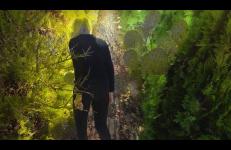
In Dreams and Autumn, 2021
In Dreams and Autumn is a three-channel synchronized video installation. A composite of the three channels presented side by side in one video is available from Video Data Bank for educational use only.
This is the last piece in the constellation of works including Kicking the Clouds, Mnemonics of Shape and Reason, and the text Hello Trouble as well as a series of etched photographs.
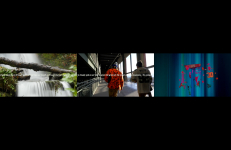
In/Out, 1997
Miller & Shellabarger, their breath made visible by the cold of a refrigerated room, exchange breath with each other.
This title is only available as an excerpt on Suitable Video, Volume 1.
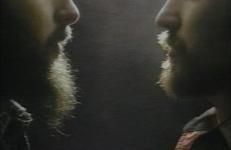
Interface, 1995
"Harun Farocki was commissioned by the Lille Museum of Modern Art to produce a video about his work. His creation was an installation for two screens that was presented within the scope of the 1995 exhibition The World of Photography. The film Interface (Schnittstelle) developed out of that installation. Reflecting on Farocki's own documentary work, it examines the question of what it means to work with existing images rather than producing one's own, new images.
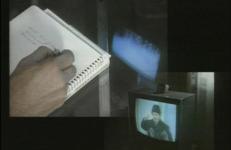
It Did It, 2000
“It Did It explores my fictional character's story before and after I took Prozac. I used the scientific method to self-evaluate whether or not I needed anti-depressants while demonstrating how it affected my storytelling.”
--Peter Brinson
This title is only available on Soft Science.
Itinerary of Surfaces, 2020
What I am//What you are//salt and sweat on my tongue.
A quarantined love letter of domestic imagination. A year of rain and other fluids. Contentment is a difficult emotion. 26 Main St. Bucksport, ME
Jollies, 1990
Benning gives a chronology of her crushes and kisses, tracing the development of her nascent sexuality. Addressing the camera with an air of seduction and romance, giving the viewer a sense of her anxiety and special delight as she came to realize her lesbian identity.
This title is also available on Sadie Benning Videoworks: Volume 1.
Kicking the Clouds, 2021
This film is a reflection on descendants and ancestors, guided by a 50 year old audio recording of my grandmother learning the Pechanga language from her mother. After being given this tape by my mother, I interviewed her and asked about it, and recorded her ruminations on their lives and her own. The footage is of our chosen home in Whatcom County, Washington, where my family still lives, far from our homelands in Southern California, yet a home nonetheless.
Kiss The Boys And Make Them Die explores how memory, sexuality, and the self are created and enforced through the family story. The video chronicles how the social act of loving women becomes channeled into narratives of incest, desire for the mother, loss of the father, separation from the family, death and self-destruction. In this work, sexuality, difference and language are paralleled with haunting memories of a childhood ghost that both desires and hates women.
L.A. Screening Workshop, 1988
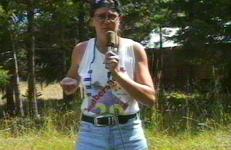
George spends a week in Los Angeles on business and at eating engagements. “I eat in Beverly Hills and do my business behind closed doors for a change....”