



Laura Mulvey published her seminal essay "Visual Pleasure and Narrative Cinema" in 1975; it has subsequently become one of the most influential work in film theory. Using a psychoanalytic methodology to discuss spectatorship, it was groundbreaking in its feminist critique of the sadistic, misogynistic mode of classical Hollywood cinema in which women were objects of fetishistic display for male viewers’ pleasure. She has also written extensively on melodrama, published three books, and co-directed six films, including Riddles of the Sphinx with Peter Wollen (1974).
Interview
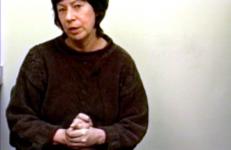
Elizabeth Murray (1940-2007) was an American painter, printmaker and draughtsman. She studied at the Art Institute of Chicago (1958–62) and at Mills College, Oakland, CA (1962–4). Elizabeth Murray’s paintings have been referred to as “dandyish abstraction.” Her work is distinctive in its use of color, shape, and surface to evoke human characteristics, personalities or humor.

Elizabeth Murray (1940-2007) was an American painter, printmaker and draughtsman. She studied at the Art Institute of Chicago (1958–62) and at Mills College, Oakland, CA (1962–4). Elizabeth Murray’s paintings have been referred to as “dandyish abstraction.” Her work is distinctive in its use of color, shape, and surface to evoke human characteristics, personalities or humor. Murray is particularly well known for her shaped canvases, which date from 1976, on to which are painted both figurative and non-figurative elements.

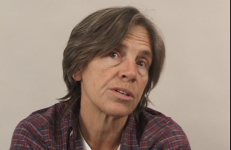
In this interview, American writer, artist, performer Eileen Myles (b.1949) discusses the various philosophies that motivate her work, including the language of film, embodied performance, and the alienation evoked by bodily vulgarity. Myles links her wide range of artistic and literary practice with notions of abstraction, improvisation, and the mythology of gender, which she explores in relation to her own identity as a working, middle-class lesbian woman. She reflects on the significance of geographical locations, both New York City and San Diego, on her art, and shares how her past struggles with addiction have shaped her life and practice.
Alice Neel: An Interview, 1975
Alice Neel (1900-1984) is known for portrait paintings of well-known persons and eccentric New York street types. Neel worked as a figurative painter throughout the decades of WPA realism, postwar abstract expressionism, 1960s Pop, and 1970s minimalism. She persevered in her work despite a turbulent personal life and critical neglect that continued until the 1960s. Neel lived and worked in New York City from 1932 until her death in 1984.

In 1973 Joan Nestle co-founded the Lesbian Herstory Archives, an essential collection of documents, writings, and artifacts of lesbian cultural history. In 1979 she began writing erotic stories and has published two collections of writings: A Restricted Country (1987) and A Fragile Union (1998). She took a controversial stance in opposition to the 1980s feminist anti-pornography movement, thus becoming a fervent pro-sex activist in the “Sex Wars.” Interview by Nina Levitt.
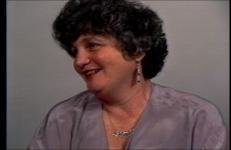
A historical interview originally recorded in 1983.
Interview by Joan Livingstone.

Growing up in the early computer age, around machines like the Commodore 64, had a formative effect on Marisa Olson and her subsequent artistic career. Now operating across a diverse spectrum of media including video, performance, and even the internet itself, she creates work that simultaneously comments upon and instrumentalizes the potential of digital machines as well as the global networks they’re linked to. However, her work is not circumscribed within the boundaries of these systems’ technical specificity.

Dennis Oppenheim was a prominent figure in various art developments throughout the ’70s. Oppenheim moved through body/performance art and related video work to earthworks to his current large-scale “factories.” In all of his work, the transference of energy is an underlying concern.

Orlan: An Interview, 1998
French performance artist Orlan uses her own body as a sculptural medium. Since 1990, she has worked on La Reincarnation de Sainte-Orlan, a process of plastic surgeries that she “performs,” making elaborate spectacles with surgeons dressed in sci-fi costumes and broadcasting the operations live via satellite to galleries worldwide. By exploring a total transformation of self, Orlan delves into issues of identity and the malleability of the flesh. She lives and works in Paris, exhibiting and performing internationally.
Interview by Shay Degrandis, via translator.

Eiko Otake: An Interview, 2022
Born and raised in Japan and a resident of New York since 1976, Eiko Otake is a movement-based, interdisciplinary artist. She worked for more than 40 years as Eiko & Koma, but since 2014 has been working on her own projects. Her works often investigate themes of death and dying, history, and the persistence of collective memory. Eiko has also broadened her collaborative practice to create interdisciplinary work with artists from different backgrounds and disciplines, both alive and deceased.

Ulrike Ottinger is a prolific German filmmaker whose work includes Madame X (1977), Ticket of No Return (1979), Freak Orlando (1981), Johanna D'Arc of Mongolia (1989), Countdown (1989), and Exile Shanghai (1997). Starting her visual arts career in Munich and Paris in painting, photography, and performance, Ottinger’s commitment to film took off with her move to Berlin.
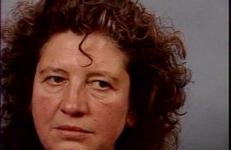
Craig Owens (1950-1990) was a critic who wrote and lectured extensively on contemporary art. He showed particular interest in the issues of photography, postmodernism, feminism, and Marxist thought. A former associate editor for October and senior editor for Art in America, as well as professor of art history at Yale University and Barnard College, his writings were collected in Beyond Recognition: Representation, Power, and Culture (1994). Owens died of an AIDS-related illness in 1990.

Betty Parsons (1900-1982) was an influential art dealer in mid to late 20th century New York. She used her gallery as an influential advocate for the abstract avant-garde, and was renowned for championing new styles and new artists well before they received wider recognition or commercial success. Notable examples of Parson's circle include abstract expressionist giants Barnett Newman, Jackson Pollock, Mark Rothko and Clyfford Still.

Ed Paschke: An Interview, 1982
Polish-American arist Ed Paschke (1939-2004) received his BFA from the School of the Art Institute of Chicago in 1961 and his MFA in 1970. Paschke was known as a member of the late-1960s Chicago Imagist movement, a group of artists who called themselves The Hairy Who, whose expressive style of figurative painting was rooted in outsider art, popular culture, and Surrealism. Paschke's fascination with the print media of popular culture led to a portrait-based art of cultural icons. Paschke used the celebrity figure, real or imagined, as a vehicle for explorations of personal and public identity with social and political implications.

Philip Pearlstein (b.1924) began painting figures in the 1960s and is known as a leading figure in American Realism. Throughout his career, Pearlstein's paintings evolved from an expressionistic style to a meticulously analytical vision. His work attempts to present the model as a documentation of the painting session, and his paintings are closely rendered under the existing studio lighting. Attuned to art history, Pearlstein is as interested in pattern and composition as he is in the body itself.

In this episode of The Live! Show, hosted by Jaime Davidovich, Eric Bogosian brings seven characters to life in seven minutes, Michael Smith plays the best driver in the world, Mitchell Kriegman offers a helping hand during the show’s popular call-in segment, and Louis Grenier demonstrates the organic face lift viewers can do at home.

Media artist Cyrille Phipps has been involved with numerous alternative media and lesbian activist projects, including Dyke TV and the Gay and Lesbian Emergency Media Campaign. Her video projects include Respect Is Due (1991), Black Women, Sexual Politics and the Revolution (with Not Channel Zero, 1992), Our House: Gays and Lesbians in the Hood (with Not Channel Zero, 1992), Sacred Lives, Civil Truths (with Catherine Saalfield, 1993), Dreaming Ourselves...
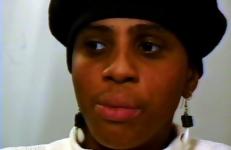
A philosopher and intermedia artist, Adrian Piper focuses on xenophobia, racism, and racial stereotyping
“As a black woman who can 'pass' and a Professor of Philosophy who leads a double life as an avant-garde artist, Piper has understandably focused on self-analysis and social boundaries. Over the years her work in performance, texts, newspaper, unannounced street events, videos, and photographs has developed an increasingly politicized and universalized image of what the self can mean.”

Spanish artist Jaume Plensa (b. 1955) creates sculptures and installations that intend to unify individuals through their relationship to memory, the body, and spirituality. Often referencing literature, psychology, biology, and history, his practice speaks of a shared humanity despite the world’s complexity. In this way, language acts as a metaphor, and the human figure a universal symbol. Plensa is perhaps best known for works that engage groups of people in public spaces.

Ingrid Pollard is a photographer living in London. Her photographic works, generally of people and landscape, serve to provide a human context for issues of transmigration and “fleeting” identity. Combining personal photographs with traditional views of the English countryside, Pollard questions as well as reconstructs the concept of “Britishness.” In doing so, Pollard also scrutinizes the location of the “other,” and contrasts actual physical similarity or material likeness of people and places with perceived or socially constructed difference.

Tom Poole: An Interview, 2002
Tom Poole is an organizer of many things. Counting arts administrator, media facilitator, and activist among the many titles he has held over the years, Poole currently brings all these capacities to bear as the executive director of the Pittsburgh Community Television (PCTV) station. In his contribution to the On Art and Artists series, Poole discusses his early foray into media activism as a member of the video art collective Black Planet Productions.

In this experimental interview with Jill Ker Conway, Freed outlines a portrait in chalk on a black surface as the soundtrack conveys Conway describing her fascination with the way ones visual self appears on camera and the way an artist perceives their subject. When the sketch is complete, Freed begins to apply paint, revealing Conway’s actual photograph beneath the chalk outline through a chroma-keying technique.

Richard Prince appropriates images from commercial advertising and travelogues for his photographs. Choosing these images for their melodramatic, super-real power, he then isolates their stylistic realism to accentuate its rhetoric. In this portrait/performance, Prince narrates experiences that demonstrate his extreme sensitivity to appearances and context. He relates the event of buying his first car as the imprinting of a certain aesthetic impression.
This title is also available on Crossover Series.

Arlene Raven (1944-2006) was a feminist historian, theoretician, poet, and art historian who has published numerous books on contemporary art and written criticism for The Village Voice and a variety of other newspapers, art magazines, exhibition catalogues, and scholarly journals since 1969. She is a pioneer in progressive education and was an architect of the educational programs of the Feminist Studio Workshop, an independent school. She is also the founder of the Women’s Caucus for Art, the Los Angeles Woman’s Building, and Chrysalis magazine.
