



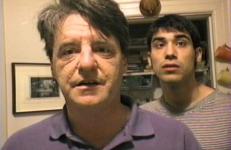
I arranged a visit to poet/novelist Kevin Killian’s South of Market apartment in San Francisco to shoot a portrait of him, and when I arrived he had a guest, poet Cedar Sigo. They had corresponded earlier, but were meeting for the first time, and Cedar agreed to participate in our video shoot. This is perhaps the least planned, most verité and documentary of the videos about writers so far. Our immediate plan was for Kevin to read one of Cedar’s poems and for Cedar to read one by Kevin.
Interview
The interstice of art and technology has proved to one of the most generative locations in contemporary transdisciplinarity. As media of all kinds become more electronically integrated and digitized across multiple platforms, current technologies approach a condition of complete imbrication with art practices, and vice versa. Ben Knapp and Andy Diaz Hope have been at the forefront of these techno-aesthetic interactions, and their career experience as hard-science engineers brings a level of practical competence to this interview that is truly enlightening.

In this interview, Phyllis Kornfeld, author of Cellblock Visions: Prison Art in America, describes her initial interest in working with prisoners in her native Oklahoma City, stemmed from an exploration of outsider artists. Detailing her first visit to a high security prison as a ‘mind blowing and breathtaking’ experience, Kornfeld discusses how she came to her realization that prisons are fertile environments for free form experimentation with the teaching process. She learned that through personalized art education, inmates could teach themselves to make positive contributions to society. - Kyle Riley

Joyce Kozloff was at the forefront of the 1970s pattern and decoration movement—a feminist effort to incorporate typically “feminine” and popular decorative arts into the fine arts. She has been involved with public art and murals for more than two decades. In this video, Kozloff prepares and installs her mural Around the World on the 44th Parallel, which features sections of maps from 12 cities around the world on the same latitude. The work was constructed at the Tile Guild in Los Angeles and installed at the library at Minnesota State University-Mankato.

Lee Krasner (1908-1984) was born in New York and attended Cooper Union, the National Academy of Design, and the Hofmann School to study painting. Married to Jackson Pollack, Krasner's own practice was largely overlooked by the art world during her lifetime. She is one of the few women to play a major part in the transition from Modernist painting of the 1930s to the eventual triumph of Abstract Expressionism in the 1950s. Krasner, with Pollack, launched the New York School after World War II.

At nineteen, Barbara Kruger (b. 1945) worked as a commercial artist designing for Conde Nast. The risky combination of contemporary art, commercial appeal and social critique runs throughout Kruger’s photography, readings, poetry, collages, and conversation. Her works uses advertising both as a foil and a format. Language and image work together, referencing the manipulations of the advertising media.

For Shigeko Kubota the video image-making process is a cultural and personal experience. She has explored cross-cultural relationships in her video diaries, transient images captured by portable equipment while traveling—Kubota’s “comparative videology.” She has also combined fleeting video images with the “objecthood” of sculptural form in her series of video sculptures inspired by Duchamp.
Beloved by filmmakers such as John Waters and Todd Solondz, George Kuchar has been working with the moving image for nearly half a century. In the 1950s, Kuchar and his twin brother Mike began producing ultra-low-budget underground versions of Hollywood genre films, with names like I Was a Teenage Rumpot and The Devil's Cleavage.

Steve Kurtz is a founding member of the Critical Art Ensemble and Associate Professor of Art at University of Buffalo. His areas of focus are contemporary art history and theory as well as post-studio practices. As a student Kurtz collaborated with Steve Barnes on low-tech videos, which they developed into a broad-based artist and activist collective known as the Critical Art Ensemble.
Interview by Gregg Bordowitz.
A historical interview originally recorded in 1999 and re-edited in 2005.

Lanesville TV News Buggy, 1972
“Trolling for news we call it,” says Bart Friedman a minute into this video, as he pushes down a road the Lanesville TV News Buggy – a baby carriage filled with video equipment, spilling over with wires. The buggy allows for easy transportation of equipment as the Videofreex make their way throughout Lanesville, interviewing residents on their daily activity. Although fairly ordinary – a visit to the lake, a small bit about a neighbor’s new electric golf cart, and an introduction to a newborn baby – the footage has an air of genuineness and all of the interactions are amicable.

On January 26, 1973, the Videofreex’s installment of Lanesville TV (Channel 3) consists of an interview with a follower of the Divine Light Mission, a semi-religious organization lead at the time by then-17-year-old Guru Maharaj Ji.

Laurie, 1998
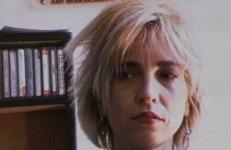
Laurie was inspired by Laurie Weeks’ uncanny ability to simultaneously embody her characters and write them from a clear distance. The text in question is just a few paragraphs from a draft of the novel Zipper Mouth, more than ten years in the making, and published by the Feminist Press.
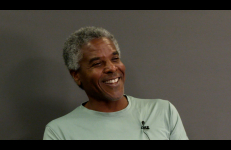
Lawrence Andrews’ work includes video, photography, installation, audio projects, and animation, focusing on issues of race, identity, and power. In this interview, he offers a deeply personal and reflective account of his journey from a politically charged childhood in Washington, D.C. to his expansive artistic and academic career.
Tom Lawson: An Interview, 1983
Scottish artist Thomas Lawson (b. 1951) is a painter, critic, and founding editor of REAL LIFE magazine who lives and works in Los Angeles. His paintings are tied to the particularities of the present, and he is especially critical of the art world’s infatuation with ego and creativity. His portraits, appropriated from the print media, represent an intervention in that vein.

Elizabeth LeCompte is the director of the Wooster Group, an experimental theater company that operates out of its own theater, the Performing Garage, in New York City. The group’s working process begins with "source" texts which are quoted, reworked, and juxtaposed with fragments of popular, cultural and social history, and combined with personal and collective experiences of the group. The resulting productions reflect a continuing refinement of a non-linear, abstract aesthetic that at once subverts and pays homage to modern theatrical "realism."
Interview by Lin Hixson.

During a conference in the late 1970s, Carol Leigh (also known as the Scarlot Harlot) coined the term “sex worker.” Now, it is a fundamental part of the lexicon regarding all worker’s rights and this is owed in large part to Leigh’s artistic and activist career. Working primarily through the medium of performance and video – her work attempts to educate and broaden audiences’ understanding of sex work and the fundamental rights sex workers deserve. This interview is a distillation of those aims.

Leslie, 1998
In the early 1990s, I went to a reading by Leslie Scalapino at Intersection for the Arts in San Francisco. I could not understand the writing, which can seem difficult and unwieldy to a reader unaccustomed to language poetry, and understood less the more I tried. After a certain point in the reading I stopped trying to figure it out and I let the words seep in. My reward was an effortless understanding of how her poetry works.
Sol Lewitt: An Interview, 1977
American, minimalist painter Sol Lewitt (1928-2007) used the grid as a foundation for his many artworks. Seeing himself in the role of architect or composer, Lewitt was most concerned with the concept behind the piece rather than the final product. His geometrical compositions stripped away extraneous information and presented the bare essentials.

Freed intercuts still color imagery of Roy Lichtenstein’s paintings with a close quarters interview conducted in Southampton, N.Y in Summer 1972. Lichtenstein discusses the creation of his work, points of inspiration and his recurring aesthetic choices. Freed interrogates Lichtenstein’s overt references to the work of other artists in his painting, questioning his intentional evocation of cliche as he tried to define the genesis of this particular approach.

Linda Montano is interviewed by Janet Dees, Curator at the Mary and Leigh Block Museum, Northwestern University.
Since the 1960s, Linda Montano has aimed to blur the distinction between art and life with her performance and video work. Delving deep into subjects like death, spirituality and personal trauma, she is seen as an influential figure in feminist performance art.

Lucy Lippard (b. 1937) earned degrees from Smith College and New York University before beginning her career as an art critic in 1962, when she began contributing to publications such as Art International and later, Artforum. In 1966, she organized an exhibition entitled Eccentric Abstraction at the Fischbach Gallery in New York City.

Lucy Lippard (b. 1937) earned degrees from Smith College and New York University before beginning her career as an art critic in 1962, when she began contributing to publications such as Art International and, later, Artforum. In 1966, she organized an exhibition entitled “Eccentric Abstraction” at the Fischbach Gallery in New York City. “Eccentric Abstraction” set the standard for what would later be regarded as postminimalism, process, or antiform art.

Writer and activist Lucy Lippard divides her time between Boulder and New York City. She narrates a reading set to selected “politically motivated” art works. Interview by Jim Johnson.

Sharon Lockhart is a photographer and filmmaker. Her photographic and filmic works interrogate the inversion of the static image as cinematic and the manipulation of the moving image into a static/stop-motion frame. Her work also contemplates how we perceive our own real-time realities.

Rick Lowe: An Interview, 1997
Awarded a MacArthur “Genius” Fellowship in 2014, Rick Lowe is a leading practitioner of social practice art. His Row Houses project is a highly lauded example of relational aesthetics successfully deployed. This interview focuses particularly on that work and the artist’s entrance into social practice.
