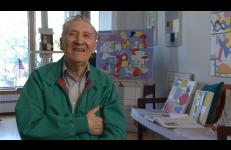



Charles Simonds (b.1945) majored in art at the University of California at Berkeley. There he discovered an area of clay pits that had once provided the raw material for some of Manhattan's older buildings. He literally immersed himself in the subject, burying himself in a pool of wet clay to get a feel for the material. Simonds's sculptures are enchanting architectural minatures. Most are landforms with small chambers and towers; some are abstract organic shapes. Carefully built brick by tiny brick, Simonds's sculptures engage the child in everyone.
Interview
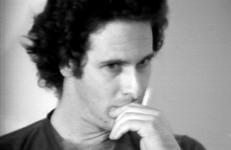
Sirrocco, 1985
Sirrocco was a drag performer and club icon in Cincinnati, Ohio during the 1980s and 1990s, and was also a close neighbor and friend of Teramana’s. In a series of short interviews, Sirrocco talks about visiting her hometown in Kentucky, hormone therapy, and dating as a transgender woman.

Ingrid Sischy was editor of Artforum in the 1980s and has been editor-in-chief of Interview magazine since the 1990s. In this interview with Robin White, Sischy discusses Artforum’s priorities, purpose, and goals.
“It’s an intricate history where painting, sculpture, performance, video, and photography are extremely connected to each other. As the editor of Artforum, I would feel at great fault to not include the best and the most interesting questions of each because they affect each other, and artists’ choices are not made in a vacuum.”

For the past 20 years Alexis Smith's mixed media work has explored primal American myths: the open road, the bad/good guy/gal, the quest for romance, and the search for paradise. This portrait of the artist explores the roots of her thought and work, and was produced in conjunction with her exhibition at the Whitney Museum of American Art, held in November 1991.
Washington, D.C.-based African-American artist Sylvia Snowden paints what she calls “figural or structural abstract expressionist” works. Three years after this tape was produced, her son was shot to death, and she spent the next three years producing 87 works in a variety of media.

Best known for her drawings and prints, Nancy Spero (1926-2009) worked as an oil painter on both paper and canvas and with installations. As both artist and activist, Nancy Spero's career spanned fifty years. Spero was active in many radical groups including WAR (Women Artists and Revolution) and AIR (Artists in Residence), the first women’s cooperative gallery in New York. She was renowned for her continuous engagement with contemporary political, social, and cultur

Sphinxes Without Secrets, 1990
Sphinxes Without Secrets is an energetic and transgressive acount of outstanding female performance artists, and an invaluable document of feminist avant-garde work of the 70s and 80s. No Mona Lisa smiles here, as performance artists spill their guts about what outrages and delights them. Performers, curators, and critics unravel the mysteries of a new art form and ponder the world women confront today. Since its inception, performance art has provided a forum for artists who create work that challenges the dominant aesthetic and cultural status quo.
Art Spiegelman was born and raised in New York, and began working as a cartoonist while still in High School. He attended the State University of New York in Binghamton, where he studied Philosophy. Spiegelman, who continued to work as a cartoonist, mainly in underground publications, throughout his schooling, has long been acknowledged as one of our era's foremost comic book artists. However, it was Maus, published in two volumes in 1986, that first brought his work to a mass audience. Maus tells the stories of a Jewish survivor of Nazi Germany and his son.
Pat Steir (b.1938) is an American painter and printmaker, whose work has resisted artworld currents and factions for decades while maintaining enthusiastic critical support.

Pat Steir (b.1938) is an American painter and printmaker, whose work has resisted artworld currents and factions for decades while maintaining enthusiastic critical support. She graduated from Pratt in 1962 and in 1964 was included in the show Drawing at the Museum of Modern Art in New York and had her first solo exhibition at the Terry Dintenfass Gallery, New York. She first came to prominence in the 1970s, when her work concentrated on signs and symbols and was close to minimal and conceptual art.

Pat Steir is an American painter and printmaker whose work has resisted artworld currents and factions for decades, while expanding its reach and maintaining enthusiastic critical support. She graduated from Pratt in 1962, and in 1964 was included in the show Drawing at the Museum of Modern Art in New York and had her first solo exhibition at the Terry Dintenfass Gallery, New York.

Born in Los Angeles in 1933, Michelle Stuart spearheaded the use of non-traditional materials from nature in the early '70s, and has produced and exhibited her work internationally.

Su Friedrich (b. 1954) is an American experimental filmmaker whose career has spanned over four decades. Her work is both personal and political, integrating autobiographical and archival elements with questions as to the nature of identity and representation. Beginning with her first film Hot Water in 1978, Friedrich has directed eighteen films and videos. She has since become a leading figure of both queer and avant-garde cinema.

John Tagg: An Interview, 1988
John Tagg is a writer, educator, and a leading contributor to the development of art-historical and photographic theory, focusing on political analysis of institutionalized culture and interventions within it. He is a professor of art history at State University of New York-Binghamton and author of Grounds of Dispute: Art History, Cultural Politics and the Discursive Field (1992) and The Burden of Representation: Essays on Photographies and Histories (1988). Interview by James Hugunin.
A historical interview originally recorded in 1988.

Kidlat Tahimik is a Filipino filmmaker, writer and actor who takes his name from the Tagalog translation of “silent lightning.” Known as the “Father of Philippine Independent Cinema,” his contemplative films are associated with the Third Cinema movement for their examination of neocolonialism and the Hollywood business-model of filmmaking.

This tape is a media arts collaboration between Joe Leonardi, Cathleen Kane, and radio artist Joe Frank. It is a synthesis of three “dark humored” radio pieces adapted for video.

Time and Space Concepts, 1978
This tape was produced by Artists TV Network, documenting a symposium that included composer John Cage, choreographer Merce Cunningham, writer Richard Kostelanetz, and video artist Nam June Paik with art critic Dore Ashton serving as moderator. This freewheeling symposium taped before a live audience ranges from individual reminiscences to discussion of then-current art community concerns about music, literature, theater, art, dance, video, and technology.

Rirkrit Tiravanija’s work explores the social role of the artist, and that role’s ability to create interactive spaces for people to come together. Focusing less on the construction of discrete objects, he maintains a practice predicated on diffuse forms of installation that facilitate the activities like cooking, reading, and general collectivity. The particularly conceptual nature of his work is a central theme in this interview. While in art school, a teacher Tiravanija greatly admired told him to “stop making art” and this was something he took very seriously.

Danny Tisdale is a performance artist from New York City. His performances challenge prevailing ideas of race, assimilation, appropriation and success by offering passers-by the chance to racially change their appearance as a means to achieve greater financial success. The mimicry of museological practices of cataloguing and preservation, display and presentation provides one of a range of rhetorical frameworks upon which Danny Tisdale hangs his practice of social critique.

Fred Tomaselli’s mosaics and collages compose patterns and images that suggest ancient global influences. His materials, however, are products of modern consumption, addiction, bodily abuse, and pleasure: pills, nicotine patches, bandages, and the like. The surfaces are coated with a lacquered veneer, making these mundane sources of highs or healing gleam. Interview by James Rondeau. A historical interview originally recorded in 1999 and re-edited in 2007.
Allan Trachtenberg is one of the most esteemed figures in contemporary photographic history and cultural studies. He received an Andrew W. Mellon Foundation Emeritus Fellowship for his continuing work on Wright Morris. Other honors include fellowships from the American Council of Learned Societies, the National Endowment for the Humanities, the Rockefeller Foundation and the Guggenheim Foundation. Trachtenberg is the Neil Gray, Jr. Professor Emeritus of English and American studies at Yale University, where he taught for thirty-five years.

In this interview, Los Angeles-based artist and filmmaker Ryan Trecartin (b. 1981) discusses his personal interests and motivations, as well as the larger cultural and philosophical concerns that shape his videos and their reception. Trecartin is known for his construction of non-linear narratives, campy costumes, and excessively visceral characters and environments. One of the most compelling aspects of this interview is his insistence that language and its verbal articulation, rather than the visual, anchor his process. Trecartin identifies the influences of 1990s retro-rave culture, hip-hop videos, and editing software tools on his work. He notes that the accelerated disintegration of high and low culture has played a major part in his growth as an artist.

The Trial of Tilted Arc, 1989
The artwork on trial is Richard Serra's public sculpture, Tilted Arc, commissioned and installed by the U.S. government in 1981. Four years later, a public hearing was held to consider the removal of the sculpture from its site in Federal Plaza in New York City. In documenting the climatic General Services Administration hearing, The Trial Of Tilted Arc is a thought-provoking indictment of the state of the arts.
Originally trained as a musical composer, receiving her MFA and Ph.D. from the University of Illinois, Champaign-Urbana, Trinh T. Minh-ha (b. 1952) is a world-renowned documentary feminist filmmaker and expert on avant-garde and third world post-colonial film theory. In 1970, Minh-ha came to the United States from Vietnam at the age of seventeen. Since then she has been involved in film, musical composition, social theory, and critical writing.

tryphon: three sounds is a candid portrait of the artist Thomas H. Kapsalis (b.