


Humor

The filmmaker accepts the challenge of the philosopher and changes not only a table but also chairs, shoes, jugs, teapots and almost everything else lying around his house.

"What prevents me from supposing that this table either vanishes or alters its shape when no one is observing it and then when someone looks at it again changes back? But one feels like saying – who is going to suppose such a thing?"

— Ludwig Wittgenstein, On Certainty (Oxford: Blackwell, 1969)

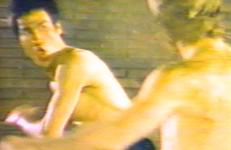
Using footage from the legendary Bruce Lee’s last, unfinished, film, Fulbeck turns the subtitled martial arts movie on itself—levelling criticism and commentary with the genre's own tools, and examining the various representative functions of the late actor.

“To master the one-minute time span requires considerable discipline, and few pieces, if any, had been shaped as genuine miniatures—most having the appearance of being extracts from larger works. The notable exception was John Smith’s Gargantuan, which was not only the right length for the idea, but actually incorporated a triple pun on the word ‘minute.’”

— Nicky Hamlyn, “One Minute TV 1992”, Vertigo (Spring 1993)

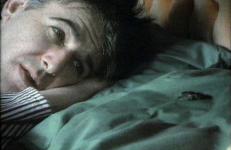
"A wonderfully witty example of how to conduct pillow talk with a small amphibian."

— Elaine Paterson, Time Out London

This very funny video plays with the identification of the camera as phallus, as an instrument of power and domination intruding upon reality; never an innocent bystander, it is always the organizing locus of events. Over sequences in which the camera/viewer approaches entrances to houses, shops, and other buildings, the soundtrack carries the moans of a man and woman reaching orgasm. The pitch and urgency of their moaning increases as the camera nears and finally penetrates its target.

“In The Girl Chewing Gum a commanding voiceover appears to direct the action in a busy London street. As the instructions become more absurd and fantasized, we realize that the supposed director (not the shot) is fictional; he only describes—not prescribes—the events that take place before him. Smith embraced the ‘spectre of narrative’ (suppressed by structural film) to play word against picture and chance against order.

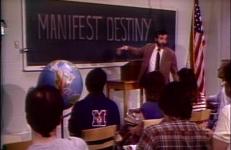
Smith’s gentle, recusant comedy is a critique of masculine domination, focusing on the myth of manifest destiny. Believing the moral of the Old West that “Everything is there for the taking”, mild-mannered Mike is inspired to “Go for it!" and conquer wide-open spaces in the modern way: as a real estate developer of suburban sub-divisions. Dressed as a cowboy and mime-riding a horse in front of images of mobile homes, Smith updates the notion of “rugged individualism” to include personal theme music and a chorus.

A meditation on the nature of “Nature” and the uncertainty of “Cause and Effect.”

“Originally (like most of my earlier film work) this was a performance piece: text performed alongside the projected image. A complex and absurd ‘story’ about a man who thought there was something wrong with his eye. He goes to the doctor, who can’t help him much, but he finds a way he can operate on himself with uplifting yet troubling results.”

—Jennet Thomas

Super-8 and 8mm, film mattes, painting directly onto film, and model/object animation.

With an all-female cast, featuring Suzie Bright as John Lennon, Cecilia Dougherty's Grapefruit plays with the romanticized history of the iconic Fab Four, gently mocking John and Yoko’s banal squabbles and obsessive rituals of self-display. Based obliquely on Yoko Ono’s book, the piece works on many levels to reposition this mythic tale of the Beatles by casting '80s women in mod drag—effectively mapping the lesbian sub-culture onto heterosexual mass culture.

In The Great Mojado Invasion (The Second US - Mexico War), writer/performer Guillermo Gómez-Peña and filmmaker Gustavo Vazquez combine Chicano wit and political vision to create an ironic, post-millennial and postmodern look at the future of U.S./Mexican relations. Both artist and director generate a complex commentary on history, society, pop culture, the politics of language and the repercussions of ethnic dominance.

In The Great Mojado Invasion (The Second US - Mexico War), writer/performer Guillermo Gómez-Peña and filmmaker Gustavo Vazquez combine Chicano wit and political vision to create an ironic, post-millennial and postmodern look at the future of U.S./Mexican relations. Both artist and director generate a complex commentary on history, society, pop culture, the politics of language and the repercussions of ethnic dominance.

Habit, 2001

Habit is an autobiographical documentary that follows the current history of the AIDS epidemic along dual trajectories: the efforts of South Africa’s leading AIDS activist group, the Treatment Action Campaign, struggling to gain access to AIDS drugs and the daily routine of the videomaker, a veteran AIDS activist in the U.S. who has been living with AIDS for more than ten years.

Harvest, 1999

An alternative earth music video. An epic last stand. A portrait of two utilitarian workers engaging in a collaboration with Karen, manifesting improvisational geographic friendships...

This title is also available on HalfLifers: The Complete History.


Heady, 1994

"Starring an inflatable wig holder that I got at a car boot sale in Bremen, Germany, this film began as a demonstration of different film animation techniques, but evolved into a bizarre improvised narrative in which the head escapes from the violent clutches of a mixed-up model girl, is sent to Poland in a wicker basket, where it has a nice holiday (I took it on holiday to Poland with me and animated it in the countryside), and finally returns on the ferry."

-- Jennet Thomas

Super 8 film, cut-out animation, model and object animation.

"Here is Everything presents itself as a message from The Future, as narrated by a cat and a rabbit, spirit guides who explain that they've decided to speak to us via a contemporary art video because they understand this to be our highest form of communication. Their cheeky introduction, however, belies the complex set of ideas that fill the remainder of the film. Death, God, and attaining and maintaining a state of Grace are among the thematic strokes winding their way through the piece, rapturously illustrated with animation, still and video imagery." 

"Here is Everything presents itself as a message from The Future, as narrated by a cat and a rabbit, spirit guides who explain that they've decided to speak to us via a contemporary art video because they understand this to be our highest form of communication. Their cheeky introduction, however, belies the complex set of ideas that fill the remainder of the film. Death, God, and attaining and maintaining a state of Grace are among the thematic strokes winding their way through the piece, rapturously illustrated with animation, still and video imagery." 

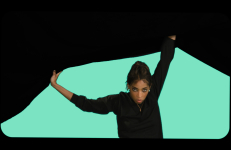
Identically dressed, and with sibling-like resemblance, performance artists Trevor Martin and Kym Olsen shift between spoken word and athletic dance choreography in a collection of 29 scenes. Set in various locations--including a gymnasium, an abandoned hospital, and a trailer park circus--Martin and Olsen slip between a ventriloquist and his dummy, a seducer and his surrogate, a doctor and his patient, and synchronized dance partners. The film examines a complex social psychology--questioning the colonization of the human body for various political, medical and religious agendas.

Identically dressed, and with sibling-like resemblance, performance artists Trevor Martin and Kym Olsen shift between spoken word and athletic dance choreography in a collection of 29 scenes. Set in various locations--including a gymnasium, an abandoned hospital, and a trailer park circus--Martin and Olsen slip between a ventriloquist and his dummy, a seducer and his surrogate, a doctor and his patient, and synchronized dance partners. The film examines a complex social psychology--questioning the colonization of the human body for various political, medical and religious agendas.

Identically dressed, and with sibling-like resemblance, performance artists Trevor Martin and Kym Olsen shift between spoken word and athletic dance choreography in a collection of 29 scenes. Set in various locations--including a gymnasium, an abandoned hospital, and a trailer park circus--Martin and Olsen slip between a ventriloquist and his dummy, a seducer and his surrogate, a doctor and his patient, and synchronized dance partners. The film examines a complex social psychology--questioning the colonization of the human body for various political, medical and religious agendas.

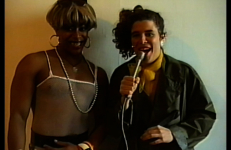
Hokey Sapp Does SPEW features Kate Schechter performing her invented media personality Hokey Sapp interviewing some of the luminaries at SPEW: The Homographic Convergence, a queer zine convention hosted by Randolph Street Gallery in Chicago in May, 1991. SPEW brought together artists, writers, editors of zines, performers, video-makers, activists, and bands from throughout the US and Canada, and marked the explosion of queercore subcultures through unabashed fashion, outrageous politics, humor, and joy.

A HalfLifers journey to a lush interior landscape where some domestic chores and an unexpected encounter provoke a crisis at Mission Control, paving the way for a seasonal reflection upon the meaning of "home."

This title is also available on HalfLifers: The Complete History.

This real-time video-meets-digital-animation trilogy of shorts features the highly excited and mildly delusional Joe Gibbons. As the phony, Gibbons recounts his influence among rock legends Iggy Pop and Brian Wilson. Brilliant superimposed computer animation by Emily Breer provides an additional layer of biting commentary.  

This rapid-montage music video for John Sex’s song “Hustle with My Muscle” portrays the singer as a ladies’ man with ample endowment to share. “Can you handle all the man below my belt?” he provocatively asks.

This title is only available on Tom Rubnitz Videoworks: Sexy, Wiggy, Desserty.

In i am wise enough to die things go (2023), Syms explores the idea of psychosis through an unnamed protagonist reciting a monologue. Responding to the work of iconic animator Chuck Jones, Syms transfers the form and narrative structure of an animated short into live-action. Working with the inherent challenges and restrictions brought about by this sort of translation, she delves into both the breaking up of images and the breakdown of the psyche.

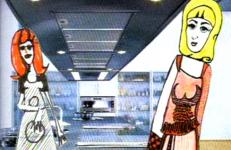
Does she ever! A tiny gem that utilises paper animation and a snippet of sound to humorous, kitschy effect.

Segalove comes out as the child of a movie star haven where messy lawns are reported to the police and designer labels are removed from hand-me-downs for the maids. She reveals some of the dirt among the manicured yards, including a local custom of girls jumping from a terraced lawn at Beverly Hills High to induce miscarriages, and her friend Yasmin Hayworth’s wish that Rita was a “natural mother.”