


Visual Art

Juan Sanchez explores his Puerto Rican heritage and the issue of Puerto Rican independence through his work as an artist and writer. Combining painting, photography, collage, and printmaking techniques, Sanchez’s art joins images of contemporary barrio life with memories of Puerto Rico, and addresses a fragmented Latino community fraught with political resistance and cultural alienation.

Interview by Bibiana Suarez.

A historical interview originally recorded in 1990.
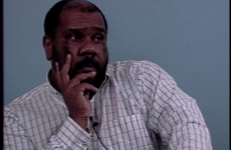
Andres Serrano was born and raised in New York. At fifteen he dropped out of high school. A few years later he attended the Brooklyn Museum School and studied painting and sculpture. After two years, Serrano decided that neither of these art forms were appropriate for his particular vision, and began to make photographs. Serrano’s work came to the attention of the general public as part of the controversy surrounding the issue of censorship and the NEA.

Joel Shapiro (b.1941) came to prominence in the early 1970s with his representational miniatures of everyday objects like chairs and houses. Since then he has become one of the most exhibited American sculptors. Shapiro’s vocabulary consists largely of rectangular volumes, with which he has created a body of work dancing on the line between abstraction and figuration. The human form has been a major theme in Shapiro’s geometric expression.

Hollis Sigler (1948–2001) was a Chicago-based artist. She received degrees from both Moore College of Art and the School of the Art Institute of Chicago. Her mature artistic style was faux-naïve, featuring paintings whose subjects, furniture and clothing set in doll-house type interiors and suburban landscapes, were stand-ins for the implicitly female figure. She was an openly lesbian artist and a prominent member of the faculty of Columbia College in Chicago.

Charles Simonds (b.1945) majored in art at the University of California at Berkeley. There he discovered an area of clay pits that had once provided the raw material for some of Manhattan's older buildings. He literally immersed himself in the subject, burying himself in a pool of wet clay to get a feel for the material. Simonds's sculptures are enchanting architectural minatures. Most are landforms with small chambers and towers; some are abstract organic shapes. Carefully built brick by tiny brick, Simonds's sculptures engage the child in everyone.

Sister City channels moments of paradoxical experience — of being a superhero or being for sale — into reverberant conduits, articulating a nature divided by panes of glass or suspended in watery solitudes. Each shift begets a kind of origin story: one encounter traces the specific azure of a James Turrell installation to a pet shop jellyfish, in another, a modern-day putto purifies a horrific tale by blowing bubbles in a tub. Sister City, like water, seeks its own level; cresting and displacing continuous bursts of life, spiritualized, succulent, and ultimately alone.

For the past 20 years Alexis Smith's mixed media work has explored primal American myths: the open road, the bad/good guy/gal, the quest for romance, and the search for paradise. This portrait of the artist explores the roots of her thought and work, and was produced in conjunction with her exhibition at the Whitney Museum of American Art, held in November 1991.


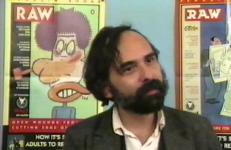
Art Spiegelman was born and raised in New York, and began working as a cartoonist while still in High School. He attended the State University of New York in Binghamton, where he studied Philosophy. Spiegelman, who continued to work as a cartoonist, mainly in underground publications, throughout his schooling, has long been acknowledged as one of our era's foremost comic book artists. However, it was Maus, published in two volumes in 1986, that first brought his work to a mass audience. Maus tells the stories of a Jewish survivor of Nazi Germany and his son.

Fred Tomaselli’s mosaics and collages compose patterns and images that suggest ancient global influences. His materials, however, are products of modern consumption, addiction, bodily abuse, and pleasure: pills, nicotine patches, bandages, and the like. The surfaces are coated with a lacquered veneer, making these mundane sources of highs or healing gleam. Interview by James Rondeau. A historical interview originally recorded in 1999 and re-edited in 2007.

In this interview, Los Angeles-based artist and filmmaker Ryan Trecartin (b. 1981) discusses his personal interests and motivations, as well as the larger cultural and philosophical concerns that shape his videos and their reception. Trecartin is known for his construction of non-linear narratives, campy costumes, and excessively visceral characters and environments. One of the most compelling aspects of this interview is his insistence that language and its verbal articulation, rather than the visual, anchor his process. Trecartin identifies the influences of 1990s retro-rave culture, hip-hop videos, and editing software tools on his work. He notes that the accelerated disintegration of high and low culture has played a major part in his growth as an artist.

The artwork on trial is Richard Serra's public sculpture, Tilted Arc, commissioned and installed by the U.S. government in 1981. Four years later, a public hearing was held to consider the removal of the sculpture from its site in Federal Plaza in New York City. In documenting the climatic General Services Administration hearing, The Trial Of Tilted Arc is a thought-provoking indictment of the state of the arts.

A short portrait of artist Anne Truitt (1921-2004). The film consists of an interview and 16mm footage made in and around her studio at the Yaddo artist colony, as well as footage from her home studio in Washington D.C.  Rather than an attempt to depict her art, which is in many respects un-photographable, the core of the film is found in Truitt speaking about the course and meaning of her work. Says Cohen, "I was honored to know Anne Truitt, and doubly so when she allowed me to make a short record of her presence and thoughts.

tryphon: three sounds is a candid portrait of the artist Thomas H. Kapsalis (b.

Jack Tworkov (1900-1982) was an important member of the first generation of Abstract Expressionist painters and was, for a number of years, head of the Yale University art program. During the Depression, Tworkov worked for the WPA Federal Art Project, and became friends with artists such as Willem de Kooning, Arshile Gorky, and Mark Rothko; their work was the foundation of the New York School of painting.  Late in his career, his work became more geometric, as the mark and gesture was increasingly determined by isometric grid structures.

This project started with an email from a stranger in 2017. The sender was the widower of the late artist Tania and he invited the filmmaker to look at her “archive.” Tania was born to Jewish parents in Poland in 1920. The family moved to Paris in the 1930s, but during the WWII they fed to Montreal, then emigrated to New York. Tania eventually became an artist. While facing many hurdles as a female artist in the 1960s and 70s, Tania vigorously created a wide range of artworks, not only paintings and three-dimensional pieces, but also public art projects.

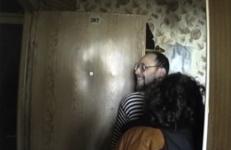
It was 1990 and, although the iron curtain was falling, Soviet official control was still iron-fisted.  Camcorder reporter Skip Blumberg went along with a group of art aficionados on a tour of the Moscow studios of the unofficial artists, an underground community of talented, courageous and often wacky conceptual artists.  His report reveals an insider’s view of the art world and, at the same time, is a video about making a video.

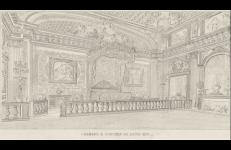
A 19th Century etching of a bedroom in the Palace of Versailles is animated and depicts the room in the midst of an earthquake. Every detail, from the moldings to the small figures in the hung paintings, trembles. Eventually all the elements — objects, furniture, decorative features — fall and pile-up on the floor. The once crowded walls are left empty, with only a few lines signifying the space. As the objects fall and break, their initial significance is questioned. The once strong, solid symbols of power and glorification fall and break to useless shreds on the floor.

Strapped for time due to her busy schedule of personal appearances, Anderson creates a rather clumsy looking clone to take over and keep up her artistic production. Anderson plays both parts, pitting the chain-smoking, productive male half against the laid-back female half. In the end, one highly successful clone begets another clone, a situation spoofing the rise and fall of the '80s art star.

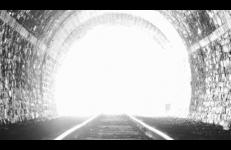
The only time I’ve visited a communist country was when I went to Poland in 1980, not long after Margaret Thatcher’s Conservative government was first elected in Britain. I first visited the former East Germany in 1997, eight years after the fall of the Berlin Wall and a few months after Tony Blair's ‘New Labour’ government was elected. Recalling these experiences many years later, White Hole questions our imaginings of life in other places, times and political systems, mirroring its narrative through its form. London and Warsaw, 1980. London and Leipzig, 1997. Where now?

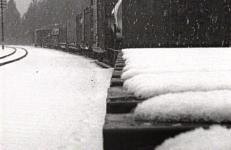
The secret history of hobo and railworker graffiti. Shot on freight trips across the western US over a period of 16 years, Who is Bozo Texino? chronicles the search for the source of a ubiquitous rail graffiti--a simple sketch of a character with an infinity-shaped hat and the scrawled moniker, "Bozo Texino"--a drawing seen on railcars for over 80 years.

Sculptor Jackie Winsor creates large-scale constructions in wood, fiber, twine, and wire. Recent works are subjected to explosions and fire. Winsor lives and works in New York City. Interview by Kay Miller and Albert Alhadeff.

This is a three-part tape shot in 1975, ’76, and ’78 as Winsor was working on three pieces: 50/50, Copper Piece, and Burnt Piece. The rhythms and rituals of her working process as well as her comments on the work are documented. Part III is the only filmic record of the final stage of construction of Burnt Piece.

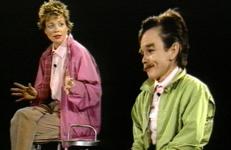
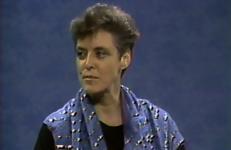
Women with a Past brings together four 20th Century artists — Yvonne Rainer, Christine Choy, Martha Rosler, and Nancy Spero — in videotaped interviews, shaped and edited by Lyn Blumenthal to examine the art of documentary. In a skillfully woven series of scenes in which the interviewer’s voice is not heard, the interviewees appear to be talking directly, intimately to the viewer. Blumenthal used short segments of each woman’s work to demonstrate how her philosophical and political stances are articulated. 

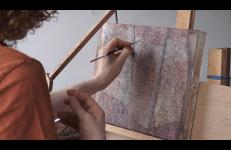
Ellen Altfest is known for her representational paintings in which she renders every detail of her subjects on a one-to-one scale. The World Must Be Measured by Eye follows the meticulous, repetitive and painstaking creative process of Altfest—the painter studies the subject, mixes paint, matches colors, measures the distance and puts the paint on the canvas with a small brush. Through observing Altfest’s practice, The World Must Be Measured by Eye examines the act of creation and the act of seeing.

Videofreex documentation from October 9th, 1971 of a crowd celebrating the opening of the Yoko Ono retrospective exhibition, This Is Not Here, at the Everson Musem of Art in Syracuse, NY.  The Videofreex document Yoko Ono’s plane landing and her getting on a bus to go to the exhibition at the Everson Museum. Once at the exhibition, we find a man inside bathing in a bathtub, who is then forced to exit by a museum official.