

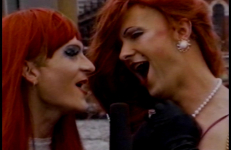
This two-part video Gender Cruise on the Circle Line involves Brenda and Glennda leading a group of drag queens, drag kings, and other gender nonconforming people on a three-hour ride on the Circle Line boat around Manhattan.
Performance
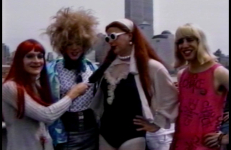
The two-part video Gender Cruise on the Circle Line involves Brenda and Glennda leading a group of drag queens, drag kings, and other gender nonconforming people on a three-hour ride on the Circle Line boat around Manhattan.
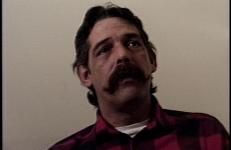
In this 2002 interview, filmmaker Joe Gibbons (b.1953) discusses his early work and the path that led him to an interest in both narrative and experimental film. Gibbons recalls how exposure to P. Adams Sitney’s Visionary Film: The American Avant-Garde while at Antioch College would compel him to begin making his own structural films. Describing his appreciation for the directness and immediacy of experimental filmmaking, Gibbons discusses a subject’s relationship with the camera as one characterized by intense intimacy.
The Girls at the Dock, 1993
In The Girls at the Dock, Teramana features performers at The Dock, a popular LGBTQ+ bar and nightclub in Cincinnati, Ohio. Teramana engages in backstage banter with the performers before a Tuesday night show, especially with Sirrocco, who was a friend and neighbor of Teramana's, and whom Teramana interviewed for an earlier video piece (Sirrocco). The Dock closed in 2018.
"I never knew Tuesday night could be so much fun... but it sure didn't do much for Wednesday." –Diane Teramana
giroscopio, 2021
giroscopio is a short experimental film by two artists, one in Pennsylvania and one in Puerto Rico, each in pandemic lockdown, each disoriented. Objects seem to control them; their bodies are unbalanced, unwieldy, comical. The horizon spins; the ground falls away; and yet a strange wonder reigns. / giroscopio es un cortometraje experimental de dos artistas, uno en Pensilvania y otro en Puerto Rico, cada uno en confinamiento por la pandemia, cada uno desorientado. Los objetos parecen controlarlos; sus cuerpos son desequilibrados, difíciles de manejar, cómicos.

giroscopio, 2021
giroscopio is a short experimental film by two artists, one in Pennsylvania and one in Puerto Rico, each in pandemic lockdown, each disoriented. Objects seem to control them; their bodies are unbalanced, unwieldy, comical. The horizon spins; the ground falls away; and yet a strange wonder reigns. / giroscopio es un cortometraje experimental de dos artistas, uno en Pensilvania y otro en Puerto Rico, cada uno en confinamiento por la pandemia, cada uno desorientado. Los objetos parecen controlarlos; sus cuerpos son desequilibrados, difíciles de manejar, cómicos.
In Glennda and Bruce Do Times Square, Glennda is taken on a night tour of Times Square by author Bruce Benderson. They observe the dynamic between forms of culture that would typically be identified as “underclass” in “suburbanite” culture within the economic and spatial landscape of New York City. Glennda and Bruce visit the apartment of performer Consuela Cosmetic, who was prolific within New York’s ball scene. She maps out the ways in which she believes gender can be expressed, and discusses the implications of ‘passing’.
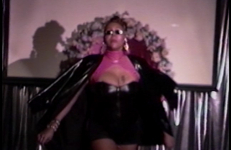
In this video, Glennda Orgasm and social critic Camille Paglia walk the streets of downtown Manhattan and discuss the status of mainstream feminism in the early 1990s. They visit the Stonewall Inn, Washington Square Park, and a gay bookstore, and confront a group of anti-pornography protesters.
An episode of Glennda and Friends, hosted by Glennda Orgasm and Camille Paglia. Featuring The Centaurians, Brian Roach, and Rennard Snowden.
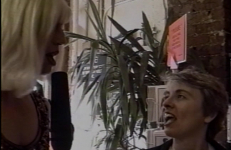
In this video, Glennda is joined by social critic and feminist scholar Camille Paglia in New York's fashion district. The pair visit designers studios to discuss their respective styles and creative processes. Additionally, Glennda and Camille explore fashion's relationship to gender and feminism, ultimately recreating an iconic scene from Breakfast at Tiffany's.
An episode of Glennda and Friends, hosted by Glennda Orgasm and Camille Paglia.
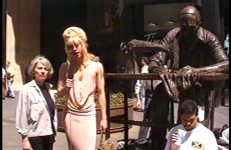
In this video, Glennda and sex activist Chris Teen attend the opening of Dress Codes at Boston's Institute of Contemporary Art. They interview museum staff, artists, and other attendees to explore how an exhibition centered upon gender nonconformity will be received by both queer communities and the general public. Glennda and Chris Teen discuss the importance of visibility for marginalized communities, and tap into gender discourses as they existed in the early 1990s.
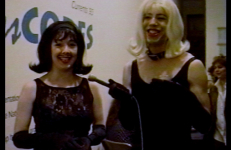
In this video, Glennda Orgasm and Chris Teen travel to Washington, DC to attend a feminist art exhibition titled Walk the Goddess Walk at the District of Columbia Arts Center. The pair talk to the owner of the gallery, artists included in the show, and attendees, including Francy Caprino, Teena Cromwell, Andrew Melon, Camille Paglia, and Joseph Virgilio.
An episode of Glennda and Friends, hosted by Glennda Orgasm and Chris Teen.
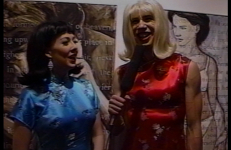
In this video, Glennda and Judy LaBruce (Bruce LaBruce) visit the auction house Christie's East on New York's Upper East Side to view Judy Garland memorabilia that is being auctioned off. They attempt to rescue Garland's Oscar from those trying to profit from the auction.
An episode of Glennda and Friends, hosted by Glennda Orgasm and Judy LaBruce.
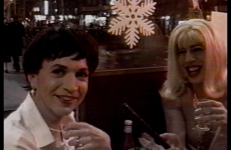
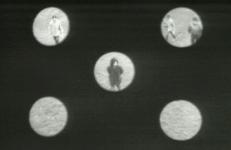
Going Around in Circles, 1973
Going Around In Circles continues Holt's interest in perception and point of view. A board with five circular holes is placed in front of the camera. The holes are covered and uncovered to reveal five people enacting a set of activities that involves walking between five spots and turning in circles.
Gone, 2001
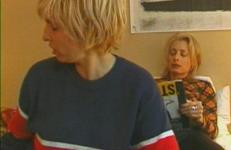
Gone is a two-channel installation based on the second episode of An American Family — the landmark PBS verité documentary about the Loud Family of Santa Barbara, California. Dougherty has created a free-form variation on the theme of parental visits to wayward queer children by mapping the dialogue and plot onto a contemporary community of artists and writers in New York today, paying homage to the art underground and the city itself.
Grace + Gravity, 2017
Grace + Gravity is a choreographed performance that reflects on Simone Weil’s poetic and profound writing entitled Gravity and Grace.
Director: Cynthia Madansky
Dancer: Idil Kemer
Voice: Lara Baladi
Cinematographer: Meryem Yavus
Sound: Zeena Parkins
Grain, 1983
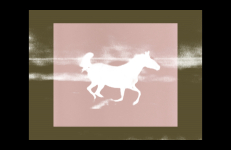
Created at Eiko & Koma's home in the Catskills and set to Gamelan music, Grain was first presented during a month-long season in an East Village loft. Charles and Stephanie Reinhart were among the ten audience members one night and invited Eiko & Koma to the American Dance Festival that year. Since then, the work toured widely.
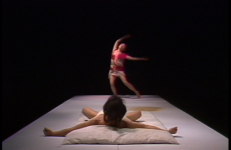
In Greetings from Lanesville, the Videofreex tour the countryside of Lanesville, New York interviewing the local people for a weekly broadcast program all from behind the wheel of the Lanesville TV Media Bus. As the first localized pirate television station, Lanesville TV brought its guerilla broadcasting to Upstate New York with interviews of ordinary townspeople in an effort to present an image of community created by the community itself.
Ground Floor, 2001
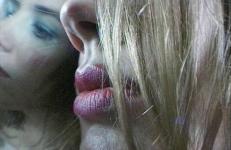
A woman is lying on her back on the floor. She seems to be tied down on the ground, but she is holding her ankles with her own hands. She wears only tights and a pair of high-heeled red shoes. Her hair-covered face makes her an anonymous victim of the camera, which is making converging circles around her body.
This title is also available on Hester Scheurwater Videoworks: Volume 1.
The Grunions are Running, 1973
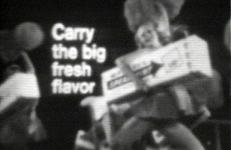
Using imagery from a Japanese "creature feature" and a chewing gum commercial, Benglis's camera focuses on different parts of the screen to emphasize different messages. With dialogue and sound replaced by the sound of frogs croaking outside Benglis's studio, the absurdly comic visuals of the movie and commercial oddly begin to echo each other, raising questions about the nature of the absurdity beamed into our homes and uncritically accepted as entertainment.
This title was in the original Castelli-Sonnabend video art collection.
Halimuhfack, 2016
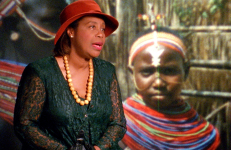
A performer lip-synchs to archival audio featuring the voice of author and anthropologist Zora Neale Hurston as she describes her method of documenting African American folk songs in Florida. The flickering images were produced with a hand-cranked Bolex so that the lip-synch is deliberately erratic and the rear-projected, grainy, looped images of Masai tribesmen and women, recycled from an educational film, become increasingly abstract as the audio transforms into an incantation.
A Hand in Two Ways (Fisted) is a looping meditation on night as space of mysterious energetic transmissions. Animals, human bodies, children, ritual, and performance are investigated as zones of conflict, desire, and a visceral movement that is more felt than seen.
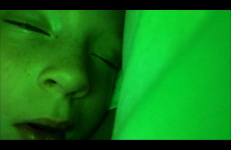
A Hand in Two Ways (Fisted) is a looping meditation on night as space of mysterious energetic transmissions. Animals, human bodies, children, ritual, and performance are investigated as zones of conflict, desire, and a visceral movement that is more felt than seen.
Hand Trap, 1970
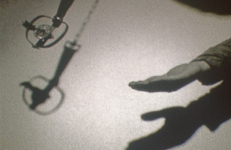
The artist swings a live-set small game trap near his extended other hand. The trap swings ominously: will it snap his fingers? The end comes quickly!
This title is also available on Sympathetic Vibrations: The Videoworks of Paul Kos.
Harvest, 1999
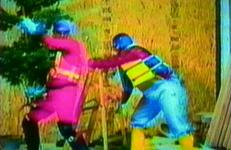
An alternative earth music video. An epic last stand. A portrait of two utilitarian workers engaging in a collaboration with Karen, manifesting improvisational geographic friendships...
This title is also available on HalfLifers: The Complete History.
Heal Me, 2000
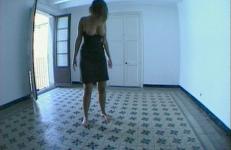
A woman is standing barefoot on a tile floor. In slow motion, the investigative camera circles around her. Her breasts are bared and liquid runs down her legs. Bit by bit, every part of her body is shown, except her face, which remains hidden behind her hair. The camera besets the woman, who remains silent.
This title is also available on Hester Scheurwater Videoworks: Volume 1.