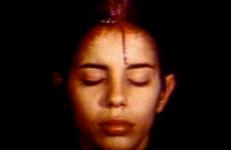



I arranged a visit to poet/novelist Kevin Killian’s South of Market apartment in San Francisco to shoot a portrait of him, and when I arrived he had a guest, poet Cedar Sigo. They had corresponded earlier, but were meeting for the first time, and Cedar agreed to participate in our video shoot. This is perhaps the least planned, most verité and documentary of the videos about writers so far. Our immediate plan was for Kevin to read one of Cedar’s poems and for Cedar to read one by Kevin.
Documentary
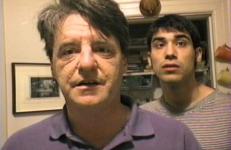
The daily life of the Panará village during the peanut harvest, presented by a young teacher, a woman shaman and the village chief.
Direction and photography: Paturi and Komoi Panará
Editing: Leonardo Sette and Vincent Carelli
Production: Video in the Villages
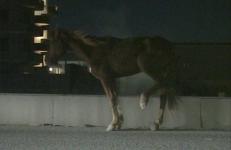
Kings of the Sky, 2004
An experimental documentary about resistance, balance and fame. Kings of the Sky follows tightrope artist Adil Hoxur as he and his troupe tour China’s Taklamakan desert amongst the Uyghurs, a Turkic Muslim people seeking religious and political autonomy.
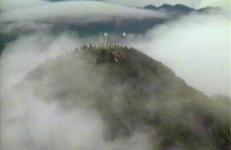
Kuyenda N’kubvina looks at how thought and culture propagate in the slender nation of Malawi. Weaving our way through video halls, book stores, dance floors and radio stations, in cities and small villages, we meet Malawians who traffic in ideas, reflecting the rhythms of Malawian contemporary life. The video was instigated by the filmmaker’s relative ignorance about the people and culture of southeast Africa, and accompanies her as she seeks out individuals and infrastructures that channel and articulate Malawian identity.
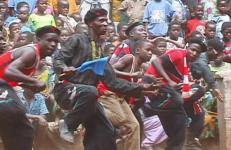
For over 70 years, Colombia has been confronted with internal armed conflict. Over the years, the outlines of the conflict have grown indistinct. A climate of generalized violence has gradually settled over society as a whole.
Violence and barbarity have worked themselves into every aspect of daily life, and fine traces of it mark the streets. Through a multitude of these traces, perhaps the narrative of this hazy war will finally take a firmer shape.
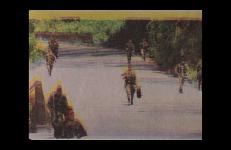
Land Mine, 2019
A series of unnatural deaths and departures (almost all, of men) disrupts the lives of nine families sharing an apartment building in Jerusalem.
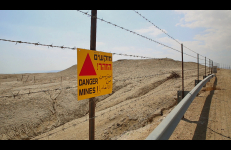
The Laughing Alligator, 1979
The personal odyssey recorded in The Laughing Alligator combines methods of anthropological research with diaristic essay, mixing objective and subjective vision. Recorded while Downey and his family were living among the Yanomami people of Venezuela, this compelling series of anecdotes tracks his search for an indegenous cultural identity.
Laurie, 1998
Laurie was inspired by Laurie Weeks’ uncanny ability to simultaneously embody her characters and write them from a clear distance. The text in question is just a few paragraphs from a draft of the novel Zipper Mouth, more than ten years in the making, and published by the Feminist Press.
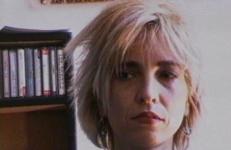
Leslie, 1998
In the early 1990s, I went to a reading by Leslie Scalapino at Intersection for the Arts in San Francisco. I could not understand the writing, which can seem difficult and unwieldy to a reader unaccustomed to language poetry, and understood less the more I tried. After a certain point in the reading I stopped trying to figure it out and I let the words seep in. My reward was an effortless understanding of how her poetry works.
"We are happy. (Silence.) What do we do now, now that we are happy?"
-- Samuel Beckett, Waiting for Godot
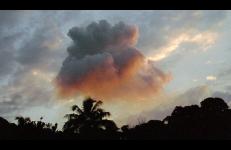
The Lord of the Universe, 1974
Sixteen-year-old guru Marahaj Ji attempts to levitate the Houston Astrodome in this 1973 DuPont award winning documentary. Follow the guru from his New York mansion to limousines in Houston and listen to his followers—celebrities and non-celebrities alike—extol his virtues. TVTV's creative use of graphics, live music, and wide-angle-lens shots to conveys the desperate efforts of these lost children to find a leader.
"If this guy is God, then this is the God the United States of America deserves." —Abbie Hoffman
LYNDALE, 2018
LYNDALE is a story of shifting family dynamics, told through the relationship of two brothers. Shot on ten different video formats, this experimental documentary is both the story of a Chicago family, and a record of the digital revolution in the early 2000s. The piece takes place over a six-year period during which filmmakers Oli Rodriguez and Victoria Stob shared a house with Rodriguez’s brother, Jeff.
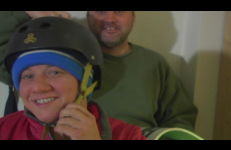
LYNDALE, 2018
LYNDALE is a story of shifting family dynamics, told through the relationship of two brothers. Shot on ten different video formats, this experimental documentary is both the story of a Chicago family, and a record of the digital revolution in the early 2000s. The piece takes place over a six-year period during which filmmakers Oli Rodriguez and Victoria Stob shared a house with Rodriguez’s brother, Jeff.
This 12-minute video by Tom Palazzolo and Chicago writer Jack Helbig tells the story of the recently discovered Chicago street photographer Vivian Maier. Though she was unknown in her lifetime, her extensive body of work is rewriting the history of post-World War II American street photography. The video, told from the point of view of Maier herself, recounts her life and work, from her childhood in France to her move to NYC in 1951 and subsequent relocation to Chicago, where the majority of her work was done.
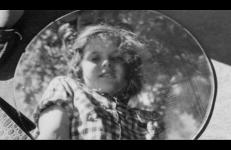
Focusing on the mentorship of Eiko and Koma with the young artists who study and work at the Reyum Institute of Arts and Culture in Phnom Penh, Cambodia, Cambodian Stories evokes questions of tradition, innovation, and the role of the artist in fostering social change and discoveries of new ways to leap from the canvas to the stage. Eiko & Koma's collaboration hones in on these young painters' collective energy and explores the challenges they face pursuing artistic careers in a country with little opportunity.
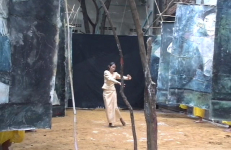
Making the Crystal Quilt, 1998
From The Crystal Quilt performance, Suzanne Lacy, Phyllis Jane Rose, Nancy Dennis, Sage Cowles, Minneapolis, 1987.
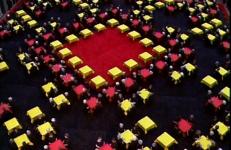
Man with a Video Camera, 1988
After an all-night session of editing Free Society, Garrin headed home with video-8 camera in-hand, only to happen upon the Tompkins Square riots. As police tried to enforce a curfew aimed at removing homeless people from the park, Garrin began gathering footage of cops beating up protesters. He was then attacked by police himself, as the camera continued to roll. The footage was subsequently incorporated into Free Society, in which the military myth of "protect and serve" is dismantled by first-hand experience.
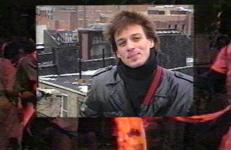
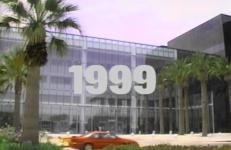
Using the opening of Godard's film Alphaville as a foundation, Lord constructs a vision of the evolving global city during the last years of the 20th Century. Structured as a series of repetitions, the montage of the changing city is offset by shots of corporate Silicon Valley facades. The result is a dialectical contrast between urban and suburban space, body and mind, chaos and order, and the postmodern and the modern. Shot in Hi-8 video in Tokyo, Fukuoka City, Mexico City, Rome, San Francisco, Naples, and Los Angeles.
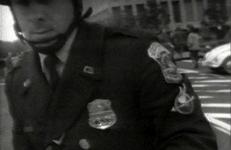
As a verite documentation of the May 1, 1971 demonstration against the Vietnam War staged in Washington, D.C., Mayday Realtime presents a largely unedited flow of events from the point of view of participants on the street. Cort's camera captures the random, disorienting incidents that marked the day - demonstrators holding up traffic in the Capitol, skirmishes with police, on-the-scene interviews with onlookers. The camera impulsively responds to shouting and movement on the street.
As a verite documentation of the May 1, 1971 demonstration against the Vietnam War staged in Washington, D.C., Mayday Realtime presents a largely unedited flow of events from the point of view of participants on the street. Cort's camera captures the random, disorienting incidents that marked the day - demonstrators holding up traffic in the Capitol, skirmishes with police, on-the-scene interviews with onlookers. The camera impulsively responds to shouting and movement on the street.
The Measures, 2014
Jacqueline Goss and Jenny Perlin retrace the journey of two 18th-century astronomers tasked with determining the true length of the meter. From the Mediterranean Sea to the English Channel, The Measures explores the metric system’s origins during the violence and upheavals of the French Revolution. Along the way, Goss and Perlin consider the intertwining of political and personal turmoil, the failures of standardization, and the subtleties of collaboration.
The Measures, 2014
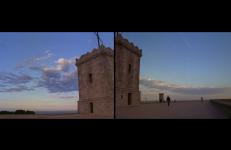
Jacqueline Goss and Jenny Perlin retrace the journey of two 18th-century astronomers tasked with determining the true length of the meter. From the Mediterranean Sea to the English Channel, The Measures explores the metric system’s origins during the violence and upheavals of the French Revolution. Along the way, Goss and Perlin consider the intertwining of political and personal turmoil, the failures of standardization, and the subtleties of collaboration.
Meeting Ancestors, 1993
Chief Waiwai recounts for his village the story of a trip he and a small entourage made to meet the Zo’é, a recently contacted group whom the Waiãpi “know” through video. Both groups speak Tupi dialects and share many cultural traditions, but the Zo’é are currently experiencing the phenomena of contact that the Waiãpi underwent 20 years ago. Waiãpi cameraman Kasiripinã illustrates the Waiwai’s account of the trip with video. The Zo’é afford their visitors the chance to re-encounter the way of life and wisdom of their ancestors.

Meeting Ancestors, 1993
Chief Waiwai recounts for his village the story of a trip he and a small entourage made to meet the Zo’é, a recently contacted group whom the Waiãpi “know” through video. Both groups speak Tupi dialects and share many cultural traditions, but the Zo’é are currently experiencing the phenomena of contact that the Waiãpi underwent 20 years ago. Waiãpi cameraman Kasiripinã illustrates the Waiwai’s account of the trip with video. The Zo’é afford their visitors the chance to re-encounter the way of life and wisdom of their ancestors.
Performance artist/sculptor Ana Mendieta used the raw materials of nature: water, mud, fire, rock, and grass. The consciousness of her politics and the poetics of her expression fill her work with an emotionally charged vision that is powerfully conveyed in this posthumous video profile. Drawing upon the raw spiritual power of Afro-Cuban religion, Mendieta used her art as a ritualistic and symbolic activity to celebrate the forces of life and the continuum of change.