



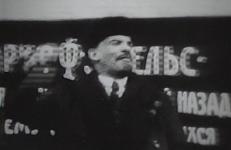
Three Songs of Lenin is an 11-minute piece made from three one-second samples taken from the second song We Loved Him of Vertov's film Three Songs About Lenin. Building on Vertov's second song's structural use of moving and still images to articulate a dynamic of Lenin's passing from life to death, this video employs an algorithmic structure where every other frame is the first frame of the one-second sample. The 29.97 frame rate allows us to almost see moving and still images at the same time as an imagining of Lenin haunting the present.
Death and Dying
Tom, 2002
A cinematic firestorm of found footage and pilfered Hollywood images, Mike Hoolboom’s hallucinatory Tom – described by the filmmaker as, "Cinema as déjà vu, or déjà voodoo" – pays mesmerizing experimental tribute to the life and work of friend and fellow avant-gardist Tom Chomont, and was selected by a national panel of film critics as one of Canada’s Top Ten of 2002.
Tosun's Dinner and Wake, 1971
In this tape the Videofreex document an impromptu experimental art gathering in 1971, hosted by New York artist, Tosun Bayrak. Before entering the gathering, the Freex record their encounters with a police officer, passersby, and a member of Vegetarians for Ecological Action (an animals’ rights activist group) protesting the misuse of animals in performance art.
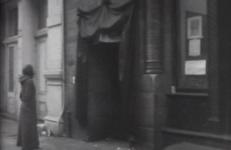
TOUCH, 2013
A man returns, after fifty years, to Chinatown to care for his dying mother. He is a librarian, a re-cataloguer, a gay man, a watcher, an impersonator. He passes his time collecting images that he puts before us – his witnesses and collaborators. Sitting in the dark, we share his cloak of invisibility, both a benefit and a curse.
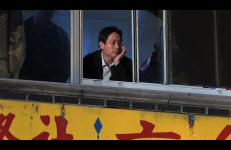
The Toy Sun, 2011
A rumination on Time, with a capital "T". Time and its ravages, which really just means its progression, its nature. Set off by an "old" poem, a T.S. Eliot poem that's literally haunted me for 30? or 40? yrs
... even before I became an old man myself.
(It's an old man's rumblings, and it never fails to move me. I used a quote from it in a film I made 25yrs ago, and the book still calls to me from its place on the bookshelf, its pages yellow, dry as bone.)
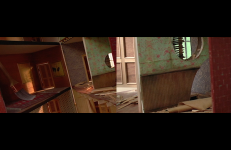
Radio reports analyze staged photographs we do not see, showing the victims of a mass murder committed by Mexican soldiers. The politicization of the film accounts for the duality between framing and mis-framing, and also shows the overflowing character of a process of transit.
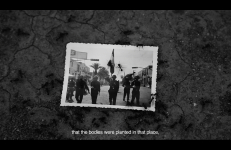
Tristes Tarzan, 2013
This film uses historical movie materials ('Son of Tarzan' films from 1920 and 1950) together with materials from a vast number of sources to produce a densely lyrical, tersely compacted meditation on brutality, martyrdom, Colonialism, and loss. The soundtrack - as involved and compelling as the visuals - is equally eclectic in derivation and serves to underscore both the intellectual and emotional charge of the film.
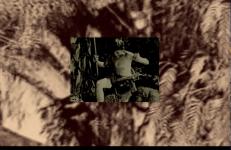
Va Pensiero, 2014
An elegy to the popular demands against ominous social and political events in the recent Mexico.
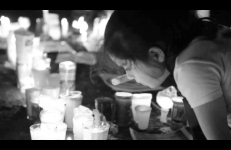
Vanessa, 2002
Vanessa is based on the untimely death of Vanessa Jordan. A work about loss and Michelangelo.
This title is only available on Broad Daylight and Other Times: Selected Works of Kevin Jerome Everson.
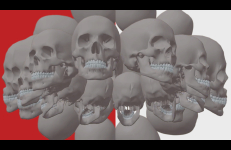
An urgent reflection on indigenous sovereignty, the undead violence of museum archives, and postmortem justice through the case of the "Kennewick Man," a prehistoric Paleo-American man whose remains were found in Kennewick, Washington, in 1996.
Directors: Adam Khalil, Zack Khalil, Jackson Polys
Director Of Photography: Samuli Haavisto
Producers: Mariana Silva, Pedro Neves Marques
Co Editors: Zack Khalil, Adam Khalil
Commissioned By: inhabitants, Contour Biennale 8, Natasha Ginawala
Executive Producer: Steve Holmgren
An urgent reflection on indigenous sovereignty, the undead violence of museum archives, and postmortem justice through the case of the "Kennewick Man," a prehistoric Paleo-American man whose remains were found in Kennewick, Washington, in 1996.
Directors: Adam Khalil, Zack Khalil, Jackson Polys
Director Of Photography: Samuli Haavisto
Producers: Mariana Silva, Pedro Neves Marques
Co Editors: Zack Khalil, Adam Khalil
Commissioned By: inhabitants, Contour Biennale 8, Natasha Ginawala
Executive Producer: Steve Holmgren
An urgent reflection on indigenous sovereignty, the undead violence of museum archives, and postmortem justice through the case of the "Kennewick Man," a prehistoric Paleo-American man whose remains were found in Kennewick, Washington, in 1996.
Directors: Adam Khalil, Zack Khalil, Jackson Polys
Director Of Photography: Samuli Haavisto
Producers: Mariana Silva, Pedro Neves Marques
Co Editors: Zack Khalil, Adam Khalil
Commissioned By: inhabitants, Contour Biennale 8, Natasha Ginawala
Executive Producer: Steve Holmgren
Visiting Manzanar, 2019
On April 30, 2019, Eiko and Alexis Moh, one of Eiko's collaborators in The Duet Project, visited the Manzanar Historical Site. Manzanar was one of ten American internment camps where over 110,000 Japanese Americans were incarcerated during the World War II. At the peak (in September 1942), 10,046 Japanese Americans were forced to live in Manzanar.
This video was shot two days after Manzanar Pilgrimage commemorated its 50th anniversary on site.
Voice: off, 2003
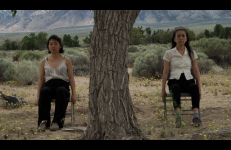
Voice: off is the autobiography of a forgotten man. Brain damaged, body violated, emotions crushed, Gerry who rarely spoke has now lost the power of speech. The video camera is his prosthesis and he borrows the memories of people who no longer need them. How can this be a comedy? It is. "Donigan Cumming looks at the violence of time that damages the body and exhausts memories. For the main character in Voice: off, Gerald, the illness is incurable. Two cancers are at work, one of which is attacking his throat.
The Wake, 2011
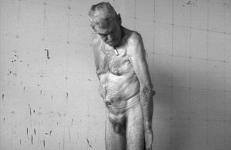
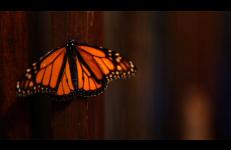
The Wake was filmed at the Invertebrate Zoology department of the Carnegie Natural History Museum in Pittsburgh. In this department there are old cabinets full of categorized butterfly specimens, neatly ordered in drawers. I released into this space 100 live butterflies that flew among the dead specimens. The result is as if these dead specimens have now come to life.
What's That Sound?, 2004
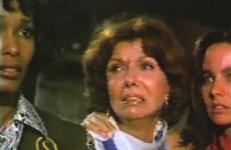
George Barber doffs his cap to the 20th anniversary of Scratch Video with What’s That Sound?, a mesmerizing montage of questions, answers, and the cries and screams of people caught in a disaster movie. The work uses as its starting point, the film Airport '77 where, improbably, a jumbo jet sinks to the bottom of the sea. What follows is a clever amalgamation of absurd linguistics, cries and shouts, highlighting the artist’s permanent fascination with speech, and human reaction to out-of-the-ordinary situations.
white city, 1994
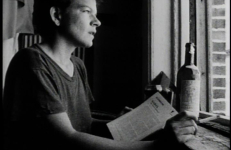
As the cacophony of grieving opens onto the deep quiet of mourning, this poetic journey explores mortality as the psychic space of dwelling. Shot on location in New York City and the Arizona desert and inspired by Rainer Maria Rilke's poem Lament, this film evokes a landscape of personal loss during the AIDS epidemic.
Wind, 1993
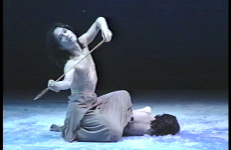
Wind imagines a dying child, a common event until recently and still so in many parts of the world today. This was a collaboration with Chanticleer music director, Joseph Jennings, who arranged a composition by Robert Mirabal and Francisco Guerrero. It was performed live by Chanticleer in San Francisco and specially recorded for tour. Eiko & Koma’s two sons, Yuta and Shin, both played the role of a boy in the piece. The floor was painted to look like a galaxy and white feathers fell from the ceiling, making a sense of wind visible.
WITNESS, 2010
Witness is a perceptual meditation on police brutality—specifically a power dynamic that law enforcement has coined “suicide by cop.” Filmed in Iceland on 8mm film, the film hinges on archival audio—unfolding in real time—of a young Black man negotiating his life with the police out of frame. Repeatedly asking for the camera, he foreshadows the camera as a potential witness in his final moments, appearing hyperaware of the possibility of being erased or silenced from history.
Wrong Place, Wrong Time, 1998
Wrong Place, Wrong Time uses appropriated images from the "reality television" genre to examine the seductiveness of the spectacle of tragedy. This video exists in an area where the division between reality and image are simultaneous. The images are of real explosions, disasters, deaths, and assaults from the nightly news, Cops, Real TV, tabloid television, and talk shows.
You Were an Amazement on the Day You Were Born is a visually stunning work that follows a woman through a life characterized by damage and loss, but in which she finds humor, love, and joy. With a score that follows the span of Lenore’s life, from her birth in the early 70s to her death in the 2040s, the film takes us from moments of harrowing loss to those of poignancy and dark humor.
You Were an Amazement on the Day You Were Born is a visually stunning work that follows a woman through a life characterized by damage and loss, but in which she finds humor, love, and joy. With a score that follows the span of Lenore’s life, from her birth in the early 70s to her death in the 2040s, the film takes us from moments of harrowing loss to those of poignancy and dark humor.