


Body

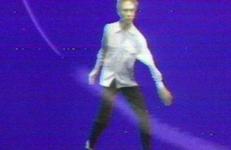
Lament, 1985

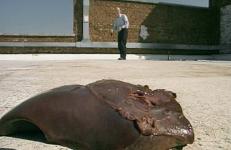
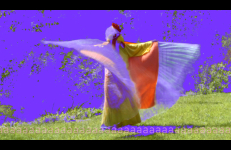
Lament is a collaboration with video artist James Byrne. Movement material is adapted from Eiko & Koma's 1984 performance work Elegy. Sound mix by Eiko & Koma.

Commissioned by the Walker Art Center, Minneapolis, MN and made possible with funds from the National Endowment for the Arts and the Jerome Foundation, St. Paul, MN. 1986, Eiko & Koma, James Byrne, Walker Art Center. Videographed July, 1985 at the Triplex Theatre, New York, NY. Edited in 1986. 
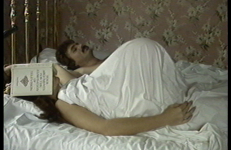
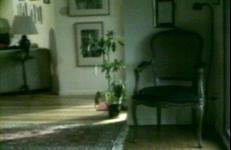
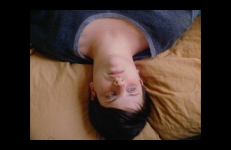
As Laurie and her child's father lie in bed, taking an afternoon nap, a large balloon resting on her belly inflates under the sheet and explodes. A humorous time-lapse of her developing pregnancy, A late afternoon... suggests a dream she is having about the transformative experience of impending motherhood.

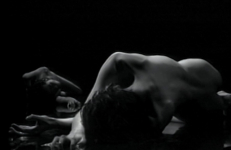
Leafless, 2011

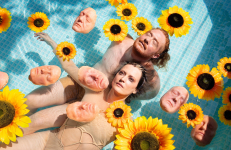
Leafless is a poem of textures about becoming familiar with a significant other’s body in reservation with its landscape.

“But the sun is also fierce; neither graceful athlete nor geometrician’s dummy will embody Apollo, the idol of light.” 

- Kenneth Clark, The Nude: A Study in Ideal Form (1956)

Sections 1-30 of an incomplete extended poem describing the artist's connection to the radical black tradition. The completed poem will be formed of 180 sections.

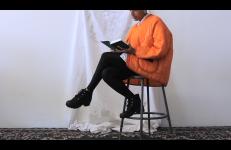
"Lessons are all about constraints; they are thirty seconds, must feature a black figure, and I have rules about where to make cuts, how to edit sound, etc."
— Martine Syms in conversation with Aram Moshayedi, Mousse Magazine

Sections 31-60 of an incomplete extended poem describing the artist's connection to the radical black tradition. The completed poem will be formed of 180 sections.

"Lessons are all about constraints; they are thirty seconds, must feature a black figure, and I have rules about where to make cuts, how to edit sound, etc."
— Martine Syms in conversation with Aram Moshayedi, Mousse Magazine

A haunting look at the hidden issues of erotic power relationships between women, told through the reconstructed story of two girlhood friends. In Zando’s tape, the origins of desire and domination are traced to the early stages of the childhood relation between mother and daughter, as revealed in the often fearful and cruel framework of childhood play. In the paradigm of need and dependency versus power and control, the submissive impulse is linked to the transcendent yearning to reunite with the pre-natal mother.

Letter to a missing woman, based partly on memories of someone who has been a political fugitive since 1983, combines documentary "evidence" and fiction in an imaginative reconstruction of public documents and private history. This is a quiet, obsessive piece addressing the human costs and repercussions of re-inventing oneself – one’s body, memories, and future – as a living piece of propaganda. The writer/narrator of this "crazy letter" is an unreliable one, a composite of half-truths, paranoid digressions, and feelings of loss.

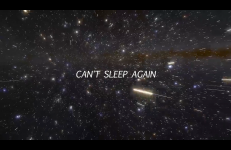
Life Without Dreams is set in the outer space of consciousness, where the surfaces of far out planetary bodies form the terrain for an exploration of 24/7 capitalism, insomnia, and the disappearance of darkness.

Lisa, 2001

Two women occupy one space. Without showing their faces, the camera lingers on their bodies in images that capture both from an extreme high angle. The camera distorts the female body, even creating a grotesque effect. A voice repeatedly calls for a woman: “Lisa, come here, don’t be afraid… that’s it, I won’t hurt you.” A video which explores the gaze on the female body, and the desires and violence overwhelming it.

This title is also available on Hester Scheurwater Videoworks: Volume 1.

An exploration of cruising glory holes, feminism, and general queer frustration.

In this surreal experimental narrative, there’s something wrong with a patch of sky. As it travels over Southern England, objects cast up into it come down hugely enlarged, bloated. Meanwhile in London, the patch is in fact a troubling scab on a crippled old man’s head. As the scab develops, all he can do is wait, going through the changes, led on gently by the idiot-savant son with his childlike multiple identities.

This distanced narrative, which approximates a soap opera or a TV interview of bereaved relatives of a victim, confronts two means by which food is used as a weapon: the internalized oppression of self-starvation as a consequence of social learning (anorexia nervosa), and starvation because of poverty and economic domination. In a scenario that merges documentary elements and theatrical acting, an impossibly young couple is addressed by an unseen questioner.

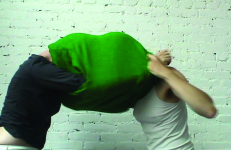
A performance by A.K. Burns and Ulrike Müller.

The title is also available on A.K. Burns: Early Videoworks. 

In The Lost Art of the Future, Cuthand talks about artists he has known who have passed while living with HIV/AIDS, and the art he wishes he had been able to see them make if their lifetimes had been longer.

This video-lament for Mother Earth is a collaboration among Jim Barbaro, sound; Tobe Carey, cinematography and video editing; and Brenda Hutchinson playing a long tube.

"Made right after Covid lockdown, my art gave me an opportunity to rejoice, grieve and sonically face impermanence via sounds and a Chicken Dance I’ve been performing for decades. The beauty of this video is that it looks like Chicken Linda can finally FLY!! Please interact if you wish and dance, sing, cry, and FLY HIGH."

–– Linda Mary Montano

Magic Thinking is a multi-platform film installation steeped in the current moment when climate catastrophe, the COVID pandemic, and the rise of fundamentalism combine to contribute to an apocalyptic aura. With this aura, magical thinking can become a survival strategy, creating surprising bedfellows. In particular, the confluence of far-right extremism and the “wellness” world.

Set in the industrial suburbs of Beirut, Majnounak (Crazy of You) explores male sexuality through interviews with three men who are asked to recount very openly the beginning, middle, and end of a sexual relationship they have experienced. The video explores the image they wanted to project of themselves, hence the image of the "male" they identify with. Their stories are alike, starting with seduction and ending after sex.

The Making and Unmaking of the Earth turns to geology as both a metaphor for and a psychic container of women's emotional states and embodied experiences of physical pain. Combining archival footage of earth processes with interviews describing mysterious physical experiences and emotional attachments, this film explores how everything we bury deep inside eventually speaks through the geology of the body.

Mama, 2005

"Mama mama mama...," a woman calls out again and again, over and over. Is it her child that she mimics, or is she calling for her own mother? A desperate video performance in the first person.

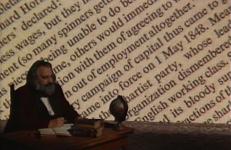
Kipnis describes this tape as "an appropriation of the aesthetics of both late capitalism and early Soviet cinema—MTV meets Eisenstein—reconstructing Karl Marx for the video age.” She presents a postmodern lecture delivered by a chorus of drag queens on the unexpected corelations between Marx’s theories and the carbuncles that plagued the body of the rotund thinker for over thirty years. Marx’s erupting, diseased body is juxtaposed with the “body politic", and posited as a symbol of contemporary society proceeding the failed revolutions of the late 1960s.

Mayhem, 1987

Through a catalogue of looks, movements, and gestures, Mayhem presents a social order run amok in a libidinous retracing of film noir conventions. Sexuality flows in an atmosphere of sexual tension, danger, violence, and glamour; antagonism between the sexes is symbolized in the costuming of women in polka dots and men in stripes. Censored in Tokyo for its use of Japanese lesbian erotica, this tape creates an image bank of what signifies the sexual and the seductive in the history of imagemaking, pointing to the way we learn about our bodies, and how to use them from images.

A Meditation on Nature in the Absence of an Eclipse is a poetic glimpse into the ways centuries of extraction, racism, pollution, and nature's commodification have altered our relationship to sacred land, water, and resources. A constellation of intersecting histories and source material include testimony from a Water Protector at Standing Rock protesting the Dakota Access Pipeline, contaminated water in Flint Michigan, and original footage of Hierve el Agua near Oaxaca, Mexico, a rock formation revered for its healing properties.

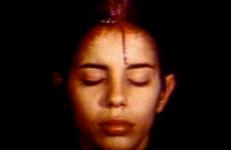
Performance artist/sculptor Ana Mendieta used the raw materials of nature: water, mud, fire, rock, and grass. The consciousness of her politics and the poetics of her expression fill her work with an emotionally charged vision that is powerfully conveyed in this posthumous video profile. Drawing upon the raw spiritual power of Afro-Cuban religion, Mendieta used her art as a ritualistic and symbolic activity to celebrate the forces of life and the continuum of change.

Performance artist/sculptor Ana Mendieta used the raw materials of nature: water, mud, fire, rock, and grass. The consciousness of her politics and the poetics of her expression fill her work with an emotionally charged vision that is powerfully conveyed in this posthumous video profile. Drawing upon the raw spiritual power of Afro-Cuban religion, Mendieta used her art as a ritualistic and symbolic activity to celebrate the forces of life and the continuum of change.

Merce by Merce by Paik is a two-part tribute to choreographer Merce Cunningham and artist Marcel Duchamp. The first section, “Blue Studio: Five Segments,” is an innovative work of video-dance produced by Merce Cunningham and videomaker Charles Atlas. Cunningham choreographed the dance specifically for the two-dimensional video monitor screen. Atlas uses a variety of video imaging effects, including chromakey, to electronically transport Cunningham’s studio performance into a series of outdoor landscapes. The audio track includes the voices of John Cage and Jasper Johns.