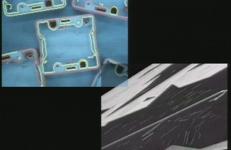



Covert Action is a stunning melange of rapid-fire retro imagery accomplishing Child’s proclaimed goal to “disarm my movies.” “I wanted to examine the erotic behind the social, and remake those gestures into a dance that would confront their conditioning and, as well, relay the multiple fictions the footage suggests (the ‘facts’ forever obscured in the fragments left us). The result is a narrative developed by its periphery, a story like rumor: impossible to trace, disturbing, explosive.”
Body
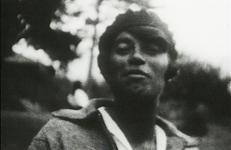
Crush, 1997
Crush is the story of a man who wants to turn into an animal as told by the man himself, and one or two observers. He employs a variety of techniques to transform himself into a beast, including cutting off parts of his body, exercising, swimming; he wants to return to the water, to speed up evolution a little. Has he gone mad, or is he just tired of being human? As the narrator descends into private obsessions, we begin to perceive the distorted outlines of reason which guide his descent.
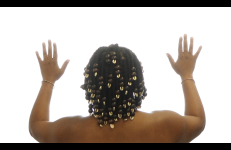
CURRENCY, 2019
CURRENCY is a sound-film of refusal—a woman wears bygone forms of currency on the tips of her hair while preserving the greatest currency for herself. CURRENCY explores the archive of embodiment through gesture and sonic transmissions, with sounds generated from articulations of the body itself.
Cut the Parrot, 1996
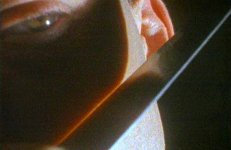
The police phoned. They left a message on the machine. They said he was dead. The video unwinds through stories of sex for rent, unclaimed bodies, cigarette burns, and other monuments of life’s long run from wall to wall. Cut the Parrot is three grotesque comedies in one: the stories of Gerry, Susan, and Albert. Songs of hope and heartbreak spill from the mouths of the performers. The order of impersonation rules.
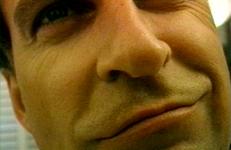
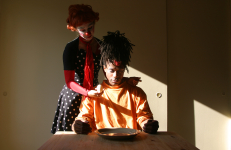
Riffing on relations between grief, love, bodies, and embodiment, this short film features two former professional Ringling Bros. and Barnum & Bailey Circus clowns. A Dark Love Story for Clowns weaves together a loosely adapted William Faulkner story with a spiritual ritualistic practice in order to explore the performativity around ethics of care and love.
Dead Body Pose, 2022
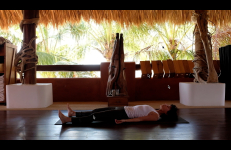
Dead Body Pose absurdly touches the contemporary bubble, encapsulating both connectivity and spirituality, a connection fueled by the global capitalistic consumption of the self. The more we are in the connectivity loop, the more thirsty we are for spirituality and assign it "a time slot". In the video, the artist performs the yoga rest pose Shavasana (dead body pose) as computer cursors come out of her body cavities and connect to their own spirituality together with her chakra affirmations.
DED, 2021
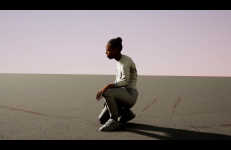
An avatar, created through a 3D scan of Syms, navigates a plain and vast virtual landscape, the perspective sometimes floating above, sometimes alongside, as she progresses through a perpetual cycle of death and resurrection. Her avatar's journey seems to reflect the spectacularly confusing or nonsensical experience of inhabiting a body during a time of violence and illness that has unceasingly threatened notions of stability and consequentiality, forcing ever-evolving tactics of survival.
Delirium, 1993
Defiantly humorous in its tone, Delirium reflects Faber’s mother’s personal experience with what has been classified as “female hysteria.” While never reducing her mother’s condition to a single explanation, Delirium firmly and convincingly links her illness to the historically embattled position women hold in a patriarchal culture. The video layers haunting imagery and humorous iconoclasm, referencing everything from television episodes of I Love Lucy to Charcot’s 19th Century photos of female hysterics.
Destino (Fate), 1999
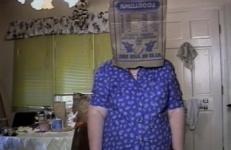
Erase the 1940s. The desire to better appearances. To try to record a love story. It's in this way that a facial can become the biggest remaining pleasure.
This title is also available on Ximena Cuevas: Dormimundo Vol. 1 (Sleepworld Vol. 1), Ximena Cuevas: El Mundo del Silencio (The Silent World), and Half-Lies: The Videoworks of Ximena Cuevas.
Deux Pieds, 1976
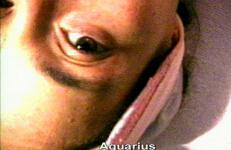
In Deux Pieds, video is used to create dance illusions, effects impossible to achieve in dance except via video technology. Video “keying” (a process of dividing areas of a black and white image into percentages of gradation) and blending of two separate images is used to enable Laurie’s legs to move independently of each other. Against a black background, she wears a black stocking on one leg, effectively “erasing” the leg to the camera’s eye, then switches the stocking to the other leg, and the two images are mixed together.
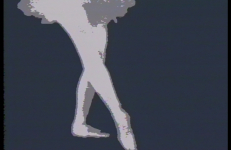
Nazlı Dinçel’s hand-made work reflects on experiences of disruption. They record the body in context with arousal, immigration, dislocation and desire with the film object: its texture, color and the tractable emulsion of the 16mm material. Their use of text as image, language and sound imitates the failure of memory and their own displacement within a western society. Born in Ankara, Turkey, Dinçel immigrated to the United States at age 17. Dinçel resides in Milwaukee, WI where they are currently building an artist run film laboratory.
Distracted Blueberry, 2019
Distracted Blueberry follows a performance art band through a series of poetic encounters. Masculine tropes are undone to form a relationship between male sexuality and the human death drive. The body, violence and humour are positioned in the larger context of nothingness and somethingness, bridging a tension between externalized anxieties and the terrors of nature. Evocative of inner emotional states, strange landscapes exist as reflections of our shared dreams and nightmares.
Viewer discretion advised
A Dog and His Reflection, 2023
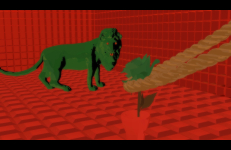
A document of two life processes: the passing of my friend Andre’s 10 year old German Shepherd, Cortàzar, and the tattooing of Cortàzar‘s image on Andre’s chest.
Please be advised, this video contains scenes of death.
Draft 9, 2003
"This movie was collected for four years before being sprayed scattershot over 28 minutes of psychic mayhem. The line between living and dead is a frontier crossed and re-crossed here. The living are dead while the dead are animated, breathing, swimming, giving birth. Consumed by the animal life of the city, the artist undertakes a first person journey, producing diary notes from one of the most skilled lens masters of the new generation. The camera is her company in this duet of death, the instrument that permits her to see the impossible, the unbearable, the invisible."
Dressing Up, 1973
A reverse striptease, non-stop comedic monologue about shopping for clothes, while eating corn nuts. Dressing Up was inspired by the artist’s mother’s penchant for bargain hunting. Mogul produced Dressing Up as a student in the feminist art program at the California Institute of the Arts in 1973.
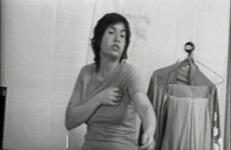
Drink Deep, 1991
Drink Deep is a lyrical vision of friendship, hidden secrets, and desires. Cohen uses several types of film image to add texture to the layered composition. Beautiful shades of grey, silver, black and blue echo the water, reminiscent of early photography and silverprints. Cohen says, "The piece was constructed primarily from footage I’d shot of skinnydippers at swimming holes in Georgia and rural Pennsylvania. It’s about water and memory and stories just submerged. It is also, in part, a response to thinking about censorship.
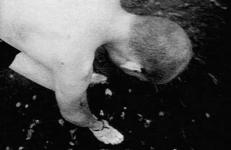
Duality Duplicity, 1980
This arresting early work conveys a tension that emanates from what Tanaka posits as life's basic dualities: male/female, past/present, known/unknown. By focusing issues of identity, doubt, wonder, and awareness through the body, and the bodies of her ancestors, Tanaka succeeds in creating a work with both personal and political power. Tanaka creates a unique voice that speaks of her experience of maturing into womanhood, repeating the refrain, "I my mother." An experimental video, this work contains one of the first examples of flicker editing.
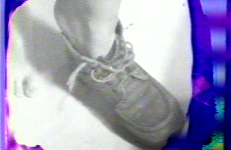
Duet, 2019
Illness, treatment, recovery, conversation. This experimental short presents stories of illness and disfunction, bringing together but also separating two performers, their stories, their bodies.
“Duet confronts illness with a caress; it takes us on a journey with two different people with two distinct conditions that present obstacles to very specific senses. A film that makes us address the way that we feel, hear, see, taste, and speak.” —Lynne Sachs

Andro/lesbian body-doubles wrestle each other in an outer-space fantasy.
Performers: A.K. Burns & K8 Hardy
Audio: Matt Volla
This title is also available on A.K. Burns: Early Videoworks
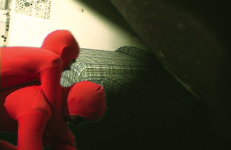
Emission, 1994
"The video Emission found its origin in three performances which I wrote between 1988 and 1991. In their original form, the performances dealt with sex, romance, and communication technologies. The video elaborates upon these themes to speak of how human beings exist in a margin between nature and technology, and works towards confounding any simplified analysis of this worn-out duality.
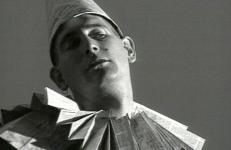
Encounters I May Or May Not Have Had With Peter Berlin deals primarily with monumentality, narcissism and the ways in which our heroes are embedded into our identities, and manifested through the body. Through a variety of gestures, the pervasiveness of this practice is highlighted alongside its ultimate, inevitable failure. The viewer moves through various stages of anxiety, idolization and actual touchdown with 1970s gay sex icon Peter Berlin himself, capturing both the apparent and the hidden.
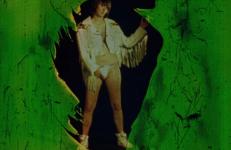
Epilogue: The Palpable Invisibility of Life is the final chapter in The Blindness Series, a body of eight videos on blindness and its metaphors that was begun in 1992. The inspiration for the series came from a 1990 exhibition Jacques Derrida curated for the Louvre Museum, titled Memoirs of the Blind.
Extractions, 2019
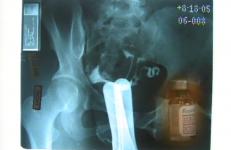
Extractions parallels resource extraction with the booming child apprehension industry. As the filmmaker reviews how these industries have affected her, she reflects on having her own eggs retrieved and frozen to make an Indigenous baby.

Eye/Machine II, 2002
"How can the distinction between "man" and "machine" still be made given today's technology? In modern weapons technology the categories are on the move: intelligence is no longer limited to humans. In Eye/Machine II, Farocki has brought together visual material from both military and civilian sectors, showing machines operating intelligently and what it is they see when working on the basis of image processing programs. The traditional man-machine distinction becomes reduced to "eye/machine", where cameras are implanted into the machines as eyes.